English
 中文简体
中文简体
News
Home > Author > Li Wenjing — Cosmetic Packaging After-Sales Specialist > Double-Wall Acrylic Cream Jars: Premium Protection, Elegant Presentation, and Reliable Cosmetic Packaging

 2026.08.17
 Li Wenjing — Cosmetic Packaging After-Sales Specialist
Content
In the competitive skincare and beauty market, packaging is much more than a container. It is the first physical expression of a product’s quality, positioning, and personality. Before a customer evaluates the texture of a body cream, night cream, serum, or moisturizing treatment, the packaging has already created an expectation. Shape, transparency, surface finish, opening method, structural stability, and the perceived quality of the materials all influence how a formulation is received.
The HB-G002 Double Wall Plastic Acrylic Body Cream Jar is designed for brands that need a cosmetic container with a strong visual presence and practical daily performance. Its spherical profile, high-transparency acrylic construction, wide-mouth format, and double-wall structure combine to create a package that looks refined while supporting the protection and presentation requirements of modern skincare products.
With available capacities of 30 ml and 50 ml, the jar is suitable for premium body creams, face creams, night creams, masks, balms, intensive moisturizers, and other thick or semi-thick formulations. The design offers a balance between compactness and visual volume, making it appropriate for both personal-care collections and prestige skincare lines.
Unlike ordinary single-wall plastic jars that may appear visually basic, the HB-G002 uses a layered construction consisting of an outer PMMA bottle, an inner PP bottle, and a cap made from PMMA and PP. This combination creates a more substantial appearance and provides brands with additional opportunities for coordinated decoration, color matching, and product differentiation.
For manufacturers and cosmetic brands, the product is especially valuable because it brings together appearance, usability, structural protection, and scalable production. It can help a new product line appear more established, while also giving existing brands a sophisticated container for premium or upgraded formulations.
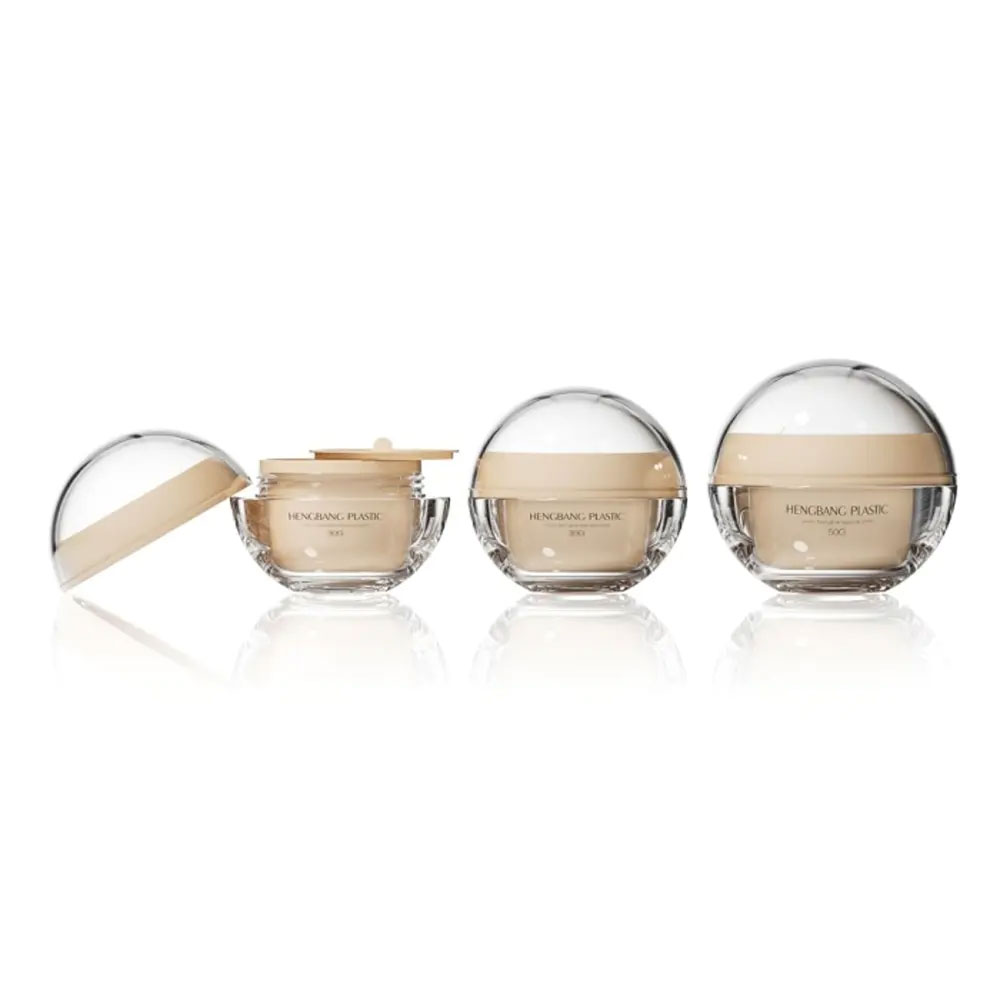
HB-G002 Double Wall Plastic Acrylic Body Cream Jar
The HB-G002 is a double-wall plastic acrylic cream jar with a rounded spherical silhouette. Its form is smooth and visually continuous, with no unnecessary lines or overly complicated ornamentation. This minimalist design allows the container to fit naturally into many cosmetic packaging styles, including modern, clinical, luxurious, natural, and high-end personal-care collections.
The exterior is made from high-transparency acrylic, commonly identified as PMMA. Acrylic is widely used in cosmetic packaging because it can provide a glass-like visual effect while offering the lighter weight and impact resistance associated with plastic packaging. The clear outer wall makes the jar look bright and polished, helping the package catch attention on a retail shelf, vanity, hotel amenity display, or professional skincare counter.
Inside the outer shell is a PP inner bottle. This inner component provides a dedicated space for the cosmetic formula and contributes to the jar’s layered construction. The combination of an acrylic exterior and a PP interior allows the design to present a premium appearance without relying entirely on glass.
The lid uses a PMMA and PP material combination. This allows the cap to coordinate visually with the body while supporting the functional requirements of closing and reopening the jar. The cap’s clean appearance complements the rounded base and helps the complete package look unified rather than assembled from unrelated parts.
The jar is available in two listed capacities: 30 ml and 50 ml. These sizes can support different product strategies. The 30 ml format may be suitable for concentrated treatments, travel-oriented products, trial versions, premium facial creams, or gift sets. The 50 ml format offers more product volume for regular-use creams, body treatments, night creams, and retail skincare products.
The listed dimensions are as follows: the 30 ml version has a height of approximately 60.6 mm and a diameter of approximately 65.35 mm. The 50 ml version is listed with a height of approximately 68.5 mm and a diameter of approximately 73.4 mm. The supplied product information presents the second height entry as “68.5 ml,” but because height is measured in millimeters in the same specification set, it is understood as approximately 68.5 mm.
| Specification | 30 ml Version | 50 ml Version |
|---|---|---|
| Product type | Double-wall plastic acrylic cream jar | Double-wall plastic acrylic cream jar |
| Capacity | 30 ml | 50 ml |
| Approximate height | 60.6 mm | 68.5 mm |
| Approximate diameter | 65.35 mm | 73.4 mm |
| Outer bottle material | PMMA | PMMA |
| Inner bottle material | PP | PP |
| Cap material | PMMA and PP | PMMA and PP |
The double-wall structure is one of the most important characteristics of the HB-G002. In a single-wall jar, the wall of the container performs several roles at once: it provides the visible exterior, holds the product, supports the closure, and determines much of the package’s tactile quality. A double-wall design separates some of these functions into different components.
The outer PMMA bottle creates the visible shell. It provides the clear, polished appearance that customers see first. The inner PP bottle forms the product-contact chamber and supports the practical requirements of storing and dispensing the formulation. Together, the two layers create a more substantial package than a simple thin-wall container.
This construction can improve perceived value. When a customer lifts the jar, the layered body can feel more solid and carefully engineered than a basic packaging format. The visual depth created by the space between the outer and inner walls can also make the cream appear more luxurious, especially when the formula has a distinctive color or texture.
Double-wall packaging also provides an additional structural layer around the inner container. Although cosmetic suitability depends on the specific formula, filling conditions, closure design, and validation testing, the outer wall can help shield the inner component from direct handling and minor external contact. This is valuable in retail environments where products may be picked up, moved, or displayed repeatedly.
Another benefit is design flexibility. The outer wall and inner bottle can be coordinated in transparent, translucent, opaque, frosted, or colored treatments, depending on the brand’s decoration requirements and the final production specification. A clear outer wall can create a floating or suspended visual effect, while a colored inner bottle can add contrast and make the formula look richer.
Compared with conventional single-wall plastic jars, a double-wall acrylic jar can therefore offer three important advantages: stronger shelf presence, a more premium hand feel, and greater separation between external presentation and internal product containment.
Luxury packaging often depends on visual depth. The customer may not consciously identify the technical reason a package appears premium, but layered walls, precise component alignment, smooth surfaces, and consistent transparency all contribute to that impression. The HB-G002 benefits from this principle through its acrylic exterior and inner PP bottle.
The spherical profile further enhances the effect. Instead of presenting a flat cylindrical body, the jar creates a rounded volume that reflects light across its surface. This can make the package appear more dimensional and attractive under retail lighting or natural light. When combined with a clear or lightly tinted formula, the contents become part of the visual design.
For skincare brands, this is particularly useful when the formula itself is visually appealing. Whipped creams, pearlized moisturizers, rich balms, colored body butters, and gel creams can all benefit from packaging that allows customers to see the product before opening it.
Cosmetic containers must be designed for more than attractive presentation. They also need to withstand normal handling during filling, transportation, storage, retail display, and consumer use. The sturdy construction of the HB-G002 supports these practical requirements while maintaining a refined exterior.
The outer acrylic shell can provide an additional barrier around the inner bottle. This does not replace product-specific compatibility testing or transport validation, but it can contribute to a more robust overall package. A solid, properly assembled jar is less likely to feel flimsy during use and can communicate reliability to the consumer.
For brands shipping products through distributors, e-commerce channels, salons, spas, and retail stores, a stronger package can support a better customer experience. The package should still be evaluated through drop testing, closure testing, vibration testing, temperature testing, and other relevant procedures before commercial launch. However, the double-wall format provides a sound foundation for this type of evaluation.
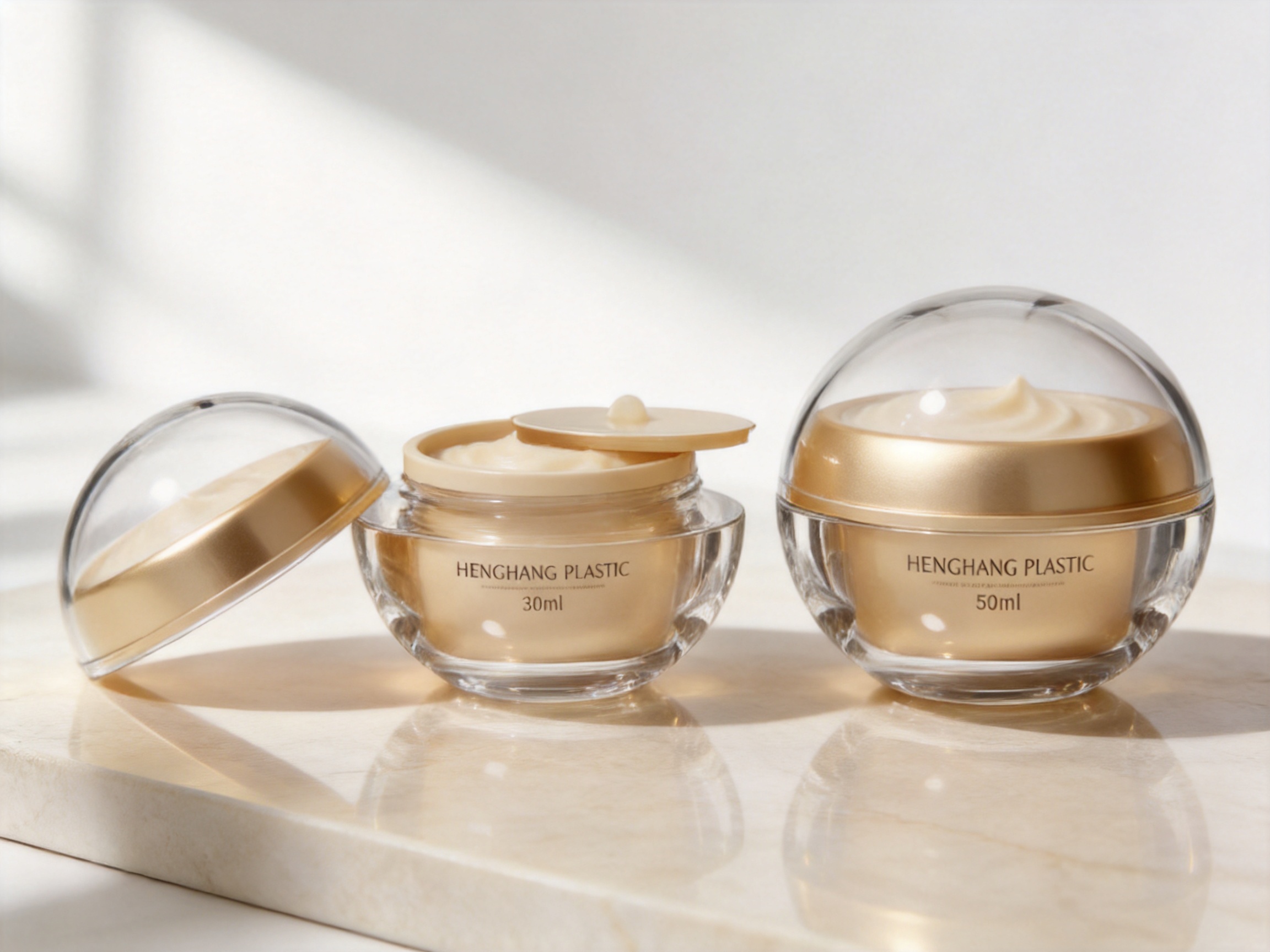
Material selection has a direct effect on appearance, usability, durability, and manufacturing consistency. The HB-G002 uses PMMA for the outer bottle and part of the cap, while PP is used for the inner bottle and part of the cap. Each material contributes specific qualities to the final package.
PMMA, or polymethyl methacrylate, is known for its high transparency and smooth visual appearance. In cosmetic packaging, it is often selected when a brand wants a container that resembles glass but prefers a plastic solution. The material can produce a bright, clean surface and can be adapted to a variety of decorative processes.
For the HB-G002, the PMMA outer bottle is central to the product’s premium appearance. Its transparency allows the package to reveal the internal structure and, depending on the final configuration, the color or texture of the product. The smooth surface also creates a suitable base for printing, labeling, coating, frosting, or other decoration options subject to production confirmation.
Acrylic is also lighter than glass in many comparable applications. Lower package weight can improve handling during filling and packing, reduce the physical burden on the consumer, and support more efficient shipment planning. The exact logistics benefit depends on the full packaging system, including the jar, cap, carton, inserts, and shipping case.
Polypropylene is widely used in packaging because of its practical balance of flexibility, toughness, chemical resistance, and processability. In the HB-G002, the PP inner bottle provides the dedicated chamber for the cosmetic product.
Using PP for the inner component can support reliable molding and consistent part production. It also gives manufacturers a material that is familiar in the personal-care packaging sector. As with all cosmetic packaging, the suitability of PP must be confirmed against the specific ingredients, fragrance system, preservatives, colorants, and filling conditions of the intended formula.
The inner bottle also creates opportunities for color coordination. A brand may choose an opaque inner component to conceal the formula and maximize visual consistency, or it may use a translucent or colored inner component to create contrast with the clear outer shell.
The cap combines PMMA and PP. This material combination supports a visually coordinated closure while retaining the functional advantages of a practical plastic component. A well-designed cap should close smoothly, remain secure during ordinary handling, and complement the body without overpowering it.
Because the cap is one of the first components a consumer touches, its surface quality and fit are important. The rounded cap can reinforce the spherical theme of the jar and create a cohesive appearance from every angle. The closure also contributes to the consumer’s perception of freshness, cleanliness, and product value.
Brands should confirm the exact closure mechanism, liner or sealing arrangement, torque requirements, and compatibility performance during development. The supplied description identifies an airtight lid intended to help maintain formula freshness and stability. Final airtightness and sealing performance should be validated for the selected formula and filling process.
The market includes many plastic cream jars, but not every jar offers the same combination of presentation and functionality. The HB-G002 distinguishes itself through its double-wall spherical construction, clear acrylic appearance, and premium proportions.
Basic single-wall jars can be cost-effective and practical, but they may not provide the visual depth required for a premium skincare line. Their walls are often thinner, their silhouettes more ordinary, and their surfaces less distinctive. The HB-G002 offers a more developed appearance that can help a product occupy a higher position within a brand portfolio.
This advantage is especially relevant for products positioned as intensive treatments, luxury body care, overnight regeneration creams, or professional skincare. In these categories, packaging is expected to communicate care, quality, and sophistication before the customer experiences the formula.
Cylindrical jars are familiar and easy to stack, but their widespread use can make it difficult for a new product to stand out. The spherical body of the HB-G002 gives the package a distinct identity. Its rounded form can be used as part of the product’s visual language, supporting a memorable shape that consumers can recognize.
The spherical design also softens the appearance of the package. This can work well for moisturizing products, nourishing creams, sensitive-skin products, and body-care formulas that want to communicate comfort and smoothness.
Glass can create a premium impression, but it also adds weight and may be more vulnerable to breakage during transportation and use. A plastic acrylic solution can deliver a similarly clear and polished appearance while reducing some of the practical challenges associated with glass.
The HB-G002 is not intended to imitate every characteristic of glass, nor should it be evaluated as a direct substitute in every application. Its advantage is that it provides a premium transparent appearance within a plastic double-wall structure. This can give brands greater freedom in shipping, handling, and everyday consumer use.
Cosmetic brands often need packaging that can be customized for different product lines, markets, or seasonal collections. Acrylic and PP components may support a range of decoration and color options, subject to technical review and minimum order requirements.
Possible approaches can include printed graphics, hot stamping, metallic effects, frosting, coating, labeling, tinted components, and customized color matching. The exact decoration method should be selected according to the product’s brand identity, expected production volume, surface geometry, and durability requirements.
Shelf presence is created by size, shape, color, transparency, surface finish, and visual consistency. The HB-G002 contributes to each of these factors through its rounded body, clear exterior, and layered construction. The jar can appear elegant when displayed individually, yet it can also form a coherent group when used across a collection.
For online retail, distinctive packaging can also improve the effectiveness of product photography. The spherical form and transparent body can create attractive highlights and shadows, making the package easier to recognize in catalog images, social media content, digital advertising, and promotional campaigns.
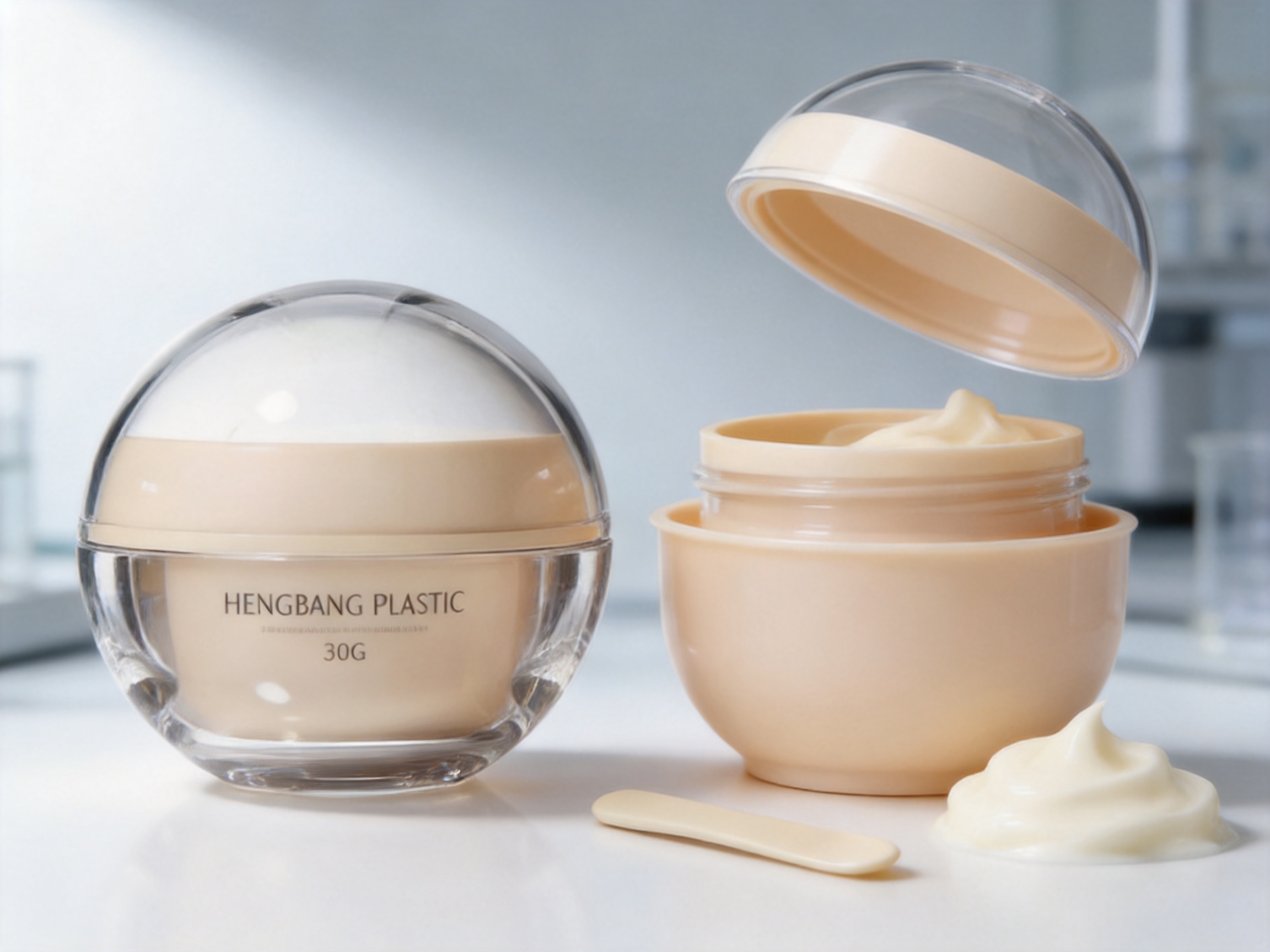
The HB-G002 is suitable for a broad range of skincare and personal-care products. Its wide-mouth design is particularly useful for formulations that are dispensed with a fingertip, spatula, or small cosmetic scoop.
The product is identified as a body cream jar, making it suitable for rich moisturizing products, body butters, firming creams, nourishing treatments, and seasonal body-care collections. The 50 ml format can work well for concentrated body treatments, gift sets, travel products, or premium sample programs.
The jar’s premium appearance is appropriate for daily moisturizers, intensive face creams, anti-aging products, barrier creams, and nourishing emulsion-based formulas. The 30 ml size can provide a compact format for high-value facial treatments, while the 50 ml size can support a more traditional retail offering.
Night creams are frequently positioned as rich, restorative, and luxurious. The HB-G002’s rounded profile and crystal-clear outer body support this positioning. A dark, pearlized, translucent, or color-coordinated inner component could be used to create a distinctive evening-oriented presentation.
Although many serums are packaged in bottles, thicker serums, gel creams, sleeping masks, and balm-like treatments can be suitable for a jar. The wide-mouth opening provides easy access to products that are too viscous for a narrow dispensing orifice.
Clay masks, cream masks, overnight masks, and nourishing sleeping masks can benefit from a jar format. The wide opening makes it easier for the consumer to see and access the formula. For masks containing pigments, botanical particles, or visually distinctive textures, the transparent outer shell can increase product appeal.
Spas, salons, dermatology-inspired brands, and professional treatment collections often require packaging that looks clean and premium. The HB-G002 can support a professional image when combined with restrained typography, precise labeling, and a consistent component color system.
The wide-mouth design is a practical advantage for creams and other viscous formulations. Consumers can access the product easily without squeezing, shaking, or repeatedly tapping the container. This is particularly useful when the formula is thick, dense, whipped, or designed to be applied in a measured amount.
A wide opening can also help the customer see how much product remains. This improves everyday convenience and may reduce the frustration associated with opaque or narrow packages. For products used on larger body areas, such as elbows, knees, hands, or legs, easy access can make the application process more comfortable.
Brands should consider whether the product will be used with clean hands, a spatula, or another applicator. For professional or premium products, including a small spatula may help support hygienic use and reinforce the product’s elevated positioning. The final package instructions should explain the recommended method of use.
Because open-jar packaging exposes the formula during use, brands should also evaluate preservation, consumer handling, fill level, and usage period. The jar can help present and dispense the product effectively, but the formula and packaging must be developed as a complete system.
The lid is described as airtight and intended to help maintain formula freshness and stability. This is a significant benefit for skincare products that may be sensitive to air exposure, moisture exchange, contamination, or repeated opening and closing.
A reliable closure can help prevent unnecessary exposure between uses. It can also reduce the risk of leakage during ordinary storage and transportation when properly matched with the inner bottle and filled to the correct specification. The closure should feel secure without being excessively difficult to remove.
However, airtightness is not a universal performance claim that can be assumed solely from the visual design. It should be confirmed through appropriate testing using the actual jar, cap, formula, filling method, and decoration system. Testing may include leakage evaluation, pressure or vacuum assessment, torque measurement, aging studies, temperature cycling, and compatibility review.
For brands developing sensitive or active skincare products, packaging selection should be coordinated with stability testing. The formula should be evaluated for changes in color, odor, viscosity, pH, separation, microbial condition, and active-ingredient performance. The container should also be examined for stress cracking, discoloration, swelling, deformation, or changes in closure performance.
The quality of a cosmetic jar depends not only on its design but also on how consistently it is manufactured. Precise molding, careful assembly, reliable inspection, and disciplined quality management are essential for producing a package that performs as expected across large production batches.
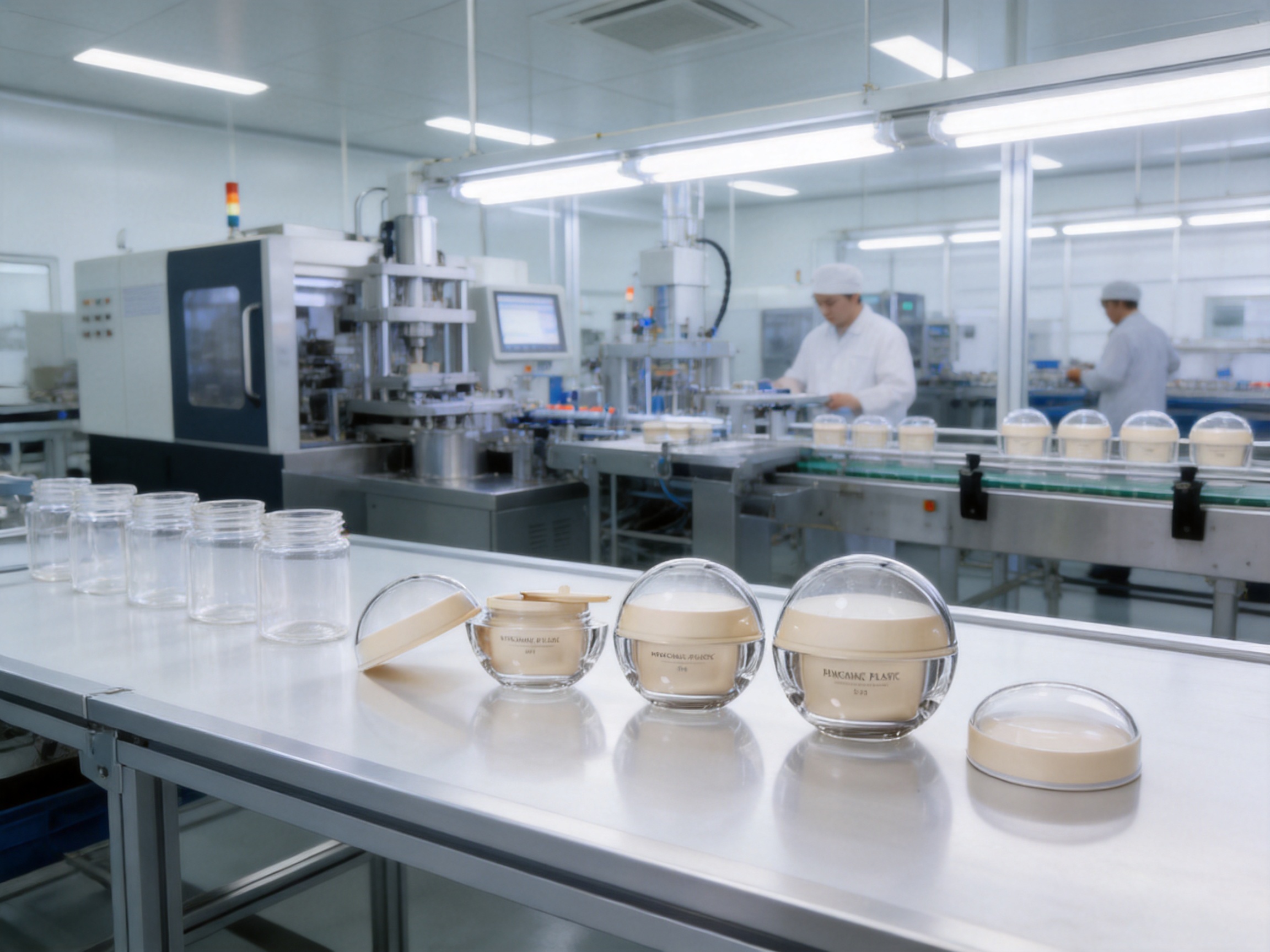
Yuyao Hengbang Plastic Co., Ltd. was established in 2006 and operates from a facility with a building area of approximately 35,000 square meters. The company has more than 300 employees and specializes in plastic packaging for cosmetics and skincare products. This focused industry experience is valuable because cosmetic packaging requires knowledge of appearance standards, component fit, decoration, filling-line performance, and product presentation.
The company provides design and development services in addition to manufacturing. This allows customers to discuss product concepts, component structures, visual direction, and packaging requirements with a team that understands the relationship between design and production.
For a product such as the HB-G002, design development may involve reviewing the spherical profile, wall thickness, inner and outer component alignment, cap fit, opening size, material selection, decoration area, and manufacturing tolerances. These details can affect the final consumer experience and the efficiency of filling and assembly operations.
An integrated development approach can reduce the risk of creating a package that looks attractive in a drawing but is difficult to mold, assemble, decorate, fill, or transport. By considering manufacturing requirements early, brands can make more informed decisions about customization and production feasibility.
Producing a clear acrylic jar with a smooth spherical shape requires attention to molding conditions and part consistency. Transparent components can reveal defects that might be less visible in opaque packaging. Flow lines, bubbles, scratches, weld marks, uneven walls, distortion, and surface contamination may affect the perceived quality of the package.
Manufacturing teams therefore need to control material handling, mold condition, processing temperature, injection parameters, cooling behavior, trimming, and post-molding inspection. The exact production process may vary according to the component design, but consistent control is essential for achieving a clean and attractive result.
The PP inner bottle also requires precise molding and dimensional control. Its shape must fit correctly within the outer PMMA bottle, and the opening must work properly with the cap. Even small dimensional variations can influence assembly force, closure fit, appearance, and sealing performance.
Double-wall packaging contains more components than a simple single-wall jar. This creates additional opportunities for visual and functional inconsistency if assembly is not carefully controlled. The inner bottle must be positioned correctly within the outer bottle, and the cap must align with the completed body.
Reliable assembly helps ensure that the final jar has an even appearance, stable structure, and consistent opening and closing behavior. It also supports efficient filling and packing by reducing the number of packages that require manual correction or rework.
Yuyao Hengbang Plastic Co., Ltd. has passed ISO9001:2015 and ISO14001:2015 certifications. ISO9001:2015 is associated with quality management systems, while ISO14001:2015 is associated with environmental management systems. These certifications indicate that the company has established structured systems for managing quality-related processes and environmental responsibilities.
Certification does not eliminate the need for product-specific inspection or customer validation, but it provides an important foundation for controlled manufacturing. A quality management system can support documented procedures, corrective actions, process monitoring, traceability, supplier management, and continuous improvement.
For cosmetic brands, this type of production structure can be valuable when packaging must be delivered consistently across repeated orders. Consistent dimensions, color, transparency, closure fit, and decoration quality all contribute to a stable brand presentation.
The company owns multiple invention patents and was awarded recognition as a Ningbo High-Tech Enterprise in 2021. These achievements reflect an emphasis on technical development and product innovation. In the cosmetic packaging field, innovation may involve improved structures, manufacturing methods, assembly systems, dispensing functions, material applications, or appearance solutions.
Technical capability is especially relevant to double-wall packaging because the product requires coordination between multiple components. A company with experience in structural development can help customers evaluate how the outer shell, inner container, and closure should work together.
The company’s team provides a full range of services, including design and development. A professional team can support customers during specification review, sample approval, decoration selection, production planning, quality communication, and order coordination.
This is important for international cosmetic brands because packaging projects often involve multiple departments. Product development teams focus on formula compatibility, marketing teams focus on appearance, procurement teams focus on cost and supply continuity, and quality teams focus on standards and testing. A capable packaging supplier can help bring these requirements into a workable production plan.
Before adopting the HB-G002 for commercial use, a brand should establish a complete technical evaluation program. The jar offers a strong starting point, but successful packaging depends on matching the container to the formula, filling process, distribution environment, and consumer usage pattern.
The first evaluation should examine compatibility between the formula and the PMMA and PP components. Brands should consider oils, solvents, alcohols, essential oils, fragrances, acids, active ingredients, pigments, preservatives, and other materials that may interact with packaging.
Compatibility testing should be conducted using production-intent components rather than only laboratory substitutes. The test should observe both the formula and the package over an appropriate period. Potential changes may include discoloration, odor transfer, viscosity change, separation, swelling, cracking, softening, stress whitening, or loss of transparency.
Stability testing helps determine whether the formulation remains acceptable throughout its intended shelf life. The package should be included in the evaluation because the container may influence oxygen exposure, moisture loss, light exposure, and product contact conditions.
Testing conditions may include room temperature, elevated temperature, low temperature, temperature cycling, light exposure, and transportation simulation. The precise program should be determined by the brand’s quality and regulatory teams.
The closure should be tested for opening and closing force, thread or fitting consistency where applicable, leakage resistance, seal integrity, and consumer usability. The cap should remain properly attached during shipping but should not be so tight that ordinary users struggle to open it.
Repeated-use testing can help confirm whether the closure maintains its performance after multiple opening and closing cycles. This is especially important for products intended to last several weeks or months.
Because the HB-G002 is designed for a premium market, appearance inspection is particularly important. Inspection criteria may include clarity, color consistency, scratches, black spots, bubbles, distortion, assembly alignment, surface contamination, cap fit, and decoration quality.
Brands should establish acceptable quality limits before mass production. Reference samples, approved color standards, inspection lighting, and clear defect classifications can help reduce disagreement between the customer and supplier.
The jar should be tested on the intended filling and assembly line. The wide-mouth format may support efficient filling, but the exact result depends on the filling machine, product viscosity, filling temperature, nozzle configuration, speed, and cleaning procedure.
Line trials can identify issues such as splashing, product residue on the rim, cap interference, misalignment, insufficient closure force, or difficulty with labeling and secondary packaging. Resolving these issues before mass production can reduce waste and improve efficiency.
The HB-G002 provides a strong base for visual customization. Because the design is simple and smooth, branding can be applied in a restrained manner without competing with the spherical silhouette.
A minimalist logo printed on the upper surface or front-facing area can create a clean luxury effect. Metallic decoration may emphasize a premium positioning, while soft-touch coating or frosting may create a more tactile and skincare-oriented impression. Transparent printing can preserve the visibility of the formula while adding subtle graphics or lettering.
Color is another important tool. A clear outer bottle paired with a white, cream, pastel, metallic, or dark inner bottle can create different product personalities. Warm tones may support nourishing body creams, cool tones may suggest hydration, and dark or jewel-like colors may support night-care or anti-aging collections.
The jar can also be coordinated with bottles, airless containers, toner bottles, or other packaging formats in the same collection. A consistent cap color, decoration style, or surface finish can unify an entire skincare range even when the containers have different functions.
For seasonal products, limited editions, gift sets, and co-branded collections, the spherical form offers a distinctive canvas. Brands can use a special color, pattern, or finish to create visual separation without changing the fundamental container structure.
Packaging should be assessed from the consumer’s perspective as well as the manufacturer’s perspective. The HB-G002 is designed to make the product feel attractive and easy to use from the moment it is picked up.
The rounded body is comfortable to hold and avoids the sharp visual and tactile character of angular packaging. Its compact proportions allow it to sit neatly on a bathroom shelf, vanity, bedside table, or travel surface. The smooth exterior is also straightforward to wipe clean when used with rich creams or balms.
The wide opening provides immediate access to the formula. Consumers can control the amount they take, which is useful for thick products that are not easily dispensed through a pump. The transparent exterior may also help users understand the remaining quantity, depending on the opacity of the inner bottle and product.
The lid contributes to the ritual of use. A smooth, secure closure can make opening and closing feel deliberate and premium. This matters for skincare products that are applied as part of a daily self-care routine. A well-designed jar can turn a simple moisturizing step into a more enjoyable sensory experience.
Modern brands increasingly evaluate packaging according to environmental considerations as well as appearance and performance. The HB-G002 uses plastic materials, so responsible development should include an assessment of material quantity, component design, supply chain efficiency, product protection, and end-of-life considerations.
The ISO14001:2015 certification of Yuyao Hengbang Plastic Co., Ltd. indicates that the company operates an environmental management system. This provides a structured framework for managing environmental responsibilities within the organization. It does not mean that every package is automatically sustainable, but it is a positive foundation for discussing environmental performance and improvement.
The double-wall structure should be evaluated carefully because additional components and material layers can increase packaging weight compared with a simple single-wall jar. At the same time, a durable package may help protect the product and reduce losses caused by damage during transportation or handling. Sustainability decisions should therefore consider the complete life cycle rather than focusing on one feature alone.
Brands may explore options such as reducing unnecessary decoration, optimizing wall thickness without compromising performance, selecting appropriate colors and coatings, using recyclable material streams where practical, and designing secondary packaging efficiently. The compatibility of any recycled or alternative material with the formula and appearance requirements must be confirmed before use.
Clear communication is also important. Environmental claims should be supported by accurate technical information and should comply with the applicable market requirements. Packaging suppliers and brands should work together to define realistic, measurable objectives.
When selecting a cosmetic packaging supplier, buyers should evaluate more than the appearance of a sample. They should also review production capacity, development support, quality systems, communication, lead times, inspection procedures, and the supplier’s ability to maintain consistency over repeated orders.
The manufacturing scale of Yuyao Hengbang Plastic Co., Ltd., including its 35,000-square-meter building area and workforce of more than 300 employees, provides a foundation for serving packaging projects that require organized production and coordination. The company’s specialization in cosmetic and skincare packaging is also relevant because it indicates a focused understanding of the sector.
During the development stage, buyers should provide information about the intended formula, filling volume, label or decoration plan, target market, shipping conditions, expected order quantity, and desired delivery schedule. Clear technical communication at the beginning can help prevent delays later.
Sample approval should cover the complete package, not only the empty body. The cap, inner bottle, outer bottle, decoration, color, and assembly should all be evaluated together. If the package will be filled by a contract manufacturer, production-line trials should be included in the approval process.
For long-term supply, brands should consider maintaining an approved reference sample and written quality standards. This makes it easier to compare future batches and manage changes in raw materials, decoration, tooling, or production conditions.
The HB-G002 is best positioned as a premium or mid-to-premium cosmetic jar rather than as a purely economy-oriented container. Its visual strengths are most valuable when the product formula, brand story, and retail strategy support an elevated presentation.
Suitable positioning themes include modern luxury, refined simplicity, professional skincare, intensive hydration, nourishing care, overnight renewal, spa-inspired treatment, and high-quality body care. The product can also support a clean beauty aesthetic when combined with simple graphics, balanced typography, and restrained decoration.
For a premium body cream, the spherical shape can make the package feel more like a treatment object than a basic bathroom container. For a facial cream, the 30 ml and 50 ml sizes provide flexibility for different product tiers. For a gift set, the transparent acrylic appearance can coordinate effectively with cartons, trays, and complementary skincare products.
The HB-G002 is a double-wall plastic acrylic cream jar designed for body creams, facial creams, night creams, serums, masks, and other skincare products. It has a spherical body made with a PMMA outer bottle and a PP inner bottle.
The listed capacities are 30 ml and 50 ml. The 30 ml version is suitable for compact premium treatments, concentrated products, travel formats, and gift sets. The 50 ml version provides greater volume for regular-use creams and body-care products.
The cap is made from PMMA and PP, the outer bottle is made from PMMA, and the inner bottle is made from PP. Final material and component specifications should be confirmed during product development and quotation.
A double-wall design creates a more substantial appearance, adds visual depth, supports a premium hand feel, and provides an additional structural layer around the inner bottle. It can also create more possibilities for color and decoration.
The product is described as being made from high-transparency acrylic. This allows the package to present a clear, polished appearance and may help showcase the contents or inner structure, depending on the selected inner-bottle color and formula opacity.
Yes. Its wide-mouth design is suitable for thick creams, body butters, masks, balms, night creams, and other products that are more conveniently removed with a fingertip, spatula, or scoop.
The supplied product information describes the lid as airtight and intended to help maintain formula freshness and stability. Brands should complete package-specific airtightness, leakage, compatibility, and stability testing with the intended formula before commercial launch.
The 30 ml version is listed at approximately 60.6 mm in height and 65.35 mm in diameter. The 50 ml version is listed at approximately 68.5 mm in height and 73.4 mm in diameter. The supplied information appears to contain a unit typo for the 50 ml height, which is understood as millimeters.
The smooth acrylic and PP components may support customization through color selection, printing, labeling, frosting, coating, metallic decoration, or other approved processes. Available options, minimum quantities, color standards, and decoration durability should be confirmed with the supplier.
The jar can suit skincare brands, body-care companies, spa and salon suppliers, professional treatment lines, private-label manufacturers, gift-set developers, and retailers seeking a premium plastic container.
Yuyao Hengbang Plastic Co., Ltd. specializes in cosmetic and skincare packaging and provides design and development services. The company operates a facility of approximately 35,000 square meters, employs more than 300 people, and has passed ISO9001:2015 and ISO14001:2015 certifications.
Yes. The company’s services include design and development. Customers can work with the supplier to review packaging structure, materials, appearance, component fit, decoration, and production requirements.
Brands should evaluate formula compatibility, stability, closure performance, airtightness, leakage resistance, dimensional consistency, decoration durability, filling-line performance, transport resistance, and consumer usability.
The spherical shape, clear acrylic exterior, double-wall structure, and coordinated cap create a distinctive and premium appearance. These features can help the product stand out from ordinary cylindrical or single-wall plastic jars.
The HB-G002 Double Wall Plastic Acrylic Body Cream Jar is a strong packaging option for cosmetic brands seeking a combination of elegance, practicality, and manufacturing flexibility. Its spherical silhouette creates a distinctive identity, while the high-transparency PMMA outer bottle gives the package a bright and premium appearance.
The PP inner bottle provides a dedicated product-contact chamber, and the PMMA and PP cap completes the layered structure with a coordinated visual finish. Available in 30 ml and 50 ml capacities, the jar can serve different product tiers, from concentrated facial treatments and travel formats to regular-use body creams and night-care products.
Compared with basic single-wall jars, the double-wall construction offers greater visual depth, a more substantial hand feel, and stronger opportunities for premium positioning. Compared with glass packaging, the plastic acrylic format can offer a lighter and more practical alternative while retaining a clear, polished look.
The product’s value is further supported by the supplier’s industry specialization, design and development services, substantial production facility, professional workforce, ISO9001:2015 and ISO14001:2015 certifications, high-tech enterprise recognition, and multiple invention patents. These capabilities provide an important foundation for consistent cosmetic packaging production.
As with any packaging project, final performance should be confirmed through formula compatibility testing, stability studies, closure evaluation, filling trials, transport testing, and quality inspection. When properly matched with the formulation and brand strategy, the HB-G002 can help transform a cream or skincare treatment into a more complete premium experience—one that protects the product, supports convenient use, and communicates quality from the first glance.
1. Product specification information for HB-G002 Double Wall Plastic Acrylic Body Cream Jar, including materials, capacities, dimensions, and product description.
2. ISO 9001:2015, Quality Management Systems—Requirements.
3. ISO 14001:2015, Environmental Management Systems—Requirements with Guidance for Use.
4. General technical principles of cosmetic packaging compatibility, stability evaluation, and closure performance testing.
5. General material reference information concerning polymethyl methacrylate and polypropylene in plastic packaging applications.
6. Company information concerning cosmetic packaging design, development, manufacturing capabilities, quality management, environmental management, and technical innovation.


Copyright © Yuyao Hengbang Plastic Co., Ltd.
All Rights Reserved.
 Wholesale Plastic Cosmetic Packaging Manufacturers