English
 中文简体

News
Home > Author > Li Wenjing — Cosmetic Packaging After-Sales Specialist > Double-Wall Acrylic Face Cream Jar: Premium Design, Reliable Protection, and Flexible Cosmetic Packaging

 2026.09.26
 Li Wenjing — Cosmetic Packaging After-Sales Specialist
Content
In the skincare market, packaging is more than a container. It is the first physical interaction a consumer has with a product, and it plays an important role in communicating quality, positioning, and brand personality. A well-designed jar can make a cream appear more luxurious, improve the user experience, and help a product stand out in a crowded retail environment. The HB-G004 Double Wall Plastic Acrylic Face Cream Jar is designed for brands seeking a combination of refined appearance, practical functionality, and dependable manufacturing support.
This square cosmetic jar uses a double-wall construction and a carefully selected combination of PMMA, ABS, and PP materials. Its geometric silhouette creates a modern visual identity, while the gold-plated finish adds a decorative effect associated with premium skincare and gift-oriented products. With a nominal capacity of 50 ml, the jar is suitable for facial creams, moisturizers, eye creams, masks, overnight treatments, and other high-value skincare formulas.
The product is manufactured by Yuyao Hengbang Plastic Co., Ltd., a China-based cosmetic packaging manufacturer established in 2006. The company operates from a facility with a building area of approximately 35,000 square meters and has more than 300 employees. Its services cover design and development as well as plastic packaging production. The company has obtained ISO9001:2015 and ISO14001:2015 certifications, has been recognized as a Ningbo High-Tech Enterprise, and owns multiple invention patents.
This article examines the jar’s construction, appearance, material selection, manufacturing advantages, application potential, customization considerations, and competitive value. It also explains why double-wall acrylic packaging can be an effective choice for cosmetic brands that need a strong balance between visual appeal and practical performance.
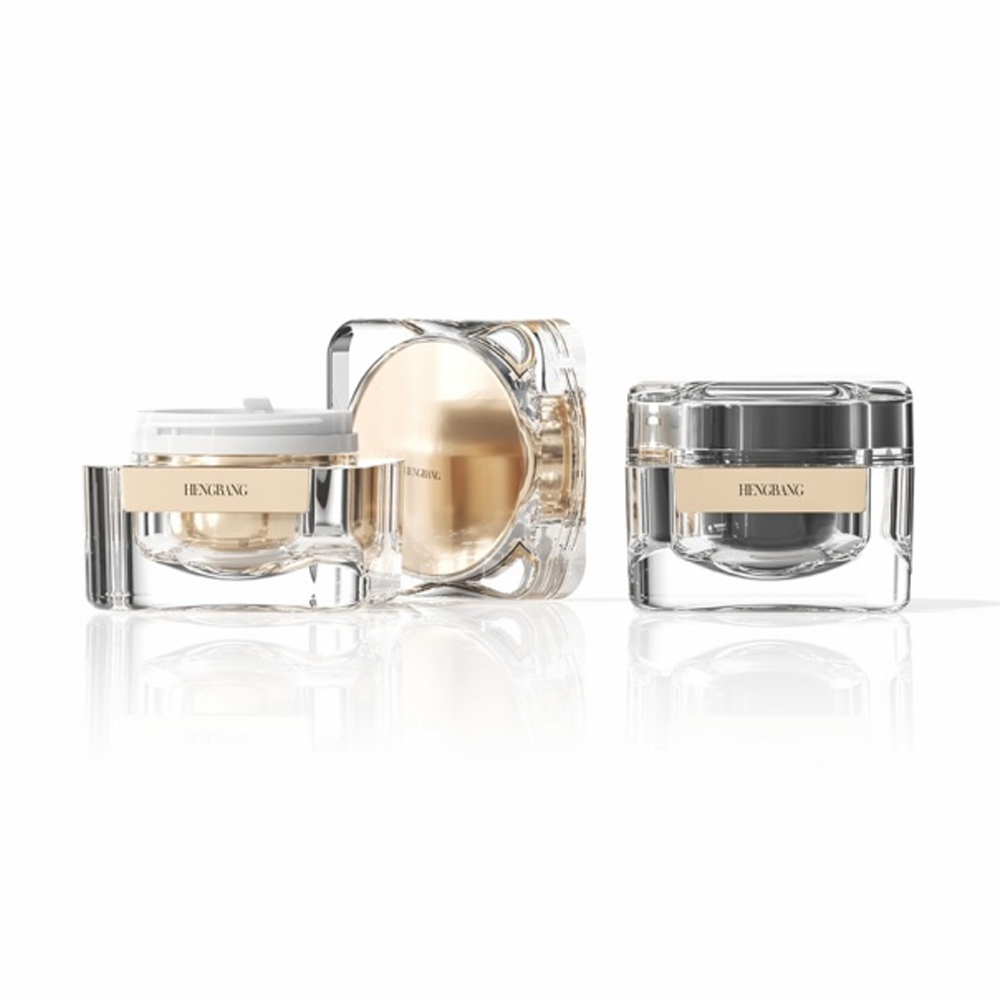
HB-G004 Double Wall Plastic Acrylic Face Cream Jar
The HB-G004 is a square double-wall plastic acrylic face cream jar with a 50 ml capacity. It is categorized as a plastic acrylic cream jar and is intended for skincare and cosmetic packaging applications. The product combines a substantial outer appearance with a relatively compact format, making it suitable for both premium retail products and giftable skincare collections.
Its design is based on clean geometric lines rather than a conventional round jar profile. The square format gives the product a structured and contemporary appearance. It can be especially appropriate for brands whose visual identity emphasizes modern luxury, architectural design, minimalism, or carefully controlled proportions.
The jar is composed of several material elements. The cap is made from PMMA and ABS, the outer bottle is made from PMMA, and the inner bottle is made from PP. This multi-material structure allows different components to perform different functions. PMMA contributes transparency, clarity, and a refined surface appearance. ABS supports structural performance in the cap. PP is used for the inner container because it is a widely applied plastic in cosmetic packaging and can provide a practical internal vessel for many skincare products.
The product specifications are summarized below.
| Specification | Product Information |
|---|---|
| Product model | HB-G004 |
| Product type | Double-wall plastic acrylic face cream jar |
| Primary category | Plastic acrylic cream jar |
| Capacity | 50 ml |
| Cap material | PMMA + ABS |
| Outer bottle material | PMMA |
| Inner bottle material | PP |
| Height | 54.8 mm |
| Length and width | 69 × 69 mm |
| Design style | Square, geometric, modern, and premium |
| Decorative treatment | Gold-plating process |
The combination of a square body, double-wall construction, and gold-plated detailing gives the jar a distinctive presence on a shelf or dressing table. It is not designed to be visually anonymous. Instead, the packaging is intended to participate actively in the product’s positioning and perceived value.
Skincare products compete not only through their formulas but also through their presentation. Consumers often encounter packaging before they experience texture, fragrance, absorption, or long-term product performance. The shape, weight, finish, color, and opening experience of a jar can influence initial expectations.
Premium cosmetic packaging can communicate several messages at once. It may suggest that the formula is carefully developed, that the product is suitable for gifting, or that the brand is focused on detail. Packaging also helps create consistency across a product range. A recognizable jar silhouette can become part of a visual identity that customers associate with a particular category or collection.
The HB-G004 jar supports this type of communication through its structured form and decorative finish. The geometric body conveys precision and modernity. The gold-plated effect introduces a warmer and more luxurious visual note. Together, these features can help a cream product appear more elevated than a standard, undecorated plastic container.
Packaging must also balance appearance with usability. A jar should be comfortable to open, stable when placed on a surface, and sufficiently robust for storage and transportation. The double-wall format helps create a more substantial outer presentation than a thin single-wall container. This can be valuable for products positioned at a higher price point, where consumers often expect the package to feel consistent with the product’s perceived quality.
One of the key characteristics of the HB-G004 is its double-wall structure. In a double-wall jar, the visible outer body surrounds or complements an inner container. This construction can provide several benefits compared with a basic single-wall jar, depending on the formula, filling process, transport conditions, and final design requirements.
A double-wall construction creates additional depth between the outside surface and the internal vessel. This can make the container look fuller and more sophisticated. It also creates more opportunities for visual layering, including differences in color, transparency, surface treatment, and decorative effects.
For a gold-finished product, the outer structure can help create a richer appearance. Light may interact with the surfaces in different ways, producing a more dimensional effect than a flat, single-layer container. This is particularly relevant to luxury skincare, where surface depth and reflective details can contribute to shelf impact.
Consumers frequently associate a solid hand feel with product value. Although weight alone does not determine quality, a well-constructed double-wall package can feel more substantial when handled. The square profile also provides a stable grip and a firm base, which may support a controlled and premium opening experience.
Compared with lightweight single-wall jars that may feel thin or flexible, the HB-G004 is designed to offer a more substantial physical presence. This distinction can be important for high-end face creams, gift sets, professional skincare lines, and products sold through premium retail channels.
The use of separate outer and inner materials allows the package to be designed around different functional priorities. The PMMA outer bottle supports the visual appearance, while the PP inner bottle provides a practical vessel for the cosmetic formula. The cap combines PMMA and ABS to support both decorative and structural requirements.
This component-based approach can also help packaging developers consider different decoration, color, and finishing options for individual parts. For example, the outer component may emphasize visual clarity or metallic decoration, while the inner component may use a color selected to coordinate with the formula or brand identity.
Double-wall packaging gives cosmetic designers more freedom to create distinctive proportions and surface effects. It can accommodate layered colors, contrast between inner and outer elements, and a more architectural silhouette. This flexibility is useful for brands that want packaging to appear recognizable without relying solely on printed labels.
It is important to note that packaging performance depends on the complete package system, including the formula, closure, filling method, storage conditions, and quality-control procedures. The double-wall construction is a design and structural advantage, but compatibility testing should still be completed for each specific cosmetic formulation.
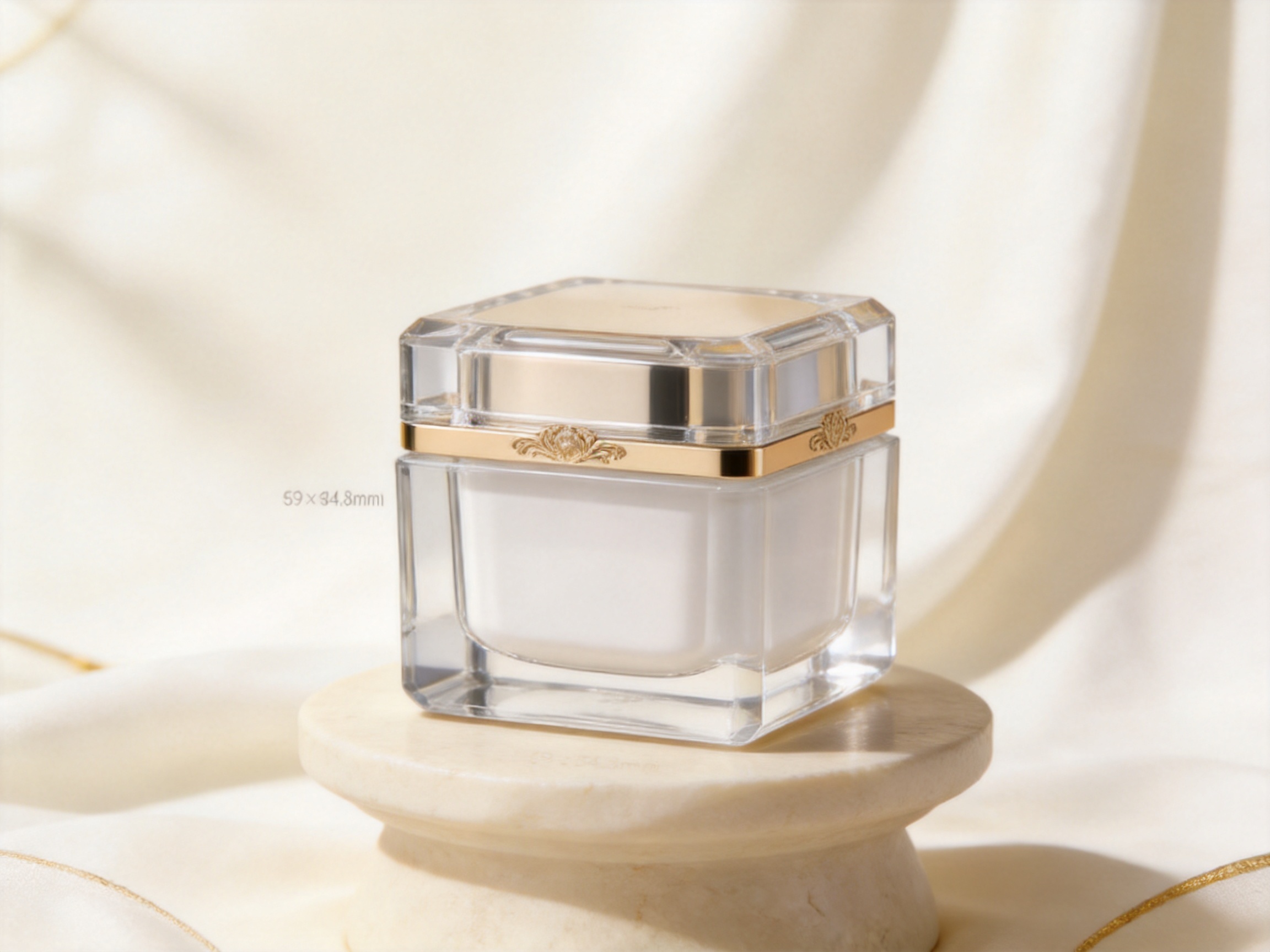
The HB-G004 uses three commonly applied plastic materials, each assigned to particular components. Selecting materials according to component function is a central part of effective cosmetic packaging development.
PMMA, or polymethyl methacrylate, is known for its clear and glass-like visual quality. In cosmetic packaging, it is often selected when brands want a transparent, polished, or high-end appearance without using glass. Its appearance can support the perception of precision and refinement.
For the HB-G004, PMMA is used in the cap and outer bottle. This allows the product to benefit from the material’s visual characteristics across important exterior surfaces. When combined with a gold-plating process, PMMA can contribute to a decorative package with strong visual presence.
PMMA can also support design concepts that depend on clean edges and carefully controlled geometry. The square format of this jar benefits from a material that can present a smooth, orderly surface. This is useful for brands that want their packaging to look modern and meticulously manufactured.
ABS is used together with PMMA in the cap. ABS is commonly selected for molded components that require a balance of strength, dimensional stability, and processability. In a cap assembly, structural stability is important because the component must maintain its shape during repeated opening and closing.
The combination of PMMA and ABS allows the cap to address both appearance and structural considerations. PMMA can support the visible decorative surface, while ABS can contribute to the underlying component structure. The final performance of the cap depends on the specific design, assembly method, tolerances, and quality-control standards applied during production.
PP, or polypropylene, is used for the inner bottle. It is widely used in packaging applications because it is lightweight, practical, and suitable for many molded container designs. In a cosmetic jar, the inner bottle is the component that directly holds the cream, so its suitability must be evaluated together with the formula.
Formula compatibility testing is essential for any cosmetic container. Factors such as oil content, active ingredients, fragrance, preservatives, pH, viscosity, and storage temperature can influence package performance. The PP inner bottle provides a practical foundation for testing, but brands should validate the complete system with their own formulation before commercial launch.
The gold-plating process is one of the product’s most noticeable decorative features. Gold is strongly associated with luxury, celebration, prestige, and gift appeal. In cosmetic packaging, a gold-plated surface can help elevate an otherwise functional container and create a stronger connection between the package and the product’s price positioning.
The finish described for this product is intended to create a luxurious metallic texture and a visually striking appearance. It is suitable for brands that want to express light luxury, classic elegance, or a premium gift-oriented identity. The reflective quality of gold can attract attention under retail lighting and can contribute to a memorable unboxing experience.
Decoration is not only about color. It also affects the way a package feels in the hand and how its surface interacts with light. A well-executed metallic finish can make edges appear more defined, emphasize the square geometry, and create contrast between the main body and other components.
The product information indicates that the coating combines wear resistance and corrosion resistance to help maintain its luster. In practical production, the appearance and durability of a decorative coating depend on the substrate, surface preparation, plating parameters, curing or finishing conditions, handling, and inspection procedures. Brands should define their visual and durability requirements clearly during development.
Compared with ordinary uncoated plastic jars, a gold-plated jar can provide stronger differentiation without requiring a completely unusual shape. This makes the decorative process a useful tool for upgrading an established package format. It may also reduce the need for excessive graphic decoration because the container itself becomes a visual asset.
The square silhouette of the HB-G004 creates a strong contrast with the round jars commonly found in the skincare market. Round jars are familiar and functional, but their widespread use can make it difficult for a brand to achieve visual distinction. A square or geometric package can immediately change the character of a product range.
The 69 × 69 mm footprint provides a broad, stable presentation surface. The 54.8 mm height gives the jar a relatively low and substantial profile rather than a tall, narrow appearance. This proportion may be suitable for face creams and masks, where a wide opening and broad top surface are often compatible with the category’s visual language.
Geometric design can also support coordinated product families. A brand may use the square jar for creams, a matching bottle for serums, and another coordinated package for lotions or masks. Even when the capacities differ, shared design elements such as straight edges, metallic details, and similar proportions can help create a unified collection.
The shape may also benefit merchandising. Square containers can be placed in orderly rows and may use shelf space efficiently. Their flat sides can create a more continuous visual block than curved containers. Retail presentation still depends on the exact shelf, tray, carton, and display configuration, but the format offers useful possibilities for organized product presentation.
The HB-G004 can be compared with conventional single-wall, round, undecorated plastic jars across several dimensions. The comparison should not be understood as a universal performance claim because the best package depends on the formula, target market, filling process, and budget. However, the product offers clear design advantages for premium positioning.
| Evaluation Area | Conventional Basic Jar | HB-G004 Double-Wall Acrylic Jar |
|---|---|---|
| Overall silhouette | Often round and familiar | Square and geometric for stronger differentiation |
| Exterior construction | Commonly single-wall | Double-wall structure with layered visual depth |
| Surface impression | May appear simple or utilitarian | Designed for a more substantial and premium appearance |
| Decoration | May rely mainly on labels or printing | Gold-plated decorative treatment creates a metallic effect |
| Material combination | May use one primary plastic material | PMMA, ABS, and PP are assigned to different components |
| Gift appeal | Depends heavily on secondary packaging | Exterior design supports a more giftable presentation |
| Brand expression | Suitable for basic or mass-market positioning | Suitable for modern luxury, classic, and premium skincare concepts |
The strongest competitive advantage is the integration of several features rather than any single feature alone. A square shape by itself can be distinctive, but the combination of square geometry, double-wall construction, acrylic exterior components, a multi-material design, and gold-plated decoration creates a more complete premium package solution.
For a brand competing in the mid-to-high-end skincare sector, this combination can help justify a stronger visual identity. It may also allow the package to communicate quality before consumers read the label or learn about the formula.
The 50 ml capacity is suitable for many facial skincare applications. It can accommodate a standard retail size for face creams and is also appropriate for products designed for daily or nightly use. The exact fill volume should be confirmed according to the formula’s density, filling tolerance, headspace requirements, and regulatory labeling needs.
Moisturizers are one of the most direct applications for this jar. A premium exterior can support moisturizing products positioned around nourishment, hydration, barrier care, or anti-aging. The square body and gold finish may complement formulas marketed as rich, concentrated, or luxurious.
Night creams and intensive treatments often use packaging that communicates indulgence and concentrated care. The jar’s substantial appearance can reinforce this positioning. A dark, neutral, ivory, or metallic color system could be paired with the gold decoration to create a sophisticated evening skincare presentation.
Depending on the target fill volume and final inner-bottle configuration, the design language may also be adapted for eye creams. Eye-care products frequently benefit from compact premium packaging because they are associated with specialized treatment and high value per unit.
Some facial masks and sleeping masks are packaged in jars because consumers need convenient access to thicker formulas. The wide square format may offer an appealing alternative to standard round mask jars, particularly for spa-inspired or prestige skincare collections.
The gold-plated appearance is well suited to gift-oriented products, holiday editions, anniversary collections, and limited releases. A brand may combine the jar with a coordinated carton, insert, or outer sleeve to create a complete premium presentation.
Before selecting the package for a specific product, the brand should assess formula compatibility, dispensing behavior, user hygiene expectations, closure performance, and the intended distribution environment.
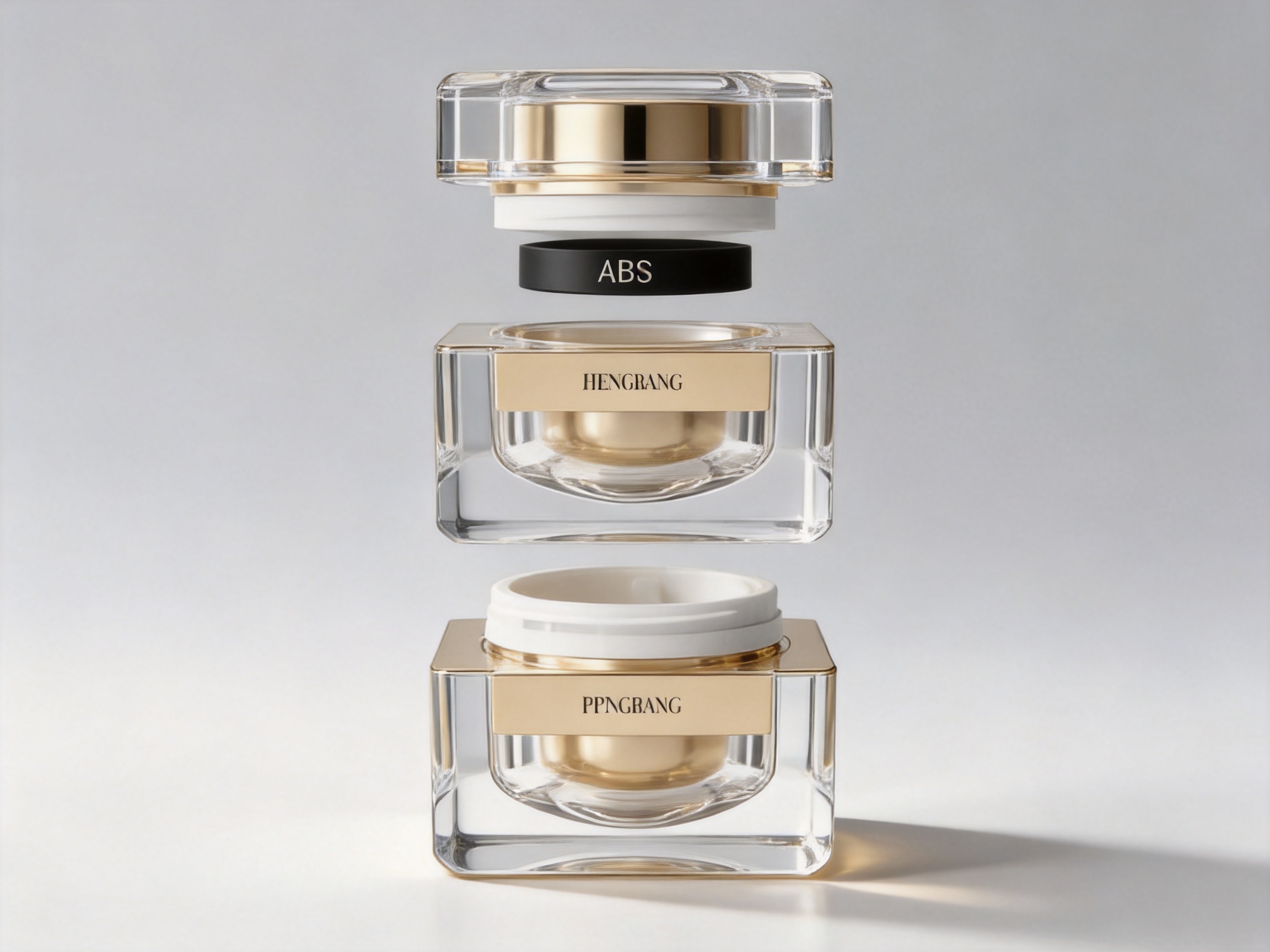
A cosmetic package is successful only when its design can be converted into a stable, repeatable, and commercially viable production process. The manufacturer’s ability to manage design development, tooling, molding, assembly, decoration, inspection, and delivery is therefore as important as the product’s appearance.
Yuyao Hengbang Plastic Co., Ltd. has been engaged in plastic cosmetic packaging since 2006. Its product scope includes packaging for cosmetics and skincare products, and its professional team provides design and development services. This combination is valuable for buyers that need more than an off-the-shelf container and require support when adapting a package to a specific product concept.
The company’s reported building area of approximately 35,000 square meters provides a substantial operating base for production and related activities. Its workforce of more than 300 employees indicates the availability of dedicated personnel across manufacturing, engineering, quality, administration, and customer-support functions. The effectiveness of any organization depends on its actual processes and management, but these resources provide a foundation for handling structured packaging programs.
Design and development support can help brands evaluate the relationship between appearance and manufacturability. A cosmetic package must maintain the intended silhouette while meeting requirements for wall thickness, assembly, closure fit, dimensional stability, decoration, and filling. Early engineering input can identify potential problems before tooling and mass production.
For a geometric double-wall jar, development may involve coordinating the outer bottle, inner bottle, and cap. The components need to align visually and functionally. Small differences in dimensions or surface finish can affect the way the finished jar looks, so component coordination is particularly important for premium packaging.
Plastic packaging production requires controlled molding conditions and consistent component dimensions. The final quality of a jar is influenced by mold design, material preparation, injection parameters, cooling, trimming, inspection, and storage. Geometric products require attention to corners, flat surfaces, parting lines, and potential deformation.
The manufacturer’s experience in plastic cosmetic packaging can support the development of components that are practical to mold and assemble. This is especially relevant when a package includes multiple materials or multiple visible surfaces that must maintain a consistent appearance.
Gold-plating and other decorative processes require careful coordination between component production and surface treatment. Surface cleanliness, preparation, handling, process control, and final inspection all contribute to the finished effect. A premium package must not only have an attractive color but also present an even and consistent surface across visible areas.
Decoration can also create additional quality-control checkpoints. The manufacturer must inspect for color consistency, uneven coverage, scratches, adhesion concerns, handling marks, and other visible defects. These checks are particularly important when the product is intended for premium or gift-oriented use.
After individual components are produced and decorated, they must be assembled into a complete package. Assembly quality affects the alignment of the cap and jar, the overall visual balance, and the customer’s opening experience. Inspection procedures should cover dimensions, appearance, component fit, closure performance, and packaging condition.
For buyers, it is useful to discuss inspection standards before placing an order. Important topics may include acceptable cosmetic defects, color tolerances, dimensional tolerances, sampling plans, packaging for shipment, and procedures for handling nonconforming products.
The company reports ISO9001:2015 and ISO14001:2015 certifications. ISO9001 is associated with quality-management systems, while ISO14001 is associated with environmental-management systems. Certification does not eliminate the need for product-specific testing or customer inspection, but it indicates that formal management frameworks are part of the company’s stated operating structure.
Quality management is especially important in cosmetic packaging because buyers often require repeatability across large production runs. A package that looks excellent in a sample must maintain its dimensional, visual, and assembly characteristics during mass production. Documented procedures, inspection records, corrective actions, and process monitoring can help support this objective.
Environmental management is increasingly relevant to packaging buyers and consumers. Plastic packaging decisions involve material selection, component count, decoration, transport, usage life, and end-of-life considerations. The HB-G004 uses multiple plastic materials, which can create a premium multi-component appearance but may also require careful consideration of material separation and recycling practices in the target market.
Brands should request current technical and compliance documentation when needed for a particular market. They should also discuss whether recycled content, reduced decoration, alternative materials, or simplified component structures are compatible with the product concept and required performance.
The company reports ownership of multiple invention patents. Patents can reflect investment in product development, manufacturing methods, structural solutions, or packaging-related technologies. For a buyer, the practical value of this experience lies in the manufacturer’s ability to solve technical problems and develop packaging that is both visually distinctive and production-ready.
Technical development in cosmetic packaging often involves small but important improvements. These may relate to component alignment, closure design, surface treatment, material distribution, molding efficiency, user handling, or production stability. A manufacturer with an active development culture may be better prepared to address the specific requirements of a new packaging project.
Brands should nevertheless evaluate each proposed product on its own merits. A patent portfolio is one indicator of technical activity, while sample quality, test results, production references, communication, lead time, and quality consistency are also important when selecting a supplier.
The HB-G004 provides a strong starting point for customization. Cosmetic brands may wish to adapt the package to their own identity through color, decoration, labeling, printing, secondary packaging, or coordinated accessories. The available options depend on the design, material, order quantity, tooling requirements, and manufacturing process.
The main body, inner bottle, and cap may be considered as separate visual elements. A brand could explore combinations such as clear and gold, opaque ivory and gold, black and gold, soft pink and champagne gold, or white and warm metallic accents. The most suitable combination depends on the target consumer, formula color, carton design, and retail environment.
Logo application can be used to reinforce brand recognition. Depending on the desired appearance, brands may consider printing, hot stamping, silk screening, labeling, or other decoration methods. The selected method should be tested on the actual component and finish because metallic surfaces can affect contrast, adhesion, and readability.
The inner PP bottle can be coordinated with the product formula or the outer design. A contrasting inner color may emphasize the double-wall construction, while a similar color may create a more unified appearance. The inner component should remain compatible with the formula and filling requirements.
A premium jar is often paired with a carton or gift box. Secondary packaging can protect the jar during distribution and provide space for product information, ingredients, usage instructions, batch details, and regulatory labeling. It can also extend the gold and geometric design language into the full presentation.
Customization should be discussed early so that the manufacturer can confirm technical feasibility, minimum order quantities, development charges, decoration limitations, sampling requirements, and production schedules.
Before commercial production, cosmetic brands should evaluate the complete packaging system rather than judging the container only by its appearance. A structured development process can reduce risk and help ensure that the final package meets both aesthetic and functional expectations.
The formula should be stored in the inner bottle under realistic and accelerated conditions. Testing may consider changes in color, odor, viscosity, separation, weight, leakage, and container appearance. The exact test plan should be determined by the formula type, intended shelf life, market requirements, and internal quality standards.
The cap and jar should be checked for proper fit and sealing behavior. Testing may include inversion, vibration, pressure variation, transport simulation, and repeated opening and closing. The goal is to confirm that the package remains secure during normal use and distribution.
The gold-plated surface should be evaluated for resistance to rubbing, scratching, handling, moisture, and exposure to substances that may be present in bathrooms or cosmetic environments. The appropriate methods and acceptance criteria should be agreed upon between the buyer and manufacturer.
Critical dimensions should be checked against approved samples or technical drawings. This includes the overall height, length, width, component fit, cap alignment, and any dimensions required for filling or secondary packaging. Consistent dimensions are important for automated or semi-automated production lines.
Cosmetic packaging may experience vibration, stacking pressure, temperature changes, and impact during transportation. Testing the filled and packaged product can help identify risks such as cap movement, surface damage, carton compression, or component breakage.
Sustainability is a complex consideration for premium cosmetic packaging. Consumers may appreciate durable and reusable-looking packaging, but a visually impressive container can also involve multiple materials and decorative processes. The best approach is to evaluate the entire package lifecycle rather than relying on one feature.
The HB-G004 uses PMMA, ABS, and PP in different components. This construction allows each part to contribute to the package’s appearance or function, but brands should consider how the components will be handled at the end of use. Clear material identification, appropriate packaging instructions, and thoughtful component design can support more responsible decision-making.
Durability is also relevant to sustainability. A package that maintains its appearance and function during use may reduce the likelihood of premature disposal. The gold-plated decoration is intended to provide lasting luster, and its practical durability should be assessed through agreed testing methods.
Brands may also consider reducing unnecessary secondary materials, optimizing carton dimensions, improving shipping efficiency, or using responsibly sourced paperboard for outer packaging. These decisions should be balanced with product protection, regulatory requirements, brand presentation, and consumer expectations.
The HB-G004 is particularly appropriate for brands that want their package to express quality before the consumer opens it. Its appearance is more structured and decorative than a basic cream jar, while its material combination supports a coordinated product system.
For emerging brands, the jar can help create an immediate premium impression without requiring an entirely custom structural concept. For established brands, it may serve as a special-edition package, a hero product container, or a new format within a coordinated skincare family.
The product is also suitable for brands that sell through gift channels, beauty boutiques, department stores, online premium retailers, and professional skincare networks. The square format and gold detailing can photograph effectively for e-commerce product pages, although final photography should represent the actual finish accurately.
Its design may appeal to several visual directions. A minimalist brand can use a restrained label and neutral color palette. A classic skincare brand can emphasize gold, cream, and elegant typography. A modern brand can contrast the rigid square body with bold color or a clean graphic system. This adaptability gives the package value beyond one specific style.
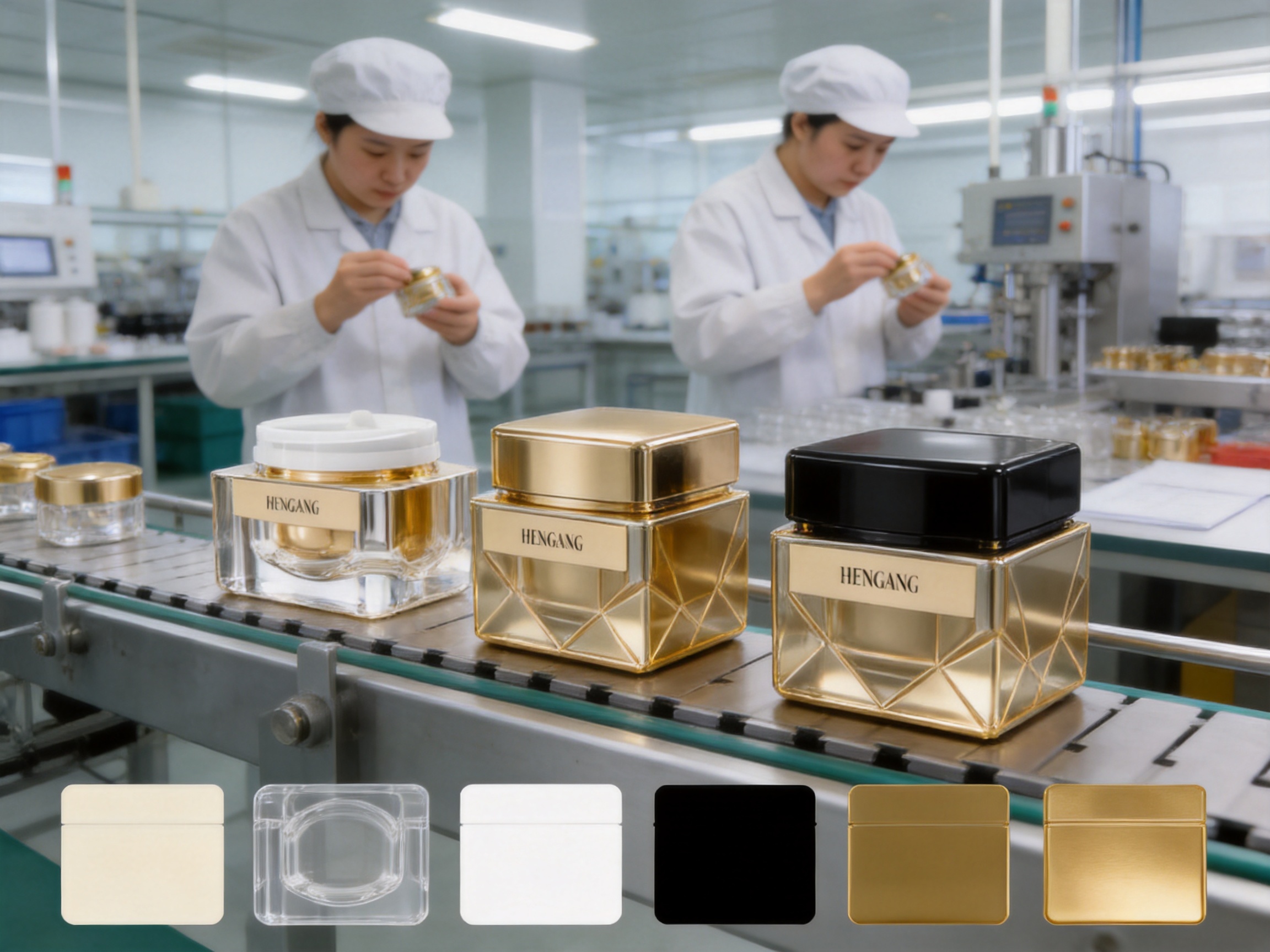
When evaluating a packaging supplier, buyers should consider more than the quoted unit price. The total project includes design development, tooling, sampling, decoration, quality management, logistics, communication, and the ability to support future production.
The manufacturer’s long operating history in cosmetic packaging can be useful for brands that need guidance during development. A supplier familiar with skincare containers may understand common requirements related to filling, component matching, closure performance, decorative finishes, and packaging presentation.
Clear communication is essential. Buyers should provide the formula type, target capacity, annual demand, intended market, desired appearance, decoration expectations, filling method, and delivery requirements. The supplier should then clarify technical feasibility, sample timing, mold requirements, minimum order quantities, testing responsibilities, and quality standards.
For repeat orders, consistency becomes especially important. Approved samples, color standards, inspection criteria, and packaging specifications should be documented. Any changes to raw materials, molds, decoration processes, or component suppliers should be managed through an appropriate change-control procedure.
The stated product height is 54.8 mm, and the stated length and width are 69 × 69 mm. These measurements describe the listed package dimensions, but brands should confirm whether they refer to the jar body, the complete assembled package, or another measurement basis. This confirmation is important when designing cartons, inserts, display trays, and shipping cases.
The nominal capacity is 50 ml. Actual filling volume may vary according to the formula, filling tolerance, headspace, and regulatory requirements. Cosmetic brands should confirm the appropriate net content declaration and conduct filling trials with the intended product.
The listed materials are PMMA plus ABS for the cap, PMMA for the outer bottle, and PP for the inner bottle. These materials should be validated against the formula, decoration method, filling process, storage environment, and target-market requirements. A technical data sheet and samples should be reviewed before approval.
The HB-G004 is a 50 ml double-wall plastic acrylic face cream jar. It has a square geometric design and is intended for cosmetic and skincare packaging applications.
The cap uses PMMA and ABS, the outer bottle uses PMMA, and the inner bottle uses PP. Each material is assigned to a specific component to support the package’s appearance and functional requirements.
The listed capacity is 50 ml. The final filling quantity should be confirmed through filling trials because formula density, headspace, and net-content requirements can affect the practical fill level.
The listed height is 54.8 mm, and the listed length and width are 69 × 69 mm. Buyers should confirm the measurement basis before designing secondary packaging or filling equipment.
Its main distinctions are the square geometric silhouette, double-wall construction, combination of PMMA, ABS, and PP materials, and gold-plated decorative treatment. These features give it a more substantial and premium appearance than a basic single-wall, undecorated jar.
Yes. The geometric design, metallic finish, and double-wall construction are suitable for modern luxury, classic elegance, premium skincare, and gift-oriented product concepts. Formula compatibility and package testing are still required before commercial use.
Potential customization options may include colors, logo decoration, printing, labels, inner-bottle colors, cap treatments, and secondary packaging. Specific options depend on technical feasibility, order quantity, tooling, and decoration requirements.
The product information indicates that the coating is designed to provide wear resistance and corrosion resistance while maintaining its luster. Buyers should request samples and agree on specific durability tests and acceptance criteria for their application.
No packaging material should be assumed to be compatible with every formula. The PP inner bottle should be tested with the intended cream, including under relevant storage and accelerated conditions, to verify compatibility and stability.
The supplier was established in 2006 and specializes in plastic packaging for cosmetics and skincare products. It reports a building area of approximately 35,000 square meters, more than 300 employees, design and development services, ISO9001:2015 and ISO14001:2015 certifications, recognition as a Ningbo High-Tech Enterprise, and multiple invention patents.
Potential applications include facial moisturizers, night creams, intensive treatments, eye creams, sleeping masks, facial masks, and other creams with suitable viscosity and packaging compatibility.
A buyer should request samples, material information, decoration specifications, dimensional drawings, testing recommendations, minimum order quantities, lead times, packaging details, and quality standards. Formula compatibility and transport testing should also be discussed.
The HB-G004 Double Wall Plastic Acrylic Face Cream Jar is designed for brands that want to combine practical cosmetic packaging with a strong premium appearance. Its 50 ml capacity supports a wide range of skincare applications, while its square geometry creates an immediate point of differentiation from conventional round jars.
The double-wall structure provides visual depth and a more substantial presentation. PMMA contributes a refined exterior appearance, ABS supports the cap structure, and PP provides the inner vessel. The gold-plating process adds a metallic finish associated with luxury, classic elegance, and gift appeal.
The product’s value is strengthened by the manufacturer’s experience in cosmetic packaging, design and development capabilities, reported 35,000-square-meter building area, workforce of more than 300 employees, quality and environmental management certifications, high-tech enterprise recognition, and invention patents. These resources can support buyers seeking a packaging partner capable of moving from product concept to manufactured component.
As with any cosmetic container, final approval should be based on formula compatibility, closure performance, decoration durability, dimensional accuracy, transportation testing, and market-specific requirements. When properly evaluated and developed, this jar can provide a distinctive and polished presentation for premium face creams and other skincare products.
1. Product specification information for the HB-G004 Double Wall Plastic Acrylic Face Cream Jar, including materials, capacity, dimensions, and decorative treatment.
2. Company profile information for Yuyao Hengbang Plastic Co., Ltd., including establishment year, facility area, employee count, services, certifications, enterprise recognition, and invention patents.
3. ISO 9001:2015, Quality Management Systems—Requirements.
4. ISO 14001:2015, Environmental Management Systems—Requirements with Guidance for Use.
5. General technical principles for cosmetic packaging development, including formula compatibility, closure testing, dimensional inspection, decoration durability, and transportation evaluation.
6. General material references for PMMA, ABS, and PP in molded plastic packaging applications.


Copyright © Yuyao Hengbang Plastic Co., Ltd.
All Rights Reserved.
 Wholesale Plastic Cosmetic Packaging Manufacturers