English
 中文简体

News
Home > Author > Li Wenjing — Cosmetic Packaging After-Sales Specialist > HB-S007 30ml Triple Chamber Airless Bottle: Advanced Multi-Formula Packaging for Modern Skincare

 2026.09.16
 Li Wenjing — Cosmetic Packaging After-Sales Specialist
Content
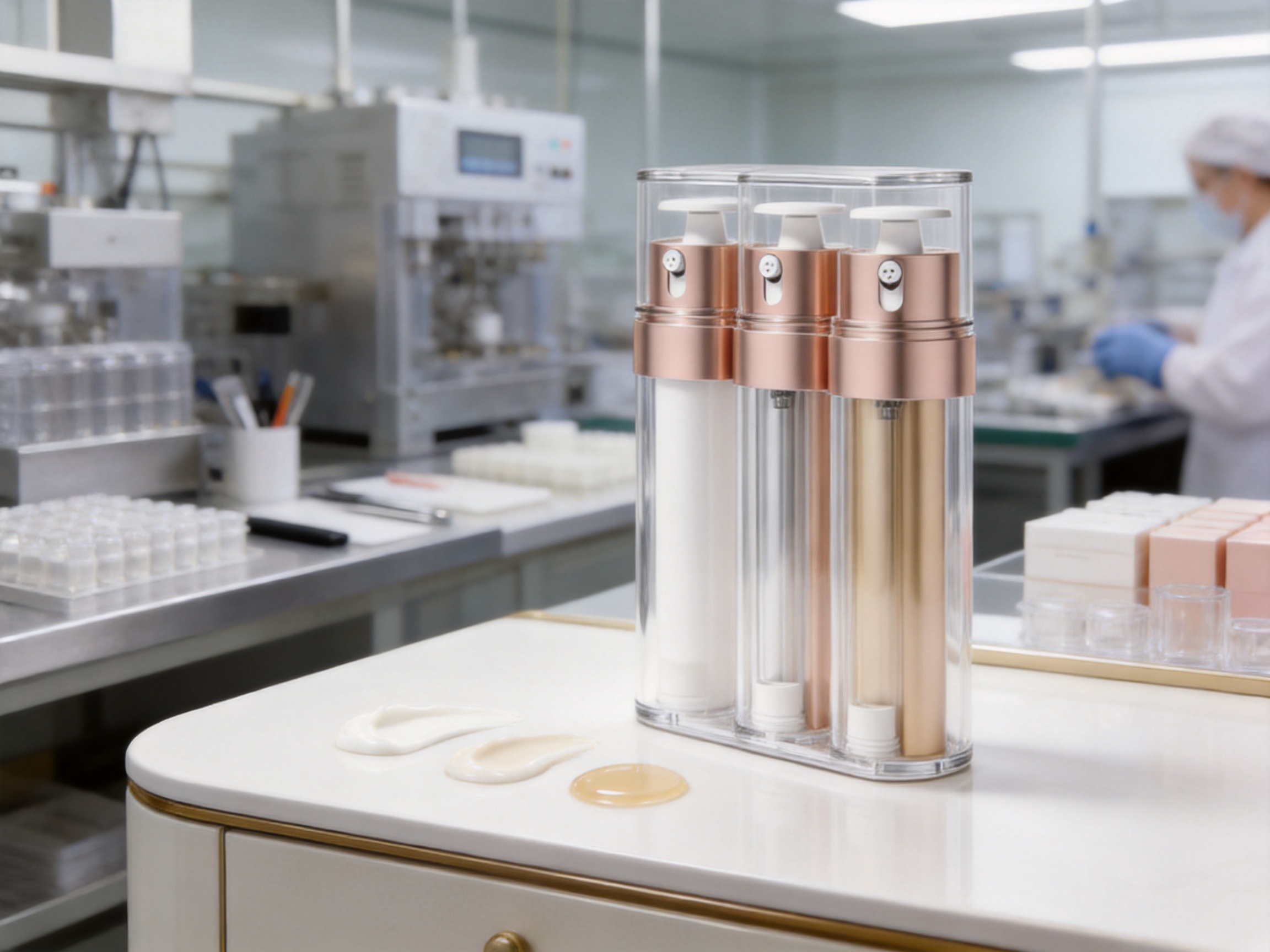
Modern skincare products are becoming more sophisticated, targeted, and personalized. Consumers increasingly expect one routine to address several concerns at the same time, while cosmetic brands are developing formulas that combine complementary ingredients, separate incompatible components, or require activation immediately before use. Packaging must therefore do more than store a product. It must protect sensitive formulas, dispense them accurately, support convenient application, and communicate a premium user experience.
The HB-S007 30ml Triple Chamber Airless Bottle is designed for this changing market. With three independent 10ml chambers and three separate outlets, it provides a practical solution for packaging two or three liquid or semi-liquid formulations in one coordinated container. The design combines the space-saving convenience of a single package with the formulation flexibility of multiple independent compartments.
Developed for essence, cream, anti-aging, whitening, and other advanced skincare products, this triple chamber airless bottle offers a valuable alternative to conventional single-chamber pumps, jars, and multi-bottle kits. Its structure supports flexible product combinations while helping brands create more distinctive packaging concepts. For manufacturers seeking a combination of functional performance, visual appeal, and production reliability, it represents a high-value cosmetic packaging format.
Traditional cosmetic packaging normally places one formula inside one container. This approach remains effective for many lotions, creams, and serums, but it can create limitations when a product concept contains several formulas. A brand may need to package a booster with a base serum, a day treatment with a night treatment, or several active concentrates intended to be used together.
One common solution is to sell two or three separate bottles. Although this arrangement gives each formula its own container, it also increases packaging volume, storage requirements, shipping materials, and the number of components a consumer must handle. Separate bottles can be misplaced, used in the wrong order, or carried inconveniently during travel. From a brand perspective, a multi-bottle kit may also require additional labels, pumps, caps, cartons, and assembly processes.
A second solution is to combine multiple ingredients in one chamber. However, some ingredients may be unstable when stored together for long periods. Certain active ingredients can react with one another, change viscosity, lose effectiveness, or affect the appearance and odor of the final product. In these situations, independent storage is essential until the moment of application.
The triple chamber airless format responds to both challenges. It keeps three formulas physically separate while integrating them into one compact package. The consumer receives an organized and coordinated skincare system, while the brand gains more freedom in developing advanced product concepts.
The HB-S007 is especially relevant to formulations that benefit from separate storage. A brand can use the three chambers for three complementary serums, two serums and one cream, a primary formula with two boosters, or other combinations determined by the product development team. The packaging does not force every formula to be blended in advance. Instead, it supports controlled dispensing and flexible use.
The HB-S007 has a total nominal capacity of 30ml, configured as three independent 10ml chambers. This capacity is suitable for concentrated skincare products and premium treatment programs where a relatively small quantity is used over a controlled period. The compact format can support trial-sized professional products, intensive treatment sets, travel-friendly regimens, or high-value retail products.
Each chamber is designed to operate independently and has its own outlet. This three-outlet arrangement is the central functional advantage of the package. Instead of relying on one shared opening, the system allows the user to dispense the selected formula or several formulas in a coordinated way. Depending on the pump configuration and product concept, the user may apply one liquid at a time or use two or three liquids as part of a combined routine.
The independent chamber configuration also gives product developers more control over formulation architecture. Ingredients that should remain separate can be filled into different chambers. The brand can define an application sequence, recommend simultaneous use, or create a customized mixing experience for the consumer. This flexibility expands the possible applications beyond those of a conventional single-liquid airless bottle.
The bottle has a listed height of 158mm and a diameter of 44mm. These proportions create a tall, compact profile that can deliver a substantial visual presence without requiring a wide footprint. The cylindrical format is compatible with many skincare packaging styles, including minimalist, clinical, luxury, professional, and modern natural designs.
The listed application dosage options are 0.24cc and 0.36cc. These dosage options can support different product dispensing requirements and provide the basis for selecting a suitable pump application. Final output performance should always be confirmed through product testing because viscosity, filling conditions, formula composition, and actuation behavior may affect the actual dispensing result.
| Specification | Product Detail | Packaging Significance |
|---|---|---|
| Product model | HB-S007 | Dedicated triple chamber airless bottle format |
| Total capacity | 30ml | Suitable for concentrated and premium skincare treatments |
| Chamber configuration | 10ml + 10ml + 10ml | Three formulas can be stored independently |
| Number of outlets | Three independent outlets | Supports selective or coordinated dispensing |
| Height | 158mm | Creates a slim, shelf-visible package profile |
| Diameter | 44mm | Provides a compact cylindrical footprint |
| Application options | 0.24cc / 0.36cc | Offers flexibility for dosage planning |
| Cap material | MS | Supports protective and decorative cap construction |
| Pump material | ABS + PP | Combines commonly used cosmetic packaging polymers |
| Bottle material | MS + PETG + ABS | Supports a multi-component structural design |
The most important advantage of the HB-S007 is the physical separation of its three formulas. A conventional single-chamber bottle requires all ingredients to remain compatible throughout the product’s shelf life. The triple chamber structure provides an alternative for brands that need to separate active components, complementary bases, or different textures.
Independent storage can help a brand develop products with a more sophisticated ingredient strategy. For example, a primary serum may be stored in one chamber, a concentrated active booster in another, and a moisturizing or soothing component in the third. The brand can determine whether these products are used together or separately according to the intended treatment program.
Separation also improves product storytelling. A brand can explain the function of each chamber clearly and build a routine around the three formulas. This gives the consumer a more interactive experience than opening a standard bottle and applying one undifferentiated product.
Compared with a set of three independent bottles, the HB-S007 reduces the number of separate items that consumers need to store and carry. One coordinated package can contain three formulas, making it more convenient for travel, gym use, professional treatment kits, and compact bathroom storage.
The integrated format can also simplify the visual organization of a product range. Instead of displaying several small bottles in a box, a brand can present one unified package with a distinctive silhouette. This may reduce secondary packaging requirements and make the product easier to recognize on a crowded retail shelf.
For the user, coordinated dispensing can reduce uncertainty about which formula to apply first. Product instructions can indicate whether the consumer should use one chamber individually or dispense multiple chambers together. The packaging therefore becomes part of the product experience rather than functioning only as a passive container.
A standard airless bottle is normally optimized for one formulation. The HB-S007 expands this concept by enabling three separate formulations to be packaged in one unit. This provides greater flexibility for product innovation without requiring the brand to move entirely to a complex multi-item kit.
The three-chamber arrangement is suitable for differentiated product concepts such as customized skincare, two-step and three-step treatments, professional facial systems, anti-aging programs, brightening regimens, and combination essence-and-cream products. It may also support seasonal or limited-edition packages in which different chambers contain complementary variants.
Consumers often associate unusual functionality with higher product value. A package that dispenses several formulas from one compact body can create a strong first impression and encourage users to engage more closely with the product. The three-outlet structure can make application feel precise, modern, and professionally designed.
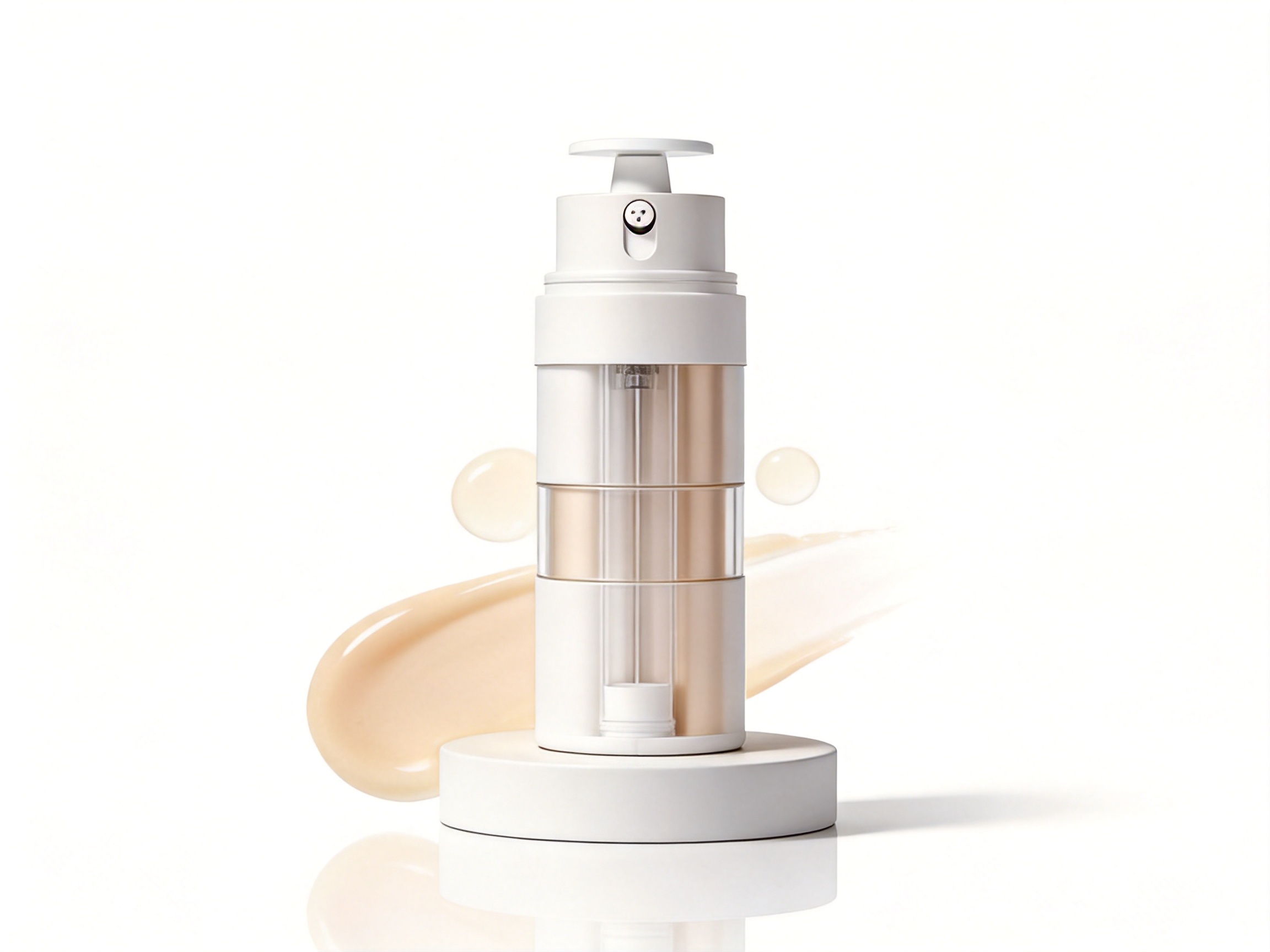
The bottle also offers opportunities for visual customization. Brands can use color, coating, printing, labels, metallic effects, or transparent elements to distinguish the three product channels. The package can communicate a clinical treatment concept, a luxury beauty concept, or a clean and minimalist identity depending on the selected decoration system.
Competition in skincare is intense, and many brands use similar claims, ingredients, and product categories. Packaging innovation can help a brand communicate a unique reason to choose its product. A triple chamber airless bottle immediately signals that the product is different from an ordinary serum or lotion bottle.
The format can support a clear marketing message: three formulas, one routine; separate until application; or customized treatment in one package. Such messages can help the brand explain a complex formulation concept in a simple and tangible way.
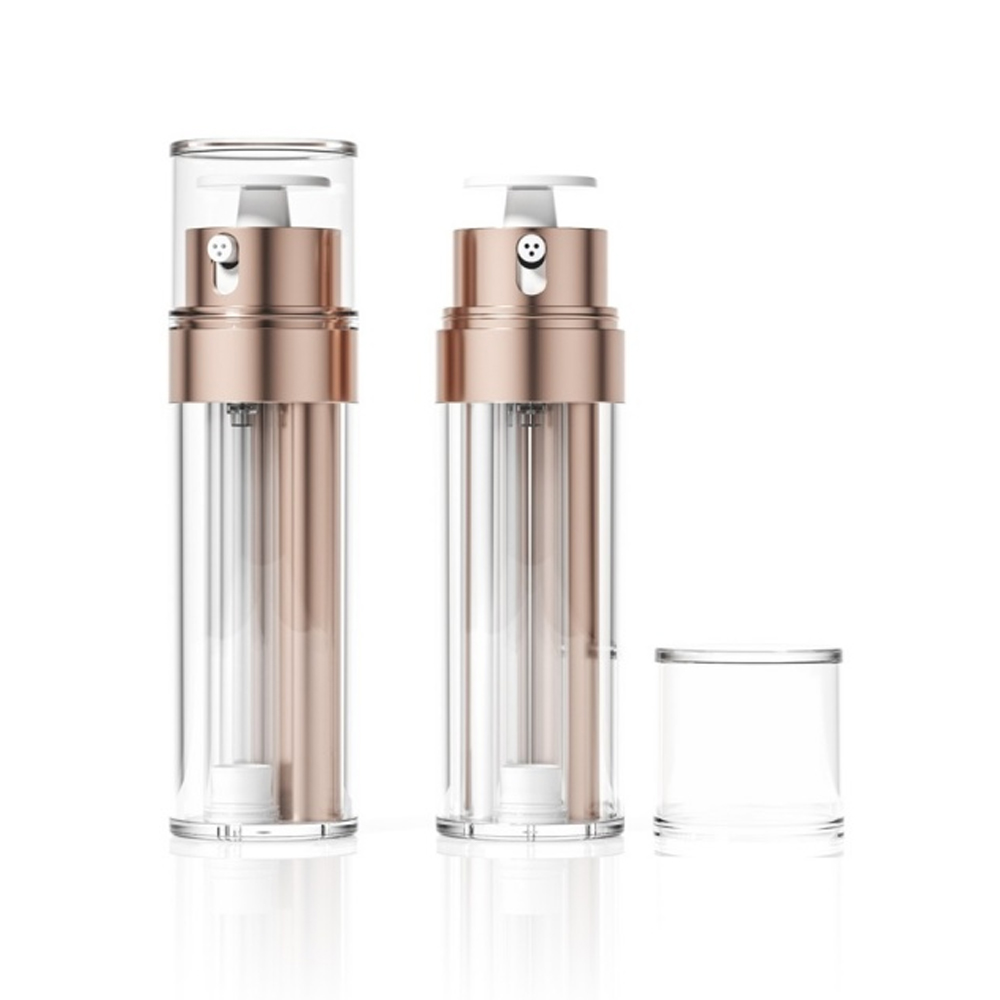
HB-S007 30ml Triple Chamber Airless Bottle
Airless packaging is widely used for skincare because it is designed to dispense product through a pump mechanism rather than requiring the user to reach into an open jar. This format can provide a cleaner, more controlled application experience. The HB-S007 extends the airless concept to three independent chambers, making the functional system more versatile.
When a consumer presses the pump, the internal structure is designed to move product toward the outlet without depending on repeated open exposure. This can help limit unnecessary contact between the formula and the surrounding environment during ordinary use. It also allows the package to be used in a more hygienic manner than a traditional wide-mouth jar, where fingers or applicators may repeatedly enter the product.
The airless format is particularly valuable for creams and serums that are sensitive to repeated handling. It can also be suitable for formulas where controlled dosing is important. The product developer and packaging engineer should evaluate the formula’s viscosity, flow characteristics, particle content, and compatibility with the pump before mass production.
With three separate chambers, the testing process is more detailed than for a single bottle. Each channel should be checked for consistent actuation, appropriate output, sealing performance, and product recovery. The three formulas may have different viscosities, so each one should be evaluated independently. If the product is designed for simultaneous dispensing, the relative output of all channels should also be assessed.
The listed application options of 0.24cc and 0.36cc give brands a starting point for dosage planning. A lower dosage may be appropriate for concentrated active serums, while a higher dosage may support richer creams or broader facial application. The best choice depends on the formula, the recommended routine, and the desired number of uses per package.
Accurate dosage communication is important for both user satisfaction and product performance. If too little product is dispensed, the consumer may believe the package is not working correctly. If too much product is dispensed, the product may be consumed more quickly than expected. Brands should conduct user trials to confirm that the selected output provides a comfortable and practical application quantity.
The three independent outlets allow brands to design different application instructions. One product may be used in the morning, another at night, and the third as an occasional booster. Alternatively, two or three formulas may be dispensed into the hand and mixed immediately before application.
This flexibility is valuable when the final combination should be prepared shortly before use. The package can support an experience in which consumers control the mixture according to their skin condition, season, or preferred texture. A brand may recommend a richer combination for dry skin and a lighter combination for oily or combination skin, provided that the formulas are developed and tested for the intended use.
For professional skincare, the bottle may support treatment protocols that require a base formula and one or two targeted concentrates. Estheticians and beauty professionals can explain the purpose of each chamber and adjust the regimen within the product’s usage instructions. This can add educational value and strengthen the connection between packaging design and treatment performance.
Essences and serums are natural applications for the HB-S007 because these products often contain concentrated ingredients and are used in relatively small quantities. A brand can assign one chamber to hydration, one to brightening, and one to skin-soothing support, creating a coordinated treatment system.
The 10ml chamber size is suitable for concentrated formulas that are applied in small amounts. It can also support a three-phase product concept in which each chamber has a clear role. Because the formulas are independent, the brand has greater freedom to combine textures or ingredient systems that might be difficult to package together in one formula.
Anti-aging products commonly combine several functional objectives, such as supporting skin firmness, improving the appearance of fine lines, enhancing hydration, and protecting the skin barrier. A triple chamber package can separate complementary treatment formulas while presenting them as one complete anti-aging system.
For example, one chamber may contain a lightweight essence, another a concentrated active treatment, and the third a moisturizing cream. The final product concept may instruct users to apply the formulas in sequence or use selected combinations according to their routine. The packaging helps communicate that the treatment has multiple coordinated stages.
Brightening products may contain several ingredients that require careful formulation management. A three-chamber package gives the development team an additional structure for separating formulas and designing a more targeted user experience. One chamber may be positioned as a daily brightening serum, another as an intensive booster, and the third as a soothing or moisturizing support formula.
All cosmetic claims and usage instructions must be supported by appropriate formulation testing and regulatory review. The packaging itself does not guarantee a particular cosmetic result, but it can provide a practical delivery system for a carefully developed brightening program.
Although many lotions and creams are packaged in single-chamber containers, the HB-S007 can provide a more advanced option for combination products. Different chambers may contain products with distinct textures, such as a fluid lotion, a richer cream, and a targeted treatment gel.
The package can also support a layered skincare concept. A consumer may use the lotion first, follow with the active serum, and finish with the cream. By integrating all three steps into one package, the brand can make the routine easier to understand and more convenient to carry.
Some brands may consider a triple chamber package for sunscreen-related routines, primer systems, or pre-sun skincare. Potential product concepts could include a moisturizing preparation, a cosmetic primer, and a sunscreen formula. Because sunscreen products are subject to specific regulatory requirements and performance testing, the suitability of the package must be confirmed for the exact formulation and market.
The format may be especially attractive for travel or outdoor kits. Its compact design can organize several related products in a single container. However, the label must clearly identify the use and dosage of each chamber, especially when one component provides regulated sun protection.
The listed materials for the HB-S007 include MS for the cap, ABS and PP for the pump, and MS, PETG, and ABS for the bottle structure. This combination reflects the multi-component nature of the packaging system. Each material can contribute different characteristics, such as rigidity, appearance, processability, dimensional stability, or compatibility with decoration.
ABS is commonly valued for its strength, surface quality, and suitability for molded cosmetic components. It can support a solid, premium feel in pump or structural parts and may be compatible with a wide range of finishing techniques. PP is widely used in packaging components because of its practical processing characteristics and suitability for moving or contact-related parts in many designs.
PETG is often selected for its clarity, toughness, and attractive appearance. In a cosmetic package, it may contribute to a refined visual effect or allow selected areas of the internal structure to be seen. MS components can support the cap and bottle assembly according to the product’s design requirements and intended finish.
Material selection must always be evaluated against the specific formula. Cosmetic compatibility testing should examine possible interactions between the formula and the container, pump, seals, and internal components. Testing may include appearance changes, odor transfer, weight loss, leakage, pump performance, and long-term storage behavior.
The use of multiple materials also requires careful dimensional control. A triple chamber system includes several functional interfaces, and the accuracy of each component affects the performance of the complete package. Proper mold design, injection molding control, assembly inspection, and sealing verification are therefore essential.
Yuyao Hengbang Plastic Co., Ltd. was established in 2006 and has developed a manufacturing base with a building area of approximately 35,000 square meters and more than 300 employees. This scale provides a foundation for organized production, engineering coordination, quality management, and customer service.
The company specializes in plastic packaging for cosmetics and skincare products. This specialization is important because cosmetic packaging requires more than basic plastic molding. It requires attention to appearance, tactile quality, color consistency, decoration, pump function, sealing, filling compatibility, and the visual language of beauty products.
The company’s professional team provides design and development services. For a product such as the HB-S007, design and development capability can help customers move from an initial product concept to a practical package specification. The development process may involve selecting the appropriate chamber arrangement, reviewing formula requirements, confirming output targets, assessing decoration possibilities, and coordinating prototype evaluation.
Multi-chamber packaging requires close cooperation between packaging engineers, mold specialists, pump designers, quality personnel, and the customer’s formulation team. A capable supplier must understand how the package will be filled, closed, transported, stored, actuated, and used by the final consumer.
Design development may include structural drawings, component review, sample production, assembly testing, output measurement, and appearance confirmation. The supplier’s experience with cosmetic packaging can help identify potential issues early, including insufficient sealing, uneven dispensing, difficult actuation, incompatible decoration, or limited formula recovery.
The existence of multiple invention patents indicates an emphasis on technical development and product innovation. For brands seeking distinctive packaging, this type of engineering background can be valuable because the supplier is not limited to reproducing basic industry formats.
Yuyao Hengbang Plastic Co., Ltd. has passed ISO9001:2015 and ISO14001:2015 certifications. ISO9001:2015 is associated with quality management systems, while ISO14001:2015 focuses on environmental management systems. These certifications indicate that the company has established documented approaches to quality control and environmental management.
For cosmetic packaging customers, a quality management system can support consistent procedures across incoming materials, production, inspection, assembly, storage, and shipment. Consistency is especially important for triple chamber products because a defect in one chamber or outlet may affect the usability of the complete package.
An environmental management system can help a manufacturer identify and manage environmental aspects associated with production. Although certification does not automatically make a product sustainable, it demonstrates that environmental management is addressed through a formal organizational framework. Brands can use this information as part of their supplier evaluation and responsible sourcing process.
A triple chamber airless bottle typically requires more detailed control than a single-wall bottle. The production team must manage multiple molded parts, internal components, pump systems, and assembly interfaces. Dimensional variation can influence the alignment of the outlets, the movement of internal parts, and the consistency of product delivery.
Quality control should therefore include appearance inspection, dimensional inspection, component matching, assembly verification, leakage testing, pump actuation testing, output testing, and packaging inspection. Where the product is customized, color and decoration checks should also be included. These controls help ensure that the package maintains both its functional performance and its premium appearance.
| Packaging Format | Formula Separation | Convenience | Innovation Potential | Typical Limitation |
|---|---|---|---|---|
| Single-chamber pump bottle | Low | High for one formula | Moderate | All ingredients must remain compatible together |
| Wide-mouth cream jar | Low | Moderate | Low to moderate | Repeated open access and less controlled dispensing |
| Three separate bottles | High | Lower for travel and storage | High | More components and a less integrated user experience |
| Dual chamber bottle | Medium to high | High | High | Limited to two formulas |
| Triple chamber airless bottle | High | High | Very high | Requires more detailed formula and component testing |
The HB-S007 is not intended to replace every cosmetic container. A simple single-chamber bottle may remain the best choice for a basic lotion, while a jar may be appropriate for a thick cream where the brand values a traditional application ritual. However, for products requiring separate formulas and a coordinated experience, the triple chamber format offers clear functional advantages.
Compared with three separate bottles, the HB-S007 provides a more integrated solution. It can reduce the visual and physical complexity of the package while preserving independent formula storage. Compared with a dual chamber bottle, it gives the brand a third channel for another active, texture, or treatment stage.
The principal trade-off is that the triple chamber package demands more careful development. Brands must test each formula separately and evaluate the interaction of all components within the complete system. This is not a disadvantage when the supplier and brand have an organized development process. Instead, it is the necessary investment for achieving a more advanced product concept.
Cosmetic packaging must perform functionally while also communicating brand identity. The HB-S007’s tall cylindrical profile gives designers a broad surface for visual development. A minimalist brand may select a single matte color with restrained typography. A clinical skincare brand may use white, silver, or cool neutral tones. A luxury brand may choose metallic decoration, a high-gloss finish, or contrasting colors for the three channels.
The chamber concept creates additional opportunities for color coding. Each outlet or chamber can be represented by a different color, allowing consumers to identify the formulas quickly. For example, one color may represent hydration, another brightening, and another firming care. Clear labeling is important so that decorative differentiation does not create confusion about product use.
Decoration choices should be evaluated for durability. Cosmetic packages are exposed to oils, creams, water, friction, temperature changes, and repeated handling. Printing, coating, labels, and surface effects should be tested to ensure that the finished package remains attractive throughout normal use.
The package can also be coordinated with cartons and secondary packaging. A compact carton may explain the role of each chamber, show the recommended application sequence, and protect the bottle during transportation. For premium products, the carton can reinforce the idea of a complete three-part treatment system.
Before confirming mass production, brands should evaluate the compatibility of every formula with the bottle, pump, seals, and internal components. This evaluation should consider the formula’s pH, viscosity, oils, solvents, pigments, powders, fragrances, active ingredients, and preservatives.
Stability studies should be conducted under appropriate storage conditions. The brand should monitor changes in color, odor, viscosity, weight, separation, leakage, and pump output. Because the bottle has three chambers, testing should cover each formula independently as well as the complete assembled package.
Filling equipment must be suitable for three separate chambers. The filling sequence, fill volume, nozzle alignment, and contamination control should be carefully planned. Each chamber should receive the correct formula, and production records should allow the filling team to verify batch identity and quantity.
Assembly inspection is equally important. The cap, pump, bottle body, and internal components must be matched correctly. The three outlets should remain properly aligned, and the finished product should be checked for smooth actuation and secure closure.
Brands should define whether the product is intended for single-channel use, sequential application, or simultaneous dispensing. The instructions should explain how much product to use, which chamber to select, and whether formulas should be mixed in the hand or applied in layers.
Clear instructions can reduce consumer confusion and improve satisfaction. The outer packaging should identify the three formulas in an easy-to-understand way. If the formulas are visually similar, chamber markings or color coding can be particularly useful.
The completed package should be evaluated under realistic transportation conditions. Vibration, impact, temperature variation, and pressure changes can affect pumps, caps, seals, and formula stability. Packaging engineers should confirm that the bottle remains closed and functional after distribution testing.
The bottle’s 158mm height and 44mm diameter should be considered when designing cartons, shipping cases, retail displays, and warehouse storage. Efficient case packing can help reduce movement during shipping and support cost-effective logistics.
Sustainability is becoming an important part of cosmetic packaging decisions. Brands increasingly evaluate material selection, production efficiency, packaging weight, recyclability, and the total amount of secondary packaging. The HB-S007’s integrated structure may help reduce the need for three separate primary containers, although the complete environmental impact depends on the materials, decoration, filling process, transport, and end-of-life infrastructure.
Responsible development should begin with an assessment of the full packaging system. The brand and supplier can review whether the size is appropriate for the formula quantity, whether secondary packaging can be minimized, and whether decoration can be optimized without compromising product protection. Manufacturing efficiency and quality control are also relevant because lower defect rates reduce material waste.
The ISO14001:2015 environmental management certification held by the manufacturer provides a useful foundation for discussions about environmental management. Brands should still request project-specific information where necessary, including material declarations, production practices, recycling considerations, and compliance documentation for the target market.
The triple chamber format can also support more efficient consumer behavior by bringing several related products together in one package. However, the presence of multiple materials may make recycling more complex. The final sustainability assessment should therefore consider whether components can be separated, how local recycling systems handle the materials, and whether appropriate disposal instructions should be included.
The HB-S007 combines several qualities that are difficult to achieve in a conventional cosmetic bottle. It provides three independent chambers, three outlets, a compact 30ml format, and an airless dispensing concept. These features support formula flexibility, controlled application, and a distinctive consumer experience.
Its value is not limited to the physical container. The package can influence the entire product strategy. It allows a brand to create more complex treatment programs, communicate a differentiated point of view, and combine several related formulas within one recognizable package. This can be particularly useful for brands that want to move beyond standard single-serum packaging.
The manufacturer’s experience in cosmetic packaging, design and development capabilities, technical patents, production scale, and certified management systems further support the product’s commercial potential. A reliable supplier is essential when the packaging includes several chambers and functional components. Strong engineering and quality control can reduce development risk and help brands achieve a consistent result across production batches.
For essence, cream, anti-aging, whitening, and other skincare products, the HB-S007 provides an adaptable platform. It can accommodate different product stories, visual identities, and usage instructions. Its advantages are especially clear when formulas should remain separate, when convenience is important, or when the brand wants packaging to become a central part of the product innovation.
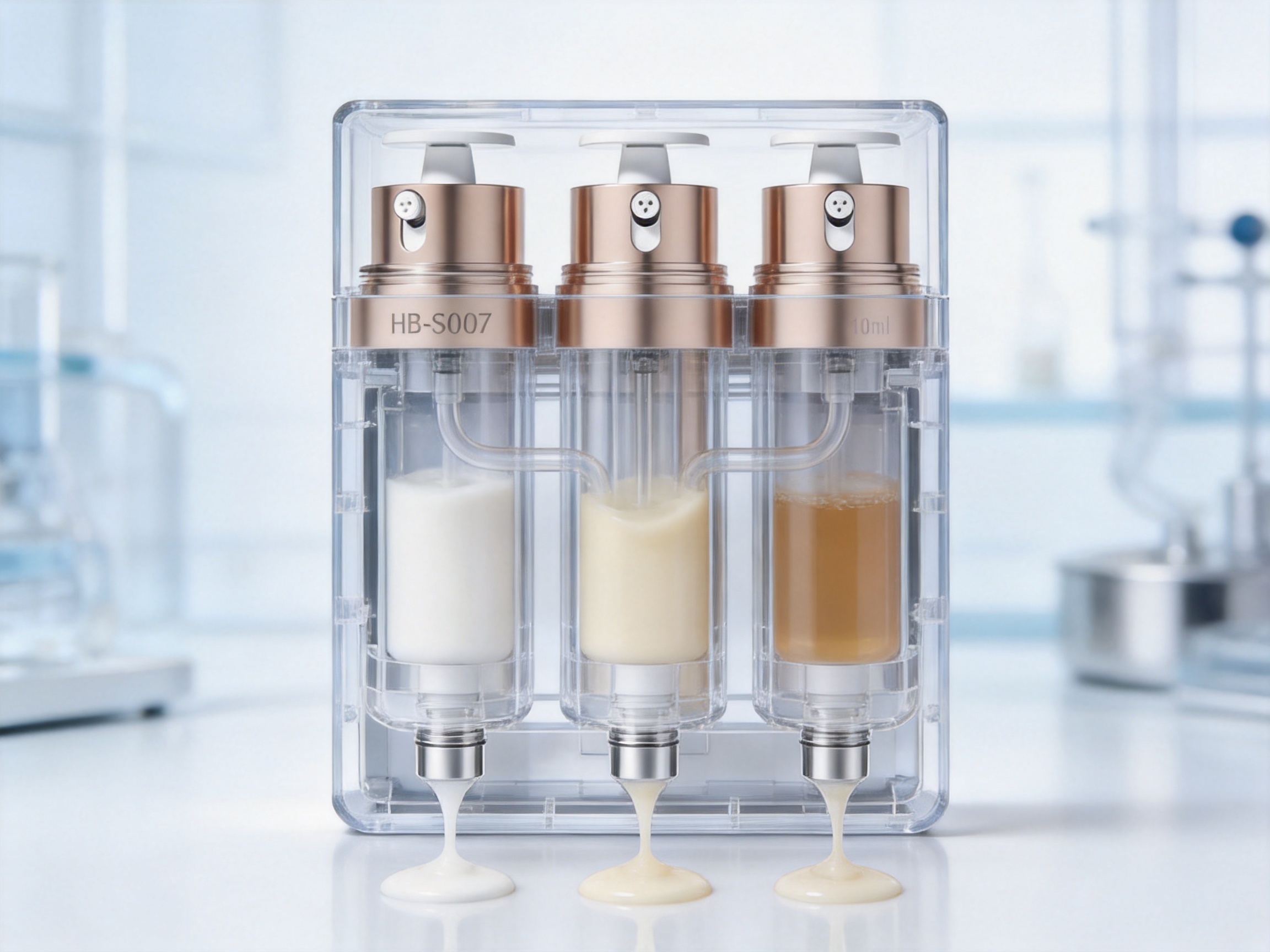
The total nominal capacity is 30ml, divided into three independent chambers of 10ml each. This configuration is suitable for concentrated skincare products, treatment systems, and premium formulas used in controlled quantities.
Yes. The independent chamber structure is designed to allow three formulas to be stored separately. The brand may use the chambers for three different products, two formulas and one booster, or another combination that has been validated for the intended application.
Yes. The product is designed with three independent outlets. This supports selective dispensing, sequential use, or coordinated dispensing of two or three formulas, depending on the pump configuration and product instructions.
The package is suitable for essence, cream, anti-aging, whitening, and other skincare products. It may also be considered for lotions, serums, boosters, professional treatment systems, and customized skincare concepts after formula and packaging compatibility testing.
The listed height is 158mm, and the listed diameter is 44mm. Brands should confirm final dimensions, decoration tolerances, and carton requirements during the product development stage.
The listed application options are 0.24cc and 0.36cc. The appropriate option depends on the formula viscosity, recommended use, desired dosage, and pump performance. Final output should be confirmed through testing with the actual formula.
The listed materials include MS for the cap, ABS and PP for the pump, and MS, PETG, and ABS for the bottle. Exact material suitability should be reviewed against the formula, regulatory requirements, decoration process, and target market.
It can be. The integrated format places three formulas in one coordinated package, which may simplify storage, transportation, and daily use. It also creates a unified product presentation. The final convenience depends on the application instructions and the user’s routine.
The airless format and independent chambers may be suitable for formulas that benefit from controlled dispensing or physical separation. However, packaging suitability cannot be determined from the container alone. Formula compatibility, stability, sealing, pump performance, and shelf-life testing are required before commercial use.
Cosmetic packaging projects may include customization of color, decoration, labeling, finish, and outer packaging. The available options should be confirmed with the manufacturer according to order quantity, design requirements, tooling conditions, and production schedule.
The brand should test formula compatibility, leakage resistance, pump actuation, output volume, chamber filling accuracy, component assembly, storage stability, transportation performance, decoration durability, and consumer usability. All three chambers should be evaluated separately and as part of the complete package.
The HB-S007 provides three independent 10ml chambers rather than two. This gives brands an additional channel for a third formula, booster, texture, or treatment step. It may support more advanced product concepts while maintaining one integrated package.
The HB-S007 30ml Triple Chamber Airless Bottle is a practical and innovative packaging solution for the next generation of skincare products. Its three independent 10ml chambers and separate outlets give brands the ability to store, dispense, and present multiple formulas in one compact package. This combination addresses the growing demand for flexible, personalized, and high-performance cosmetic routines.
Compared with conventional single-chamber bottles, the package offers greater formula separation and product development freedom. Compared with three separate bottles, it provides a more convenient and integrated experience. Its airless dispensing concept, compact dimensions, flexible dosage options, and adaptable visual profile further strengthen its suitability for premium skincare.
The product is supported by the manufacturing capabilities of Yuyao Hengbang Plastic Co., Ltd., including long-term experience in cosmetic packaging, design and development services, a substantial production base, a professional workforce, invention patents, and ISO9001:2015 and ISO14001:2015 certifications. These strengths provide a solid foundation for producing advanced multi-component packaging with consistent quality and reliable performance.
For brands developing essence, cream, anti-aging, whitening, or other multi-formula treatments, the HB-S007 can transform packaging from a basic container into an active part of the product concept. With appropriate formulation testing, quality control, and consumer instructions, it can help create a more convenient, distinctive, and memorable skincare experience.
1. Yuyao Hengbang Plastic Co., Ltd. Product specification information for the HB-S007 30ml Triple Chamber Airless Bottle.
2. Yuyao Hengbang Plastic Co., Ltd. Corporate information, manufacturing capabilities, certifications, and product development profile.
3. ISO 9001:2015, Quality Management Systems — Requirements.
4. ISO 14001:2015, Environmental Management Systems — Requirements with Guidance for Use.
5. General cosmetic packaging engineering principles concerning airless dispensing, material compatibility, dosage control, sealing, and package stability.
6. General product development practices for multi-chamber cosmetic containers, including formula compatibility, filling accuracy, assembly control, transportation testing, and consumer usability evaluation.
Product: HB-S007 30ml Triple Chamber Airless Bottle


Copyright © Yuyao Hengbang Plastic Co., Ltd.
All Rights Reserved.
 Wholesale Plastic Cosmetic Packaging Manufacturers