English
 中文简体
中文简体
News
Home > Author > Li Wenjing — Cosmetic Packaging After-Sales Specialist > Why the HB-F004 Plastic Blue Sunscreen Squeeze Bottle Supports Modern Skincare Packaging

 2026.09.04
 Li Wenjing — Cosmetic Packaging After-Sales Specialist
Content
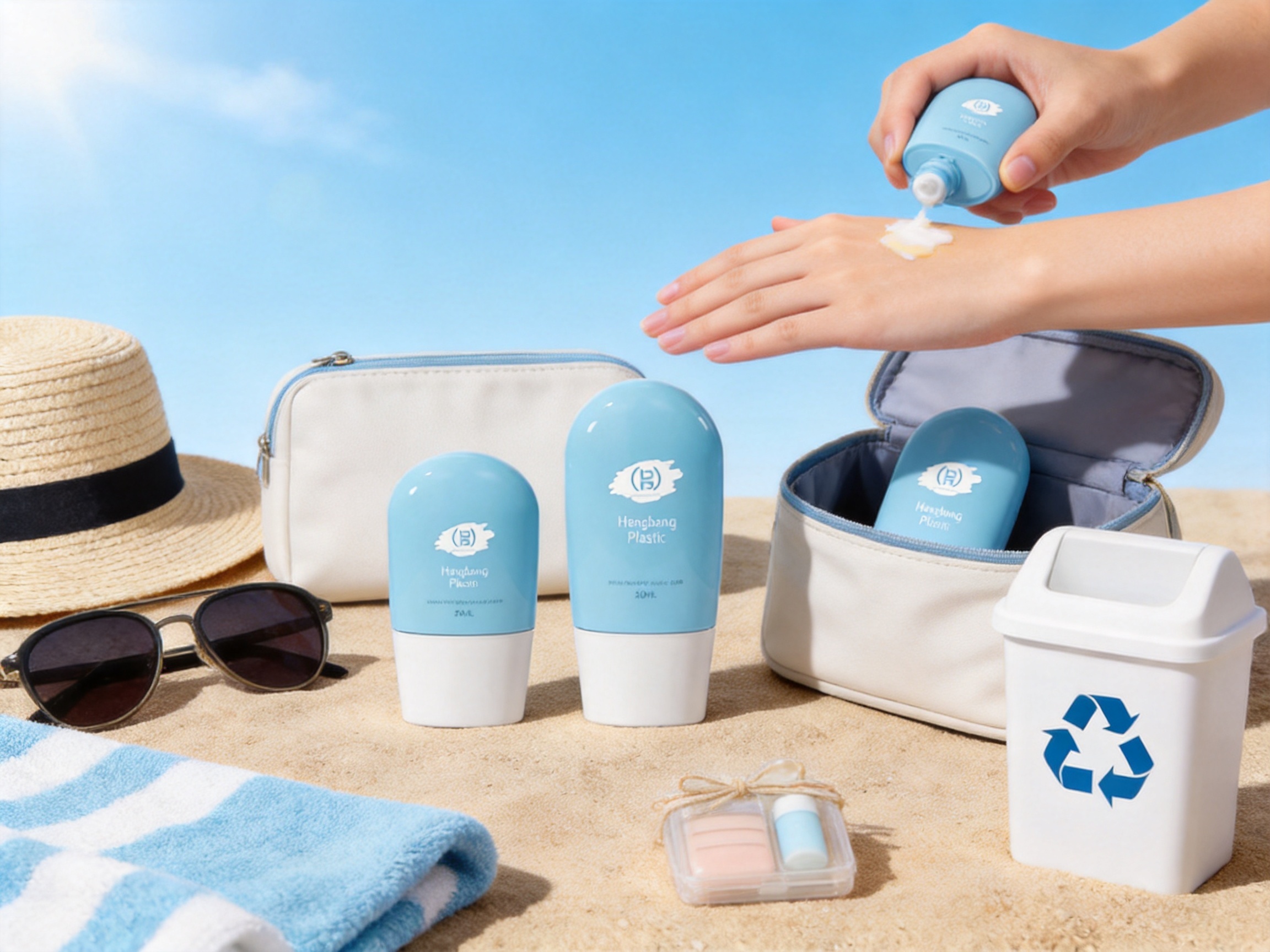
Packaging has a direct influence on how consumers use, store, and evaluate skincare products. For sunscreen in particular, the package must do more than hold a formula. It should help protect the product from environmental exposure, dispense an appropriate amount, remain comfortable during repeated use, and support practical requirements such as portability, durability, and responsible material selection. The HB-F004 Plastic Blue Sunscreen Squeeze Bottle is designed around these everyday needs.
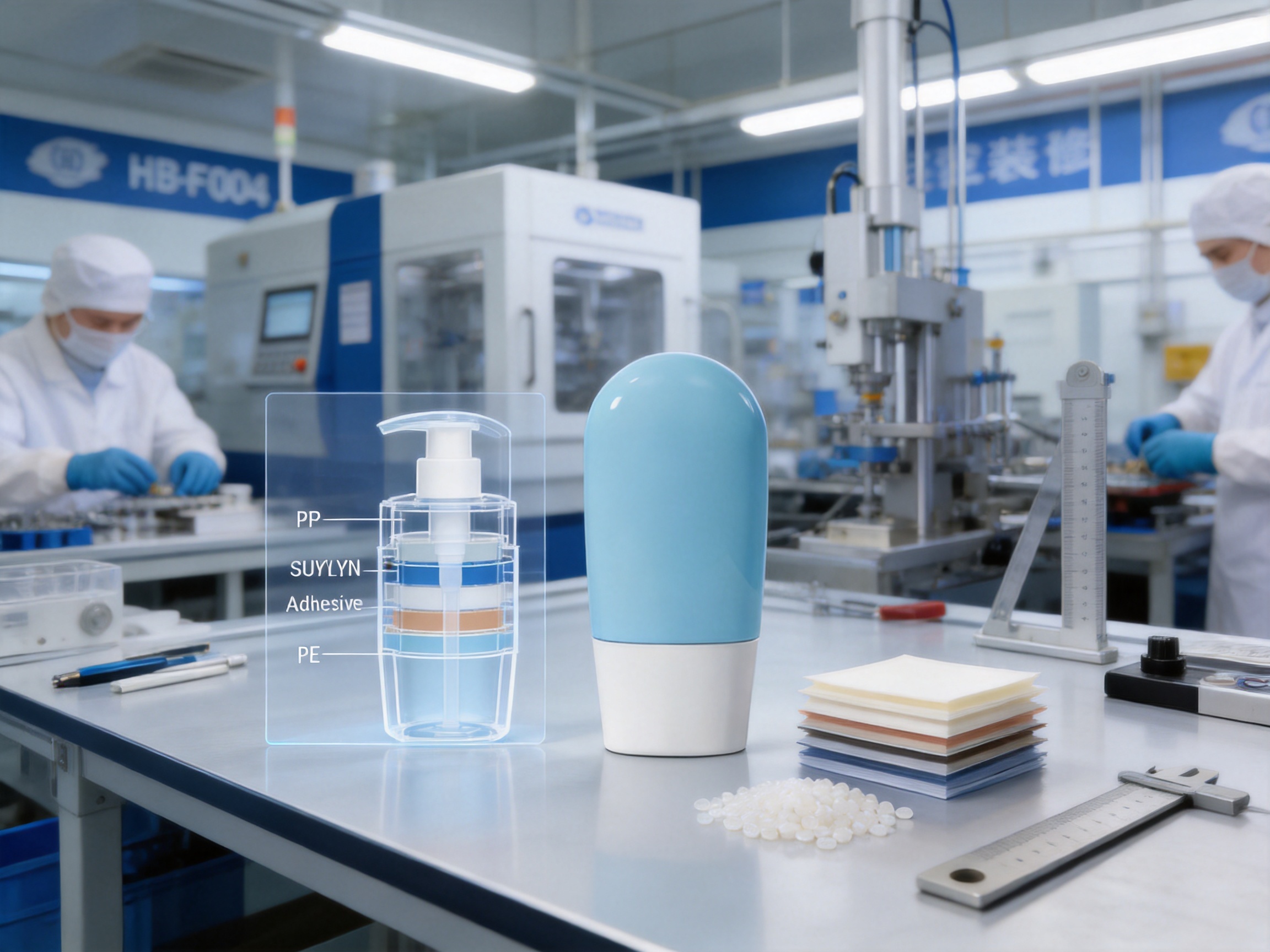
This 30 ml or 50 ml squeeze bottle combines a soft, easy-to-use body with an opaque blue appearance that can help reduce the impact of light exposure on sunscreen contents. Its construction uses PP, SUYLYN, adhesive, and PE, creating a multilayer packaging solution intended for cosmetic and skincare applications. The bottle is compact enough for personal care routines while offering a format that is suitable for daily sunscreen products, travel sizes, promotional sets, and professional cosmetic packaging programs.
Manufactured by Yuyao Hengbang Plastic Co., Ltd., the HB-F004 reflects the capabilities of a specialized plastic packaging producer with experience in cosmetic and skincare containers. The company operates a 35,000-square-meter building area, employs more than 300 people, and provides services covering design and development as well as production. Its ISO9001:2015 and ISO14001:2015 certifications, invention patents, and recognition as a Ningbo High-Tech Enterprise demonstrate a structured approach to quality management, environmental management, technical development, and production specialization.
This article examines the bottle’s design, material characteristics, performance advantages, manufacturing considerations, customization potential, and application value. It also explains why a squeeze format can be a strong alternative to rigid jars and conventional pump containers for selected sunscreen and skincare formulas.
The HB-F004 is a plastic blue sunscreen squeeze bottle developed for sunscreen and related skincare products. Its primary category is a plastic sunscreen squeeze bottle, but the format can also be considered for lotions, hand creams, body care products, after-sun products, travel skincare, and other semi-fluid cosmetic formulas that benefit from controlled manual dispensing.
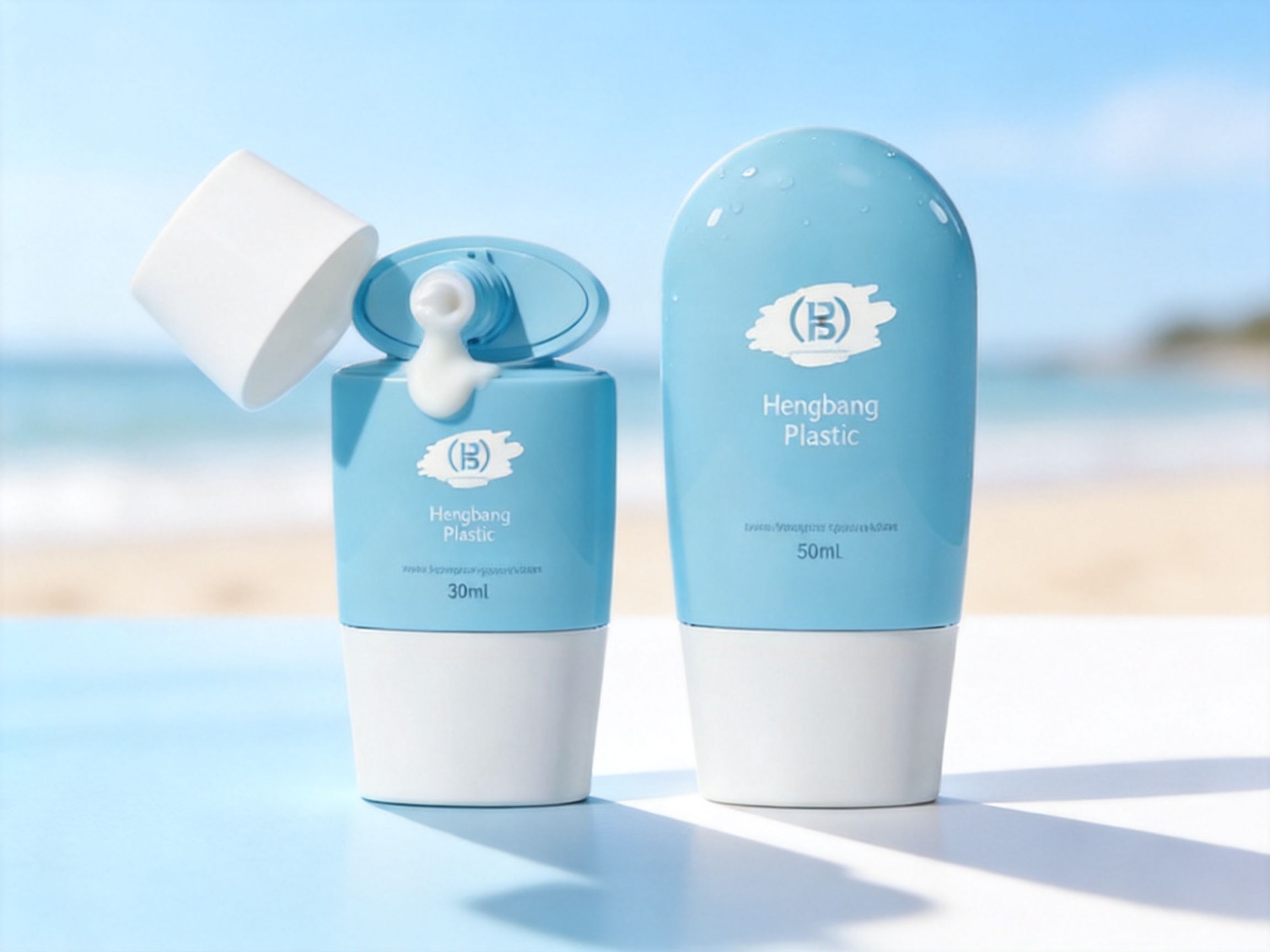
The bottle is available in two stated capacities: 30 ml and 50 ml. These sizes cover two common packaging requirements. The 30 ml option is convenient for travel, trial programs, portable daily use, and product sets. The 50 ml option provides additional volume for routine use while remaining compact enough for handbags, cosmetic cases, and travel toiletry bags.
The body is typically softer than a rigid plastic container, allowing users to squeeze it with one hand. This characteristic can make the package more intuitive for consumers who want to dispense sunscreen quickly before outdoor activities. A squeeze bottle also avoids the need to insert fingers into a jar, helping create a cleaner and more convenient user experience.
The blue or opaque appearance serves both functional and visual purposes. From a functional perspective, an opaque exterior can help limit direct exposure of the formula to light. Sunscreen products may contain ingredients that require protection from environmental conditions, and a package that reduces light penetration can support the product protection strategy. From a visual perspective, blue communicates freshness, cleanliness, protection, and skincare functionality, making it well suited to sun-care positioning.
The HB-F004 is made from a combination identified as PP+SUYLYN+ADHESIVE +PE. This material structure indicates that the bottle is not simply a single-material rigid container. Instead, it uses a combination of plastic layers and bonding materials to achieve the intended balance of softness, appearance, structure, and usability. The exact production configuration may depend on the selected specification, decoration method, and customer requirements.
| Product Attribute | Available Specification or Description |
|---|---|
| Product name | HB-F004 Plastic Blue Sunscreen Squeeze Bottle |
| Primary category | Plastic Sunscreen Squeeze Bottle |
| Material | PP + SUYLYN + adhesive + PE |
| Capacity options | 30 ml and 50 ml |
| Stated height information | 91.2 mm and a second listed value of 116.2, requiring specification confirmation |
| Stated diameter information | 53 × 26.5 mm |
| Recommended product types | Sunscreen, lotion, cream, after-sun care, and selected skincare formulas |
| Body style | Soft squeeze bottle |
| Visual style | Blue or opaque appearance |
Because the source specification lists “116.2ml” in the height field, buyers should confirm whether this value is intended to be 116.2 mm. Dimensional confirmation is a normal and important part of packaging development, particularly when a bottle will be paired with a cap, filling line, carton, label, or retail display.
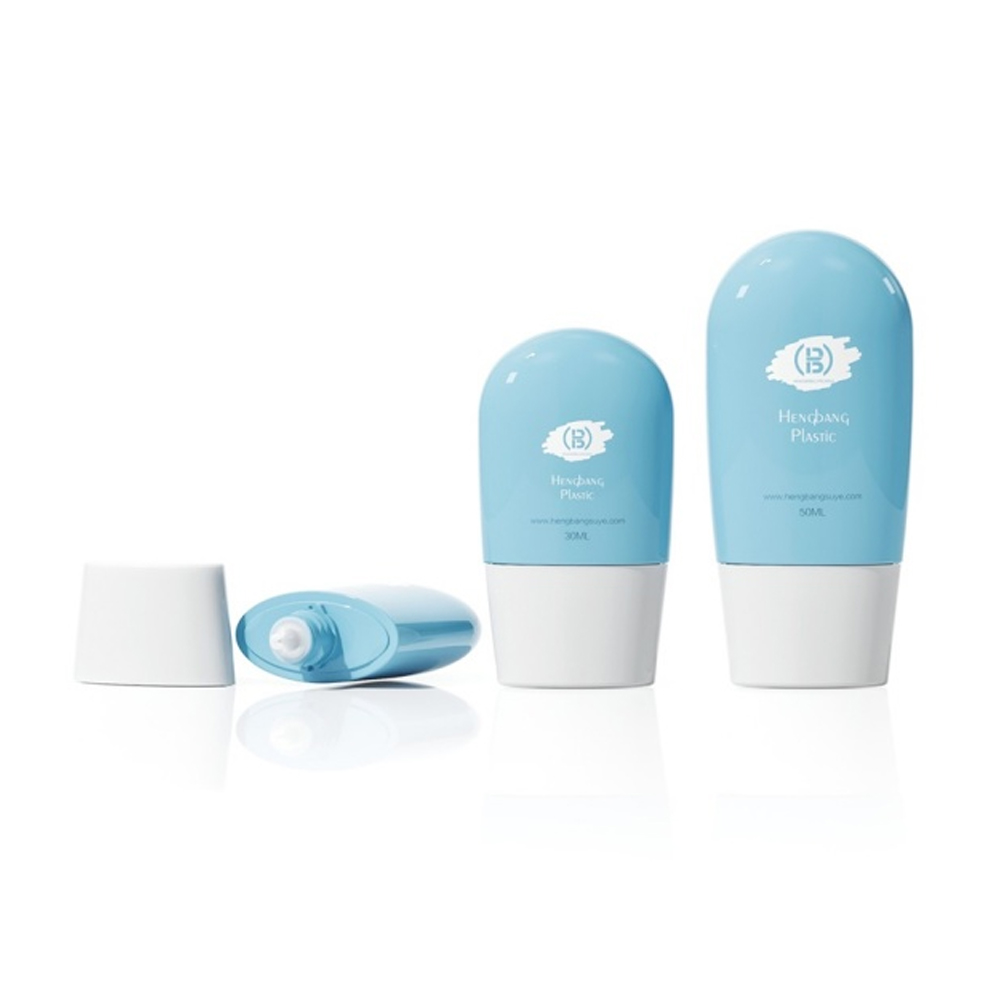
HB-F004 Plastic Blue Sunscreen Squeeze Bottle
Sunscreen is used frequently and often in outdoor environments. Consumers may apply it at home, carry it to work, place it in a beach bag, keep it in a sports bag, or take it on a holiday. This creates packaging demands that differ from those of products used only occasionally or stored in a bathroom cabinet.
A sunscreen package should be easy to open, comfortable to hold, simple to dispense, and sufficiently robust for everyday handling. The container should also support protection of the formula from conditions that may affect its appearance, texture, or performance. While packaging cannot replace appropriate formulation stability testing, material compatibility testing, or regulatory evaluation, the selected container is an important component of the overall product system.
The HB-F004 format addresses these requirements through four central design features: a soft body, a compact capacity range, an opaque blue appearance, and a plastic construction suitable for cosmetic packaging programs. These features are especially useful for sunscreen products that are applied repeatedly and need to be carried by consumers.
Sunscreen is commonly applied in multiple situations, including morning skincare routines, outdoor activities, sports, beach visits, and reapplication during the day. A squeeze bottle allows the consumer to control dispensing by applying light or firm pressure to the body. This can be more direct than using a jar and may be more familiar to consumers than a pump mechanism for smaller portable formats.
The flexible body can also help the user dispense product even when the remaining contents are low. With a rigid container, some product may remain in corners or on the bottom where it is difficult to reach. A squeeze format allows the user to direct the product toward the opening by changing the orientation of the bottle and applying pressure.
The 30 ml and 50 ml sizes provide flexibility for different marketing and consumer needs. A 30 ml package can be used for travel-friendly sunscreen, introductory sizes, gift sets, sample programs, or premium skincare collections. A 50 ml package can serve as a daily-use size for consumers who want a compact product with more contents.
Offering more than one capacity can also help a brand build a consistent packaging family. The same visual design language may be used across different sizes, allowing a business to create a recognizable sun-care range while adapting volume to different channels. For example, the smaller size may be positioned for travel retail or promotional sets, while the larger size can be offered through standard retail or online sales.
The bottle is often made opaque or blue, which can reduce the amount of direct light reaching the product inside. This is an important consideration for formulas that may be sensitive to ultraviolet exposure or visible light. The package should be evaluated together with the formula through appropriate stability and compatibility testing, but an opaque exterior can provide a useful protective design approach.
Opaque packaging also offers a consistent appearance when the formula itself varies in color or when a brand wants to maintain a controlled visual identity. The bottle can reduce the influence of the filled product’s color on the outside appearance, helping maintain a more uniform presentation across production batches.
The listed material combination for the HB-F004 is PP, SUYLYN, adhesive, and PE. Each element may contribute to the overall package structure, depending on the specific production method and design configuration. Polypropylene is widely used in cosmetic packaging because it can provide a practical combination of light weight, chemical resistance, processability, and durability.
Polyethylene is also widely used in packaging structures and can contribute to flexibility and sealing performance. A bonding layer may be used to join different plastic components or layers. SUYLYN, as identified in the supplied material information, forms part of the product’s specific material construction. Customers should confirm the exact grade, layer arrangement, and technical documentation with the manufacturer before finalizing a formula-package combination.
PP is commonly associated with recycling symbol number five. This does not mean that every local recycling system accepts every PP package, because recycling infrastructure varies by region, shape, decoration, closures, and material combination. However, the use of PP provides a recognized material reference for customers seeking plastic packaging with a recyclable resin category.
For brands with environmental packaging objectives, material selection should be assessed as part of a wider packaging life-cycle strategy. This may include reducing unnecessary material, selecting an appropriate wall thickness, improving package emptying, reviewing decoration methods, and communicating disposal instructions accurately. The HB-F004’s PP-related material profile can support this conversation, while the complete structure should be reviewed before a recyclability claim is made.
A major difference between this bottle and a conventional rigid cosmetic container is its tactile behavior. The body is intended to be softer and easier to squeeze. This can improve dispensing convenience and provide a more comfortable experience for consumers who use the product frequently.
Softness must be balanced with sufficient shape retention and resistance to handling. A package that is too soft may deform excessively, while a package that is too rigid may lose the main advantage of a squeeze format. Professional packaging production therefore requires control of material selection, wall design, forming conditions, dimensional consistency, and quality inspection.
The tactile quality of the container also contributes to product positioning. A smooth, controlled squeeze can make the product feel practical and modern. For sunscreen, this can reinforce a message of easy daily protection rather than occasional seasonal use.
The HB-F004 should not be viewed as a universal replacement for every type of cosmetic container. Different products require different dispensing systems, barrier properties, closure styles, and filling processes. Nevertheless, the squeeze bottle offers several advantages over conventional formats in applications where portability, frequent use, and simple dispensing are priorities.
Plastic cream jars are often selected for thick creams, masks, body butters, and rich skincare products. They can offer a wide opening and a strong shelf presence. However, users generally need to open the lid and remove product with a finger or spatula. This can be less convenient for sunscreen used on the move, and repeated contact with the product may be undesirable for some consumers.
The HB-F004 provides a closed dispensing format that allows the consumer to squeeze out the desired amount without placing fingers inside the container. Its narrower body can also be easier to carry in a small bag. For sunscreen, these attributes may create a more efficient and hygienic-feeling experience than a jar.
Rigid bottles can offer excellent dimensional stability and may be suitable for liquid or semi-liquid formulas. However, a rigid body usually cannot be compressed by the user. Product removal may depend on a pump, a flip-top opening, or gravity. If the product becomes more viscous or if the bottle is not designed for complete evacuation, some contents may remain inside.
A squeeze bottle gives the user direct control over the package body. It can be especially useful for lotions and sunscreen creams that are too thick for some standard lotion pumps. The compact shape and flexible body can also support better product access near the end of use.
Glass can create a premium appearance and provide useful chemical resistance for certain applications. However, it is heavier and more vulnerable to breakage than plastic. These disadvantages can be significant for sunscreen products intended for outdoor use, travel, sports, children, or beach environments.
The plastic construction of the HB-F004 helps reduce the risks associated with breakage and can contribute to lower package weight. This may improve portability and simplify logistics. Plastic also allows the package to be formed into a soft squeeze body, a characteristic that glass cannot provide.
Large sunscreen bottles may be efficient for family use, professional settings, or repeated application at home. However, they are not always convenient for handbags, travel, gym bags, or retail gift sets. The 30 ml and 50 ml options provide a more portable alternative while preserving the familiar squeeze-bottle experience.
Smaller packaging also allows brands to create targeted product offerings. A travel version, trial size, limited edition, or bundled product can reach consumers who may not initially purchase a larger container.
Packaging must satisfy both consumer expectations and commercial requirements. The HB-F004 provides a practical base for brands that want a portable sunscreen container with a clear skincare identity.
Blue is frequently associated with water, freshness, calmness, and protection. When combined with an opaque finish and sunscreen positioning, it can help consumers quickly understand the product category. The shape and size can also be integrated into a broader visual system for sun-care or daily skincare products.
A recognizable package can be particularly useful in crowded retail environments. Sunscreen shelves often include many similar products, and a consistent blue squeeze bottle can help a product establish a distinct silhouette and color presence. Final brand recognition will depend on the label, decoration, closure, typography, and overall design, but the base container provides a practical starting point.
The bottle can support several market positions. It may be used for mass-market sunscreen, travel skincare, professional cosmetic lines, outdoor products, gift collections, or private-label programs. Its uncomplicated form allows the brand to emphasize different benefits through decoration and formula development.
For a family-oriented product, the squeeze body may communicate simplicity and ease of use. For a premium skincare product, a carefully selected blue tone, matte finish, detailed printing, and refined cap can create a more elevated appearance. For a travel product, the compact dimensions and smaller capacity can become central selling points.
The user experience begins before the formula is applied. A consumer must identify the product, pick it up, open it, dispense it, and close it again. A squeeze bottle reduces the number of complicated operating steps. It can be held in one hand and used without a separate applicator in many situations.
The bottle’s user interaction should still be validated through practical testing. Product developers should assess the force required to squeeze the container, the amount dispensed per use, the behavior of the formula at different temperatures, the ease of closing the package, and the ability of the bottle to stand or lie securely during storage.
Yuyao Hengbang Plastic Co., Ltd. was established in 2006 and specializes in plastic packaging for cosmetics and skincare products. The company’s experience in this field provides an important foundation for customers seeking packaging that is designed specifically for personal care applications rather than adapted from an unrelated container category.
The company has a building area of 35,000 square meters and more than 300 employees. This scale can support coordinated activity across product development, engineering, production, quality control, sales, and customer service. A larger and specialized organization may also be better positioned to manage repeat orders, production planning, specification control, and communication for multiple packaging projects.
Hengbang provides a full range of services, including design and development. This is valuable when a customer needs more than a standard stock item. Packaging development may involve selecting the correct size, adjusting the body shape, confirming the closure, reviewing filling compatibility, choosing colors, and refining the visual relationship between the bottle and the brand.
Design and development support can shorten communication paths between concept and production. Instead of working with separate suppliers for design, tooling, and manufacturing, a customer may be able to coordinate more stages through one specialized packaging partner. This can help improve consistency between the approved sample and the production version.
The company has passed ISO9001:2015 certification. ISO9001 is associated with quality management systems and structured control of processes, documentation, responsibilities, and continual improvement. Certification does not eliminate the need for product-specific inspection, but it indicates that the company has established a formal framework for managing quality-related activities.
For a squeeze bottle, quality management may cover incoming raw materials, color consistency, dimensional accuracy, forming conditions, appearance inspection, closure fit, leakage checks, packaging, and shipment control. Customers should agree on detailed acceptance criteria before mass production, including allowable color variation, flash, scratches, deformation, contamination, and dimensional tolerance.
Hengbang has also passed ISO14001:2015 certification. This standard relates to environmental management systems and provides a framework for identifying environmental aspects, controlling relevant processes, meeting applicable obligations, and pursuing improvement.
For plastic packaging production, environmental management may involve waste reduction, energy use, production material control, wastewater or emissions management where applicable, and responsible handling of manufacturing residues. While certification is not the same as a complete environmental impact assessment for a particular bottle, it gives customers a structured basis for discussing environmental performance with the supplier.
The company was awarded as a Ningbo High-Tech Enterprise in 2021 and owns multiple invention patents. These achievements indicate an emphasis on technical development and innovation. In packaging manufacturing, technical capability may contribute to improvements in product structure, forming methods, decoration, material integration, production efficiency, or quality control.
For customers developing a differentiated sunscreen package, a supplier with technical development experience can be valuable. A specialized partner may help identify production limitations early, recommend feasible structures, and reduce the risk of developing a visually attractive package that cannot be manufactured consistently or filled efficiently.
Hengbang describes its business philosophy as “Quality, Integrity, and Customer First.” For international packaging projects, service quality is important because product development often involves multiple rounds of samples, specification review, quotation, testing, approval, production, and shipment.
Clear communication is especially important for a bottle with multiple material components. Customers should receive clear information regarding the material structure, available colors, closure options, decoration, dimensions, tolerances, packing method, minimum order quantity, sample lead time, production lead time, and recommended testing program.
The exact manufacturing route for the HB-F004 depends on the approved technical drawing, selected materials, tooling, decoration requirements, and final closure configuration. However, professional cosmetic packaging production generally involves a sequence of controlled stages that transform raw materials into a finished container.
The process begins with reviewing the product concept and technical requirements. The manufacturer and customer should confirm capacity, height, diameter, wall structure, opening size, cap design, color, surface finish, decoration, filling method, and intended product viscosity.
For sunscreen, the formula’s density, viscosity, oil content, solvent content, fragrance, active ingredients, and preservative system should be considered. These factors can influence material compatibility, dispensing behavior, stress cracking risk, odor transfer, and long-term package stability.
The 30 ml and 50 ml capacities should be validated through actual filling trials rather than relying only on nominal dimensions. The usable fill volume, headspace, product density, and filling tolerance all affect the final package. A technical drawing should also resolve any ambiguous dimensional information, including the listed 116.2 value in the height field.
Raw materials should be selected and prepared according to the approved specification. Resin grades, colorants, additives, bonding materials, and any applicable barrier components should be controlled to maintain consistency. Material documentation may include technical data sheets, safety information, regulatory declarations, and batch records.
For a cosmetic package, the material selection should also be reviewed against the intended market. Different regions may have different requirements related to substances, packaging waste, food-contact analogies, heavy metals, allergens, or chemical restrictions. The packaging manufacturer and brand owner should determine which declarations and tests are required for the target market.
The bottle body may be formed using a process appropriate to its structure and geometry. A squeeze bottle with multiple material components requires careful control of layer integration, shape formation, and bonding. The purpose is to achieve a body that is flexible enough for dispensing but stable enough for storage and handling.
Production conditions can affect wall thickness, surface appearance, dimensional accuracy, and mechanical behavior. Process parameters should therefore be monitored and adjusted through qualified production procedures. Samples from the beginning, middle, and end of a production run can be compared to identify variation.
The blue or opaque appearance is an important part of the product’s identity. Color control should be based on an agreed standard, such as a physical master sample, color card, or defined color measurement target. Visual inspection under consistent lighting can help identify shade differences, uneven coverage, streaking, or surface defects.
Surface finish also affects the perceived quality of the bottle. A smooth finish may provide a clean cosmetic appearance, while a matte or soft-touch effect may offer a more tactile presentation. Any surface treatment must be evaluated for durability, adhesion, resistance to rubbing, and compatibility with printing or labeling.
Depending on the project, the bottle may be decorated through labeling, screen printing, offset printing, hot stamping, or another suitable method. The decoration should be tested for adhesion and resistance to normal handling, sunscreen oils, water, sweat, and rubbing inside a cosmetic bag.
Product identification should remain clear throughout the package’s use. Important information may include product name, net contents, ingredients, directions, warnings, batch information, responsible company details, and disposal guidance. The bottle design should leave enough usable surface area for mandatory and marketing information.
After forming and decoration, the bottle components can be assembled with the selected closure or dispensing part. Assembly inspection may include checking alignment, fit, appearance, torque or closing performance, and the relationship between the bottle and cap.
Leakage testing is particularly important for sunscreen packaging. The test method should reflect the product’s actual use conditions, including orientation, temperature variation, pressure changes, vibration, and transport. The package should be evaluated both empty and filled, because the formula can influence seal behavior and internal pressure.
Packaging approval should be based on a product-specific testing program. The HB-F004 offers a suitable design concept, but the final suitability must be confirmed with the customer’s actual formula and closure system.
Compatibility testing examines whether the formula changes the package or whether the package changes the formula. Potential observations include discoloration, swelling, softening, brittleness, stress cracking, leakage, odor transfer, loss of decoration, and changes in dispensing performance.
Testing should be conducted over an appropriate period and under relevant temperature conditions. Accelerated testing can provide early information, but real-time stability testing remains important. Samples should be stored in different orientations when appropriate, because contact between the formula and closure or shoulder area may vary.
The package should be assessed for the amount dispensed under normal hand pressure. Too much product per squeeze may create waste, while too little may frustrate consumers. The opening size, formula viscosity, body softness, and cap design all influence dispensing.
Testing should include the first use, repeated use, and end-of-life use. A sunscreen formula may behave differently at low and high temperatures, so dispensing trials under temperature variation can be helpful. Human-use evaluations may also reveal whether the package is easy to hold, open, squeeze, and close.
Plastic cosmetic containers may experience compression, vibration, impact, stacking, and temperature variation during manufacturing, warehousing, distribution, and retail handling. Mechanical testing can help assess whether the bottle and closure remain intact throughout these stages.
Common evaluations may include drop testing, compression testing, cap fit testing, leakage testing, and transportation simulation. The exact test method should be selected according to the bottle’s shipping configuration, carton design, distribution route, and sales channel.
Appearance inspection is important because consumers often associate visual consistency with product quality. The manufacturer and customer should define criteria for color, gloss, surface texture, printing, label position, seam appearance, flash, deformation, contamination, and other visible conditions.
Inspection standards should distinguish between critical defects, major defects, and minor defects. A documented quality agreement can help ensure that both parties evaluate production samples according to the same expectations.
Although the HB-F004 has a defined blue sunscreen bottle identity, cosmetic packaging projects often require customization. Depending on the design and production scope, customers may discuss color matching, surface finish, decoration, closure selection, label application, and packaging configuration.
Blue can be adjusted to support different brand directions. A light blue may communicate softness and freshness, while a deep blue may create a more technical or premium impression. A translucent, semi-opaque, or fully opaque effect may also be considered, subject to the desired product protection and appearance.
Color approval should be based on production-representative samples. Screen images are not sufficient for final approval because color can vary between monitors, lighting environments, resin batches, printing processes, and surface textures.
The closure should match the formula and consumer use pattern. A flip-top cap may support quick opening and closing, while another cap style may be selected for a different visual or functional purpose. The closure must be tested with the bottle neck, seal area, and filling process.
For a sunscreen product, the closure should help protect the opening from contamination and reduce the chance of accidental leakage in a bag. The final design should also consider whether the user can operate it with wet or lotion-covered hands.
Decoration can turn a functional container into a recognizable brand asset. Printing may be used for a clean direct-to-package appearance, while labels can provide flexibility for multiple versions, languages, and market-specific information. Surface effects can add tactile distinction, but they should not compromise legibility or durability.
Brands should consider the complete decoration area before finalizing artwork. Curved surfaces can create distortion, and squeeze movement can place stress on printed or labeled areas. A production sample should be used to confirm artwork scale, alignment, color, and resistance to handling.
Environmental responsibility in cosmetic packaging requires more than selecting a single resin. It involves considering material quantity, package size, manufacturing efficiency, product protection, transport weight, consumer behavior, and end-of-life management.
The HB-F004 uses a plastic structure that includes PP, and PP is commonly identified with recycling symbol number five. This provides a recognized material reference for sustainability discussions. However, the listed combination also includes other components, including SUYLYN, adhesive, and PE. The complete multilayer or composite structure may affect sorting and recycling performance.
Brands should avoid making broad recycling claims without confirming the final structure and the recycling conditions in the intended market. Instead, they can work with the manufacturer to review opportunities such as reducing unnecessary material, improving emptying, selecting compatible components, and providing accurate disposal instructions.
A smaller bottle can also reduce the amount of product and packaging transported per unit, although the environmental result depends on the product’s use frequency, refill behavior, shipping configuration, and number of units required. The 30 ml and 50 ml sizes allow a brand to choose a volume that matches the intended use instead of relying on one oversized container for every application.
The HB-F004 is intended primarily for sunscreen, but its squeeze format can be considered for other compatible products. The final application should always be confirmed through formula compatibility, dispensing tests, and regulatory review.
The compact format is suitable for facial sunscreen products designed for daily application. A 30 ml size may be positioned as a portable facial sunscreen, while the 50 ml size may provide a more complete routine product. The blue exterior can support a protective and clean skincare image.
For body sunscreen, the 50 ml option may be useful for targeted or portable use, such as applying to the face, neck, arms, or hands during outdoor activities. A larger package may be more practical for full-body application, but a compact squeeze bottle can complement a larger home-use product.
After-sun lotions often emphasize soothing, cooling, or moisturizing care. A soft bottle can provide convenient dispensing after outdoor exposure, especially when users want to avoid handling a jar with tired or wet hands.
Selected hand creams and body lotions can also work well in squeeze packaging. The 30 ml size is suitable for handbags and travel kits, while the 50 ml size can support regular personal use. Formula viscosity and dispensing behavior should be evaluated before approval.
The bottle’s compact capacities make it suitable for coordinated cosmetic gift sets. A brand may combine sunscreen with cleanser, moisturizer, serum, or after-sun care in a unified collection. Matching colors, labels, and closures can create a cohesive retail presentation.
Businesses purchasing the HB-F004 should prepare a clear packaging brief before requesting samples or a quotation. The brief should include the intended formula, target capacity, market, annual demand, decoration requirements, closure preference, filling method, and desired delivery schedule.
Formula information is particularly important. A sunscreen may contain oils, silicones, alcohol, emulsifiers, mineral filters, organic filters, fragrance, or other ingredients that can interact with packaging materials. Sharing relevant technical information allows the manufacturer to recommend suitable testing and identify potential risks at an early stage.
Customers should request production-representative samples rather than evaluating only a visual mock-up. A sample should be filled with the intended formula whenever possible. The customer can then assess squeeze force, dispensing amount, closure behavior, leakage resistance, appearance, storage stability, and consumer handling.
Before approving the package, the buyer should confirm whether the 30 ml and 50 ml values refer to nominal fill capacity, overflow capacity, or another measurement. The height and diameter should be checked against the technical drawing. The listed 116.2 value should be clarified, and the complete dimensional table should be reviewed.
The buyer should also confirm the exact layer structure, material grades, closure material, decoration method, tolerance range, packing method, minimum order quantity, sample process, production lead time, and inspection standard. These details help prevent misunderstandings during mass production.
If the customer uses an automated filling line, the bottle should be tested with the relevant equipment. Important considerations include bottle feeding, orientation, neck alignment, filling nozzle access, cap placement, torque, labeling, coding, and final packing.
Manual filling and semi-automatic filling may provide more flexibility for small or emerging brands, but the package should still be checked for stable handling. A bottle that performs well during hand filling may require adjustments when introduced to higher-speed equipment.
Cosmetic containers should be packed to reduce scratches, deformation, dust, and contamination during storage and transportation. The packing configuration should also support efficient loading and unloading. Buyers may request details regarding inner bags, cartons, palletization, carton dimensions, unit quantity per carton, and protective separators.
Transport testing should reflect the actual shipping route. International sea freight, domestic trucking, air shipment, and courier delivery can create different risks. Temperature changes and pressure variations may also affect filled containers, particularly when a product is shipped to hot or cold climates.
A cosmetic package is closely connected to the product’s appearance, safety strategy, usability, and commercial identity. General plastic production experience can be useful, but specialized cosmetic packaging knowledge provides additional value. A supplier familiar with skincare containers is more likely to understand the importance of clean appearance, accurate decoration, formula compatibility, controlled dispensing, and consistent batch quality.
Hengbang’s specialization in plastic packaging for cosmetics and skincare products supports this type of project. Its combination of design and development services, quality management certification, environmental management certification, technical recognition, invention patents, and production scale creates a foundation for serving brands that require more than a basic plastic container.
Advanced manufacturing does not refer only to machinery. It also includes product engineering, process documentation, material traceability, quality inspection, technical communication, and continuous improvement. For a squeeze bottle, these elements work together to produce the desired softness, shape, color, closure fit, and dispensing behavior.
For customers comparing suppliers, the most meaningful evaluation should include sample quality, communication speed, technical transparency, testing support, production consistency, and the ability to manage the complete project from development to delivery. A supplier that can coordinate these factors may reduce development risk and make it easier to build a reliable packaging program.
| Advantage | Practical Benefit |
|---|---|
| Soft squeeze body | Supports simple one-hand dispensing and convenient product access |
| 30 ml and 50 ml capacities | Provides options for travel, daily use, gift sets, and promotional programs |
| Blue or opaque appearance | Creates a distinctive skincare identity and can help reduce direct light exposure |
| Plastic construction | Offers lightweight handling and lower breakage risk than glass |
| PP-related material structure | Provides a recognized plastic material reference for packaging evaluation |
| Cosmetic packaging specialization | Supports development for skincare and personal care applications |
| Design and development services | Helps customers coordinate packaging concepts, samples, and production requirements |
| ISO9001:2015 certification | Indicates a structured quality management system |
| ISO14001:2015 certification | Indicates a structured environmental management system |
| High-tech enterprise recognition and patents | Demonstrates attention to technical development and innovation |
The HB-F004 is designed primarily for sunscreen products. Its squeeze format may also be considered for compatible lotions, creams, after-sun products, hand creams, and other skincare formulas. Each alternative application should be confirmed through compatibility and dispensing tests.
The supplied specification lists 30 ml and 50 ml capacity options. These sizes are suitable for different uses, including travel, daily skincare, gift sets, promotional programs, and portable outdoor care.
The blue or opaque appearance provides a clear visual identity and can help reduce direct light exposure to the product inside. The actual protection level depends on the final material structure and should be verified through appropriate product stability testing.
The listed material is PP+SUYLYN+ADHESIVE +PE. Customers should request the complete technical specification, including material grades, layer arrangement, closure material, and any applicable regulatory documentation, before placing a production order.
PP is commonly identified by recycling symbol number five. However, acceptance depends on local recycling infrastructure and the complete package structure. Because this bottle includes multiple listed components, brands should confirm end-of-life information before making a specific recyclability claim.
A squeeze bottle is convenient for repeated use, allows direct control over dispensing, and can be easier to carry than a large rigid container. It also avoids the need to place fingers inside a jar and may help users access product near the end of the package.
A jar provides a wide opening but usually requires the user to scoop out the product. The HB-F004 offers a closed squeeze format that can be more portable and convenient for sunscreen used outdoors or during travel.
Customers may discuss customization options such as color, surface finish, decoration, labeling, closure selection, and packaging configuration. Final customization availability should be confirmed with the manufacturer according to tooling, volume, and technical requirements.
No package should be considered universally suitable for every formula without testing. Sunscreen products can vary considerably in viscosity, oil content, solvents, filters, and additives. Compatibility, stability, leakage, and dispensing tests should be completed with the actual formula.
Yuyao Hengbang Plastic Co., Ltd. has passed ISO9001:2015 and ISO14001:2015 certifications. The company was also recognized as a Ningbo High-Tech Enterprise in 2021 and owns multiple invention patents.
Buyers should confirm the exact height, diameter, capacity definition, neck dimensions, closure fit, and tolerances. The supplied information lists a height of 91.2 mm and another value written as 116.2 ml. The second value should be clarified, as it may be intended to represent 116.2 mm.
The bottle can be considered for export projects, but the brand owner remains responsible for confirming the packaging and product requirements of each target market. Relevant documentation, labeling, material declarations, and testing should be reviewed before commercial launch.
The company specializes in cosmetic and skincare packaging, has a 35,000-square-meter building area, employs more than 300 people, and provides design and development services. Its quality and environmental certifications and technical achievements further support its position as a specialized packaging supplier.
The HB-F004 Plastic Blue Sunscreen Squeeze Bottle combines practical dispensing, portable capacity options, a recognizable blue or opaque appearance, and a material structure developed for cosmetic packaging applications. Its soft body is suited to frequent sunscreen use, while the 30 ml and 50 ml sizes provide flexibility for travel, daily care, gift sets, and promotional programs.
Compared with jars, rigid bottles, glass containers, and larger-volume packages, the squeeze format offers advantages in portability, handling, and direct user control. Its opaque appearance can also support a packaging strategy focused on reducing light exposure, although final formula protection must be demonstrated through testing.
The product is supported by the manufacturing capabilities of Yuyao Hengbang Plastic Co., Ltd., a company established in 2006 and focused on plastic packaging for cosmetics and skincare products. Its design and development services, 35,000-square-meter building area, workforce of more than 300 employees, ISO9001:2015 certification, ISO14001:2015 certification, high-tech enterprise recognition, and invention patents provide a strong foundation for customer projects.
For successful commercialization, the bottle should be evaluated together with the actual sunscreen formula, closure, filling line, decoration, shipping method, and target-market requirements. Buyers should clarify all dimensions, confirm the complete material structure, approve production-representative samples, and establish detailed quality standards. With these steps in place, the HB-F004 can serve as a practical and adaptable packaging solution for modern sunscreen and skincare brands.
1. Product specification supplied for the HB-F004 Plastic Blue Sunscreen Squeeze Bottle, including material, capacity, dimensional, and application information.
2. Yuyao Hengbang Plastic Co., Ltd. company profile and manufacturing capability information supplied for this article.
3. ISO 9001:2015, Quality Management Systems—Requirements.
4. ISO 14001:2015, Environmental Management Systems—Requirements with Guidance for Use.
5. General technical principles for cosmetic packaging material compatibility, stability evaluation, leakage testing, and transport testing.
6. General guidance on polypropylene identification, recycling code number five, and the limitations of recycling claims for composite packaging structures.


Copyright © Yuyao Hengbang Plastic Co., Ltd.
All Rights Reserved.
 Wholesale Plastic Cosmetic Packaging Manufacturers