English
 中文简体

News
Home > Author > Wang Mengyao — Product After-Sales Service Coordinator > Why Double-Chamber Airless Bottles Are Redefining Premium Skincare Packaging

 2026.10.22
 Wang Mengyao — Product After-Sales Service Coordinator
Content
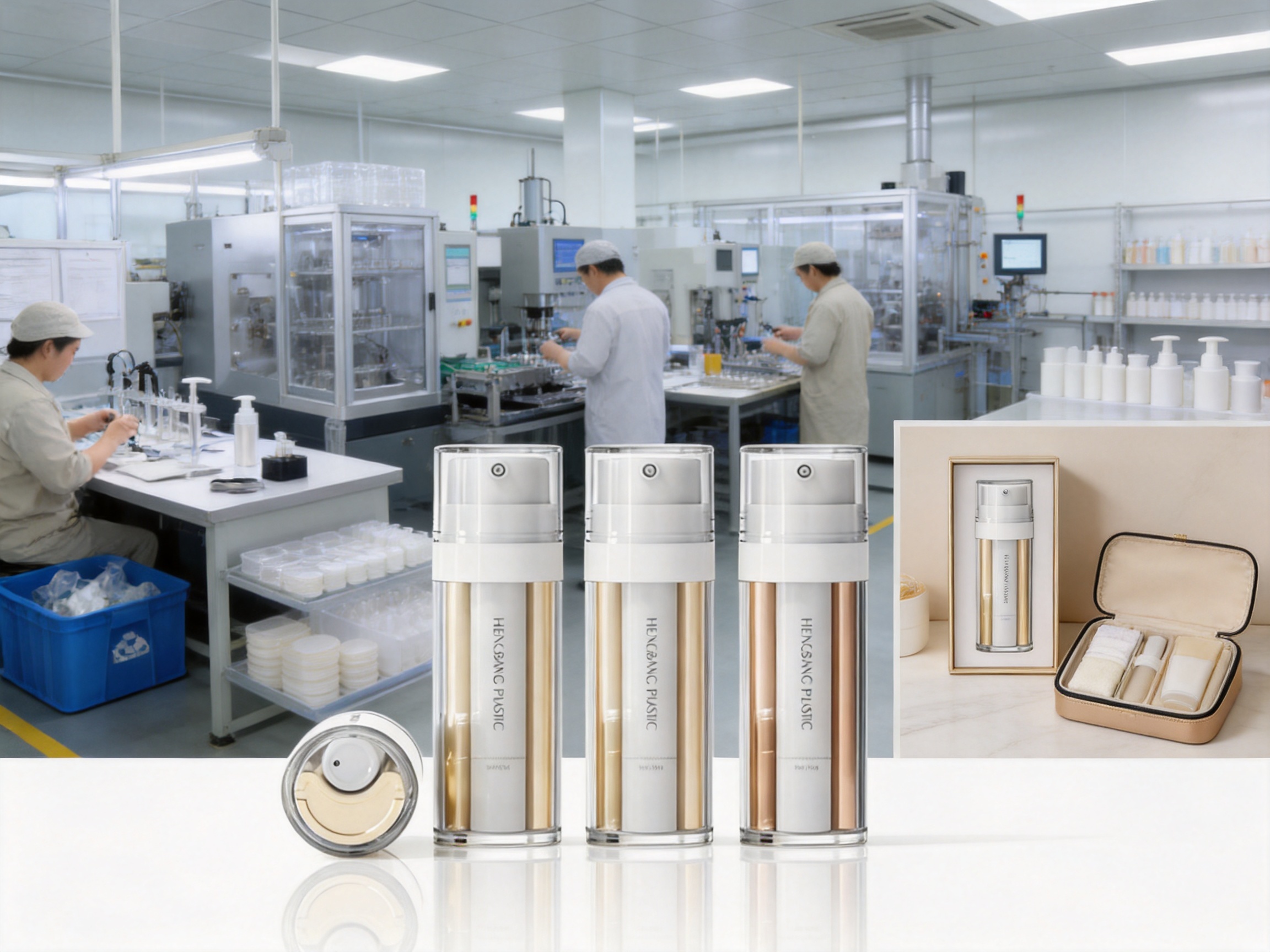
The packaging selected for a cosmetic or skincare product influences far more than its appearance. It affects how consumers understand the formula, how easily they use it, how well the product is protected, and whether the brand is perceived as modern and trustworthy. In an increasingly competitive beauty market, packaging must combine visual appeal, functional performance, convenient dispensing, and dependable manufacturing quality.
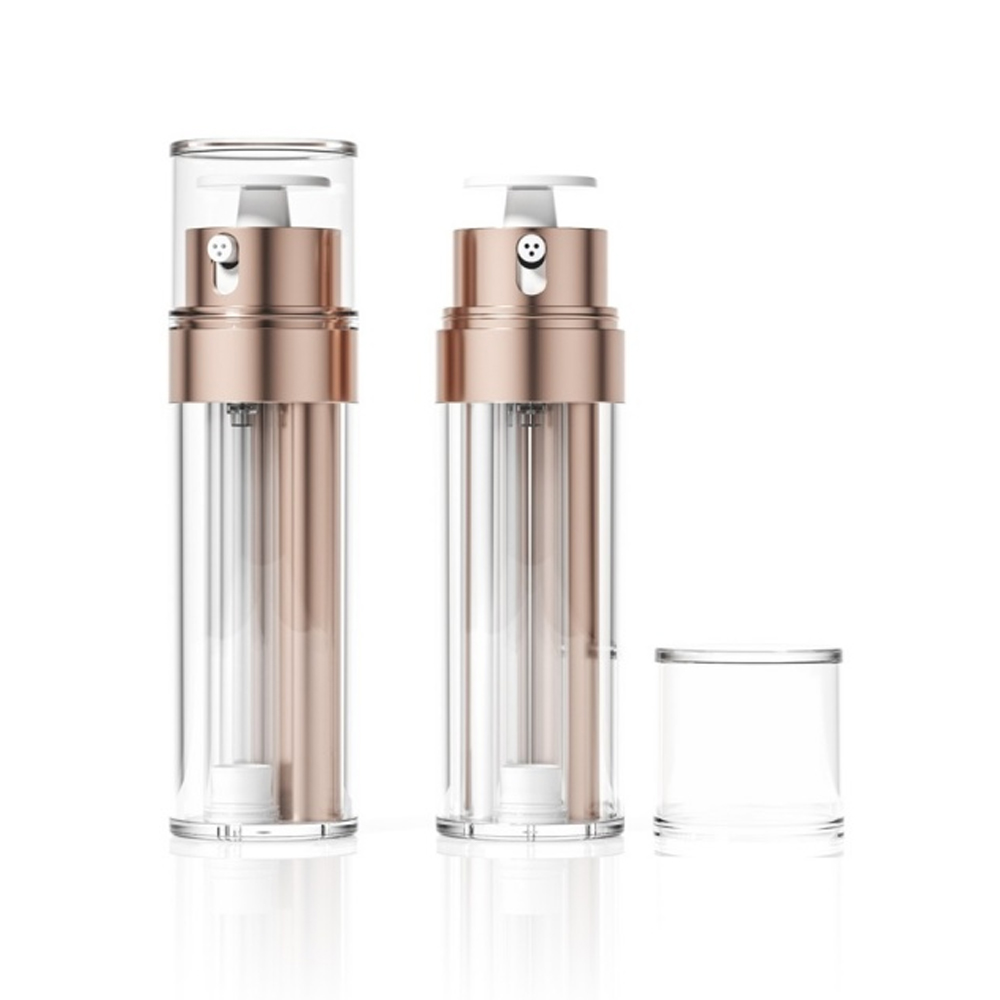
The HB-S003C 7+28ml Cosmetic Double Chamber Lotion Bottle responds to these demands with a distinctive dual-container structure. It combines a cylindrical airless pump tube with a crescent-shaped lotion tube inner bottle, creating a packaging solution that is both visually recognizable and functionally versatile. With a total capacity of 35ml, the package is compact enough for skincare routines, travel, sampling, premium gift sets, and targeted cosmetic applications.
Manufactured by Yuyao Hengbang Plastic Co., Ltd., the bottle reflects the company’s focus on plastic packaging for cosmetics and skincare products. The manufacturer combines product design and development capabilities with established quality and environmental management systems. Its manufacturing background, professional team, production scale, certifications, and accumulated patent portfolio support the development of packaging that serves both brand presentation and practical product requirements.
This article examines the construction, appearance, performance advantages, manufacturing considerations, application potential, and commercial value of the HB-S003C bottle. It also explains why a double-chamber airless format can offer meaningful advantages over conventional single-chamber bottles, ordinary open-neck containers, and less distinctive cosmetic packaging designs.
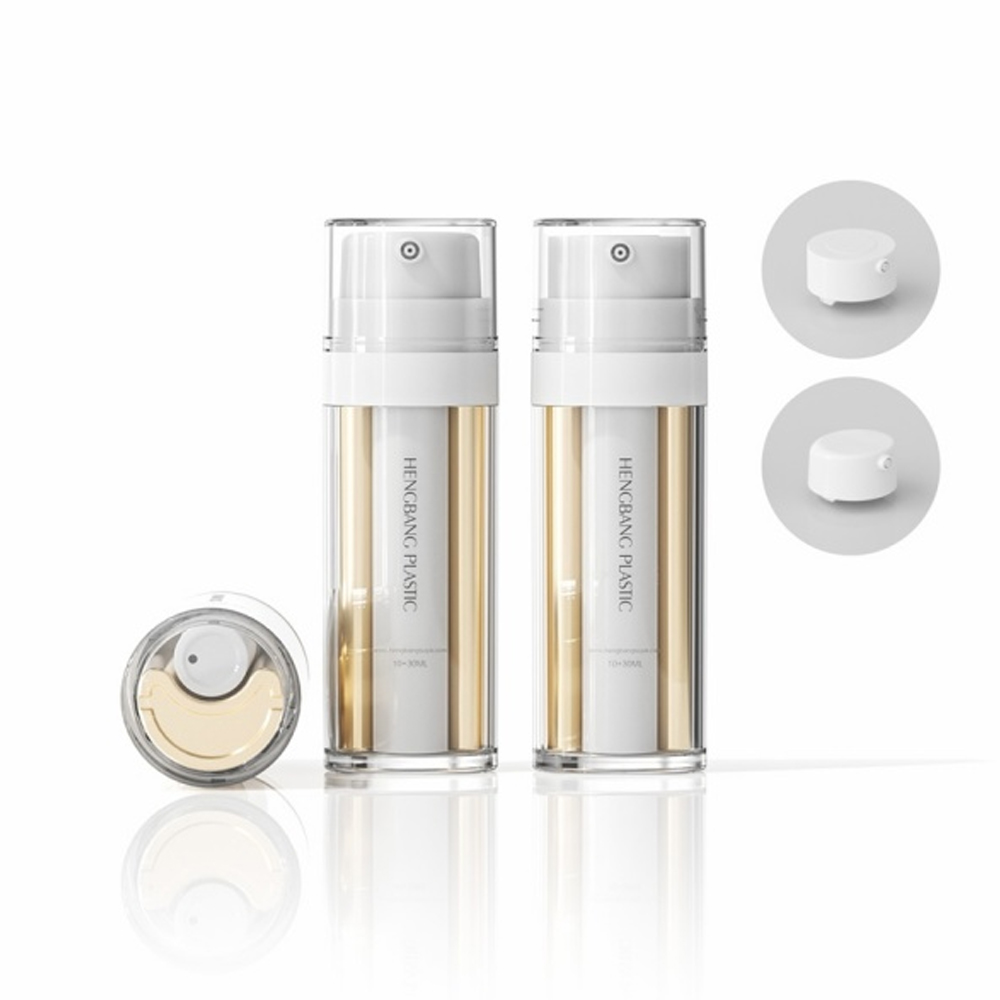
HB-S003C 7+28ml Cosmetic Double Chamber Lotion Botlle
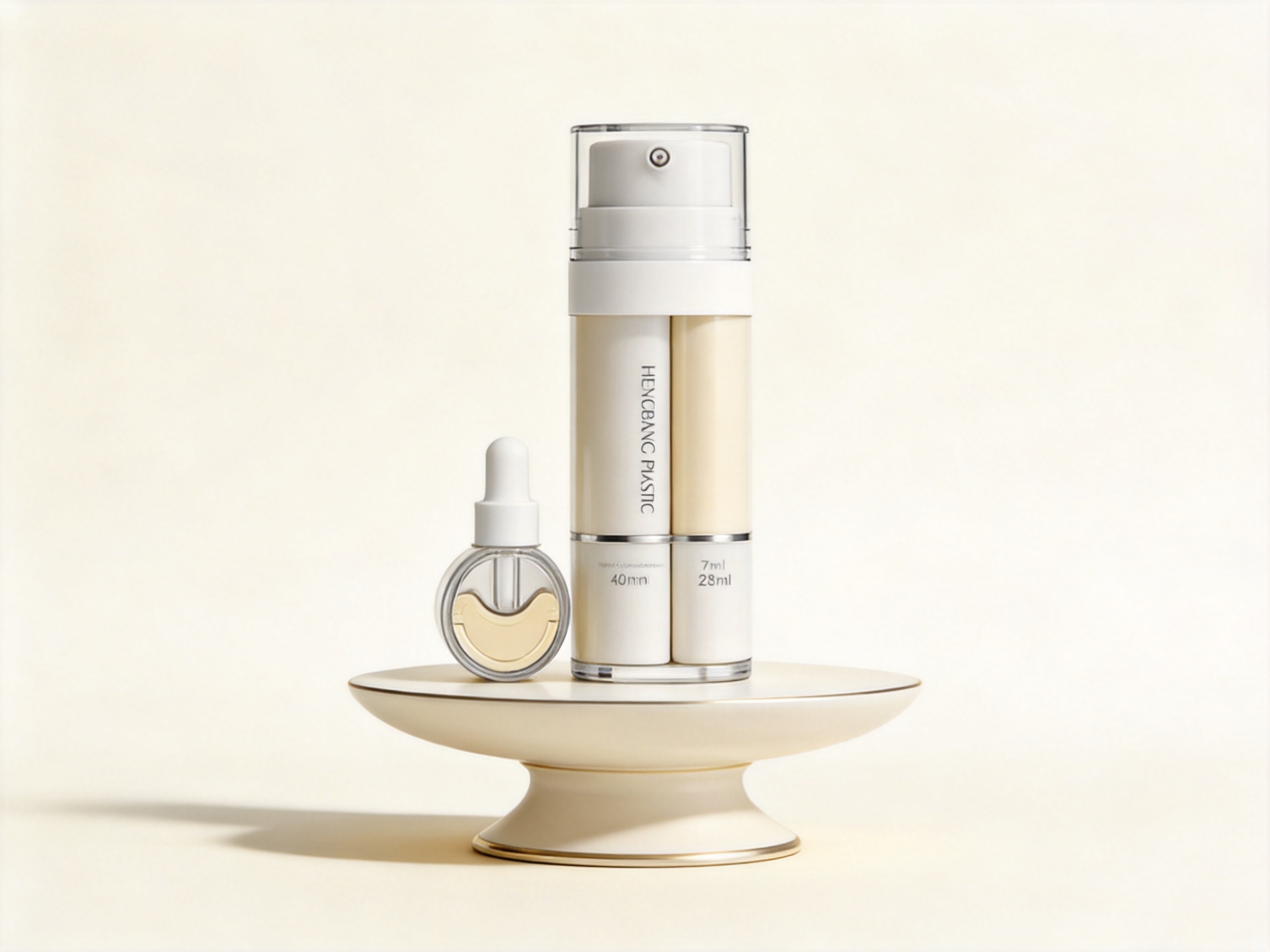
The HB-S003C is categorized as a double-chamber airless bottle. Its stated capacity is 7+28ml, indicating two separate product-holding sections with different volume proportions. The larger 28ml chamber can accommodate the primary lotion, cream, serum, or emulsion, while the smaller 7ml chamber can be used for a complementary formula, concentrated additive, booster, or secondary skincare preparation, depending on the product concept and filling design.
The bottle has a height of 125mm and a diameter of 40mm. These dimensions create a tall, slim cylindrical profile that is easy to display on retail shelves and convenient to hold during use. The 40mm diameter provides a stable footprint without making the container appear bulky. The 125mm height gives the package a refined vertical presence, helping it stand out among shorter jars and conventional cylindrical bottles.
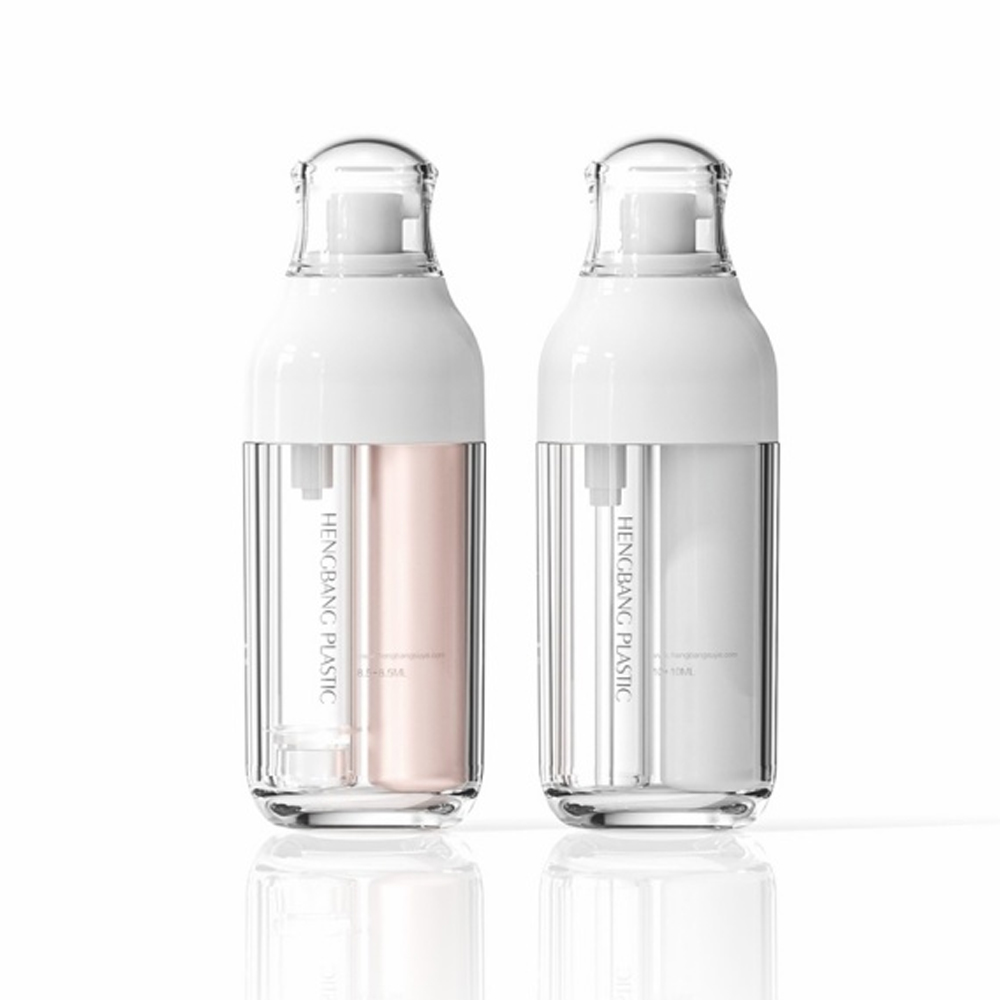
The main visual feature is the combination of a cylindrical airless pump tube and a crescent-shaped lotion tube inner bottle. This arrangement gives the package a sculptural appearance. Rather than presenting a simple round bottle with a standard pump, the design introduces a contrast between the main cylindrical body and the curved internal section. That contrast creates a more premium and contemporary visual identity.
The product title identifies the container as a cosmetic double-chamber lotion bottle, but its potential use is not limited to one specific lotion formula. Similar packaging concepts may be considered for skincare emulsions, facial treatments, moisturizing products, primers, sun care preparations, and other products that benefit from separated storage or differentiated dosing. Final suitability depends on the formula, filling process, compatibility testing, and dispensing requirements.
Product model |
HB-S003C |
Product type |
Double-chamber airless bottle |
Nominal capacity |
7+28ml |
Overall height |
125mm |
Diameter |
40mm |
Application or output specification |
0.07+0.28cc |
Cap material |
MS/PETG |
Pump material |
ABS+PP |
Bottle material |
PETG+PP / MS+PP |
The listed application specification of 0.07+0.28cc describes the stated dispensing or application proportions associated with the two chambers. For a finished cosmetic product, brands should confirm the precise dose, formula viscosity, pump behavior, and filling configuration through technical evaluation before commercial production.
Traditional cosmetic packaging commonly stores one formula in one chamber. This arrangement is suitable for many products, but it can limit the possibilities for formulations that benefit from separation. A double-chamber bottle creates two distinct storage areas within one coordinated package. This allows a brand to design a product around two related components while preserving a unified consumer experience.
The 7+28ml configuration is especially useful when one formula is intended to be used in a smaller quantity alongside a larger primary product. For example, the larger chamber may contain a daily lotion, while the smaller chamber may hold a concentrated treatment, essence, fragrance-free booster, or complementary preparation. The exact application depends on the product development strategy and the interaction between the two formulas.
In some product concepts, separate chambers can help maintain the intended condition of each component until dispensing. This can be important when two formulas have different stability requirements or when the brand wants consumers to combine them only at the point of use. The packaging does not replace formula stability testing, but its separated structure can provide a useful foundation for such product architectures.
A double-chamber format can also create a stronger product story. Consumers often respond positively to packaging that communicates a clear reason for its design. A package with two visible or structurally distinct sections suggests a more advanced skincare system than a basic container. When supported by a well-developed formula and clear instructions, the structure can help explain why the product deserves a premium position.
The airless pump concept adds another functional dimension. Instead of relying on a wide-open jar or a conventional dip tube, an airless system is designed to dispense product through a pump mechanism while reducing direct exposure to the surrounding environment. This can help support clean and controlled application, although actual performance depends on the formula, internal structure, filling quality, and compatibility of all components.
Controlled dispensing is important for lotions, creams, and concentrated skincare formulas. A pump can help users obtain a measured amount without repeatedly inserting fingers into the package. This improves convenience and can make the product feel more hygienic and professional. It also supports consistent daily use, especially when a product is intended to be applied in a defined quantity.
The stated 0.07+0.28cc application specification provides a basis for evaluating the relationship between the two dispensing channels. Brands can use this information during product testing to assess whether the output matches the recommended application method. If the formula or usage instructions require a different dosage, technical teams should verify whether the pump configuration and filling quantity are appropriate.
Two chambers provide greater product design flexibility than a single chamber. They can support paired formulas, two-step skincare concepts, or a primary formula with a smaller complementary component. The separated structure may also help the brand differentiate the product from standard lotion bottles that offer no visual or functional distinction.
However, double-chamber packaging must be considered as part of a complete packaging system. The two formulas may have different viscosities, densities, or chemical characteristics. A suitable project should therefore include compatibility testing, pump performance testing, leakage checks, filling trials, storage tests, and consumer-use simulations. These activities help ensure that the packaging and formula work together throughout the intended shelf life.
Many cosmetic containers are visually similar. Round bottles, simple pump dispensers, tubes, and jars remain common because they are familiar and easy to produce. While these formats can be effective, they may not provide enough differentiation for a premium or innovative skincare launch. The HB-S003C offers a more distinctive structural identity through its combination of cylindrical and crescent-shaped elements.
The crescent-shaped lotion tube inner bottle contributes visual movement to the design. It introduces a curved feature that contrasts with the straight external profile. This detail can make the package more memorable when viewed on a retail shelf, in an online product image, or in a social media presentation. Distinctive geometry can be especially valuable for brands that want packaging to communicate innovation before the consumer reads the label.
The compact vertical silhouette also supports an upscale presentation. A 40mm diameter creates a controlled, slender appearance, while the 125mm height gives the package sufficient presence. Compared with a wide cosmetic jar, the format occupies a different visual category and may be easier to arrange in coordinated product collections.
Because the product is divided into two chambers, it can provide a more sophisticated appearance than a conventional single-reservoir bottle. This visual complexity can support premium skincare positioning, professional cosmetic lines, and products built around multi-step or dual-action claims. The actual marketing claims must remain consistent with the formula and applicable cosmetic regulations, but the packaging itself can help express the concept.
Packaging is often the first physical contact between a shopper and a cosmetic product. A distinctive silhouette can attract attention quickly, particularly when products are displayed among many competing items. The HB-S003C’s combination of a cylindrical outer structure and crescent-shaped internal component gives designers a recognizable foundation for labels, decoration, and color coordination.
The design may also suit brands that prefer a clean, modern appearance. Its geometry does not depend on excessive ornamentation. A restrained color palette, carefully selected surface finish, and clear typography can emphasize the form. Alternatively, metallic effects, transparent elements, soft-touch treatments, or contrasting colors may be considered, subject to material compatibility and decoration feasibility.
For online retail, the unusual structure can create stronger product photography. Images showing the package from the front, side, and top can communicate the two-part concept. A recognizable package may also improve visual consistency across advertisements, product listings, and social media content.
The bottle’s compact dimensions can support convenient handling. It is large enough to provide a meaningful 35ml total capacity but remains smaller than many full-size skincare bottles. This makes it suitable for travel-oriented products, premium trial sizes, promotional kits, hotel amenities, and portable daily-use products.
The pump format can be easier to use than a screw-top jar, especially for consumers who want to avoid touching the product directly. The vertical body can be held in one hand, while the pump can be operated with controlled pressure. Brands should conduct practical user trials to confirm ease of use for the target audience, including users with limited hand strength or different application habits.
Airless packaging is widely considered for skincare products because it is designed to dispense product without relying on the same type of open access found in a traditional jar. The pump structure can help limit direct contact between the product and the outside environment during ordinary use. This may be advantageous for formulas that are sensitive to repeated exposure, although the actual protection level depends on the complete package design and formula requirements.
For brands, the airless format can support a clean and controlled usage experience. Consumers press the pump rather than opening the container and scooping product with their fingers. This can reduce mess around the opening and help maintain a more orderly appearance during daily use.
Airless packaging may also help users access product efficiently over the life of the package. A well-designed airless system is intended to move product toward the dispensing area as the internal mechanism operates. Actual residual product levels, evacuation performance, and end-of-life behavior should be measured during packaging validation rather than assumed solely from the airless classification.
The double-chamber structure adds complexity, so performance evaluation is particularly important. Each chamber should be assessed for sealing, output consistency, formula compatibility, and structural reliability. The dispensing paths should operate as intended, and the package should withstand normal transportation, storage, and consumer handling conditions.
Material compatibility is a central consideration in cosmetic packaging. The HB-S003C specification lists PETG, PP, ABS, and MS across the cap, pump, and bottle components. Different materials contribute different characteristics, including appearance, rigidity, chemical resistance, molding behavior, and decoration potential.
PETG is often selected for its clarity, appearance, and forming characteristics. PP is widely used in packaging components because of its balance of functionality and chemical resistance. ABS can contribute structural strength and a finished appearance in pump components. MS can be used where a particular visual or tactile result is desired. The suitability of each component must be confirmed against the specific formula and processing conditions.
Compatibility testing should consider color change, swelling, cracking, stress deformation, odor transfer, leakage, pump behavior, and changes in formula appearance. Testing may be performed under different temperatures and storage conditions to simulate the intended distribution environment. These steps are essential for protecting both the cosmetic formula and the brand’s reputation.
Yuyao Hengbang Plastic Co., Ltd. was established in 2006 and has developed a substantial manufacturing foundation in plastic packaging for cosmetics and skincare products. The company has a building area of 35,000 square meters and more than 300 employees. This scale provides an organizational base for coordinating product development, production, quality management, and customer service.
The company’s specialization in cosmetic packaging is important because cosmetic containers require more than basic plastic processing. They must meet expectations for appearance, dimensional consistency, smooth operation, formula compatibility, decoration, and delivery reliability. A supplier that focuses on this sector can better understand the relationship between packaging structure and cosmetic product positioning.
Hengbang’s team provides design and development services in addition to manufacturing. This full-range approach can help customers move from an initial packaging idea toward a manufacturable product. Development support is particularly valuable for specialized formats such as double-chamber airless bottles, where the design must balance visual details with internal functionality.
Product development begins with understanding the brand’s intended application. The supplier can evaluate the desired volume, formula type, dispensing method, appearance, dimensions, and market position. For a product such as the HB-S003C, development discussions may include the relationship between the 7ml and 28ml chambers, the required output, filling strategy, closure design, surface finish, and decoration options.
A packaging design must be attractive, but it must also be practical to mold, assemble, fill, transport, and use. Development teams need to consider how each component fits together, how the pump performs, and how the finished package behaves in real conditions. The combination of design and manufacturing experience helps reduce the risk of creating a visually appealing concept that is difficult to commercialize.
Customer collaboration can also support customized brand applications. Although the HB-S003C is presented with defined specifications, brands may require specific colors, printing, surface treatments, labels, or secondary packaging. Any customization should be evaluated for production feasibility, minimum order requirements, lead time, and quality consistency.
Hengbang has passed ISO9001:2015 certification. This standard is associated with quality management systems and structured processes for managing customer requirements, production control, documentation, corrective action, and continual improvement. Certification does not remove the need for product-specific testing, but it indicates that the company has established a formal framework for quality management.
For double-chamber packaging, quality management is especially important because the product contains multiple coordinated components. Dimensional variation in one component can affect the fit or function of another. Pump output must remain within an acceptable range, closures should seat properly, and the package should maintain its integrity during handling and storage.
Quality control may include incoming material checks, molding inspections, component dimensional checks, assembly evaluation, visual inspection, pump testing, leakage testing, and finished-product sampling. The exact control plan depends on the product design and customer requirements. A professional supplier should be able to discuss inspection standards and provide appropriate technical documentation during project development.
The company has also passed ISO14001:2015 certification, which relates to environmental management systems. This demonstrates that environmental considerations have been incorporated into the organization’s management framework. For cosmetic packaging buyers, environmental management is increasingly relevant as brands examine material use, production efficiency, waste reduction, and supplier responsibility.
The HB-S003C is a plastic package, and responsible evaluation should consider its entire life cycle. Important questions include the amount of material used, the feasibility of reducing unnecessary components, the efficiency of production, the compatibility of decoration with recycling systems, and the disposal conditions available in target markets. No packaging format should be described as universally sustainable without considering local recycling infrastructure and the complete material combination.
The use of multiple materials can provide functional and aesthetic benefits, but it can also complicate recycling if components are difficult to separate. Brands should therefore discuss material structures, assembly methods, and end-of-life considerations with the supplier at the beginning of development. Clear consumer communication may also be appropriate where disposal instructions are relevant.
Hengbang owns multiple invention patents and was awarded as a Ningbo High-Tech Enterprise in 2021. These achievements indicate a commitment to technical development and product innovation. They are particularly relevant to packaging formats that require more than conventional bottle structures.
Innovation in cosmetic packaging can involve the shape of the container, the relationship between multiple chambers, the pump system, the assembly process, or the method used to improve consumer convenience. A company with experience in invention and development may be better positioned to address specialized packaging requirements and refine products for commercial use.
Patent ownership does not automatically guarantee that every project will meet a specific brand’s requirements. However, it demonstrates that the company has invested in technical capabilities rather than relying solely on standard packaging products. This can be a valuable consideration for brands seeking differentiated packaging with a strong functional concept.
Producing a double-chamber airless bottle requires coordination between material selection, molding, component preparation, assembly, and quality inspection. The outer bottle, internal chamber, pump, cap, and other components must be manufactured to compatible dimensions. The final product must preserve its visual appearance while delivering reliable dispensing performance.
Plastic component production typically begins with material preparation and molding. The mold must reproduce the intended geometry accurately, including the cylindrical body and crescent-shaped inner structure. Consistent molding is important because uneven walls, warpage, or dimensional variation can influence assembly and appearance.
After molding, components may undergo trimming, inspection, decoration, or additional processing. Surface quality is important for premium cosmetics because small visual defects can be noticeable on a product positioned at a higher price point. Color consistency, gloss level, transparency, and alignment should be managed across production batches.
Assembly brings the separate components together. The pump must be properly connected to the bottle structure, the chambers must remain correctly separated, and the cap should protect the dispensing area. Assembly controls should address both functional and cosmetic requirements. A container can meet dimensional specifications yet still create an unsatisfactory consumer experience if the pump feels inconsistent or the components are visibly misaligned.
Dispensing performance is one of the most important areas for this product. The stated output of 0.07+0.28cc provides a reference for the two application channels. Quality teams can test output over multiple pump actuations to evaluate consistency, initial priming, recovery after storage, and end-of-use behavior.
Testing should also consider formulas with different viscosities. A lightweight lotion may behave differently from a thicker cream or gel. If the two chambers contain formulas with different flow properties, each channel may require separate evaluation. The brand should work with the supplier to determine whether the proposed pump configuration is appropriate for the intended formulations.
Cosmetic packaging must withstand movement through warehouses, distribution centers, retail environments, and consumer bags. Leakage testing can help identify weaknesses in closures, seals, chamber walls, and pump interfaces. Transportation testing may involve vibration, impact, compression, temperature variation, and orientation changes.
The 125mm height and 40mm diameter provide a relatively slender format. A suitable secondary carton or protective packaging system may be useful to reduce the risk of scuffing, impact, or deformation during shipping. Brands should evaluate the complete packaged product rather than testing the bottle alone, particularly when the product is intended for export or e-commerce fulfillment.
Double-chamber filling requires careful coordination because the two formulas must be placed in the correct chambers and quantities. The filling sequence, equipment, viscosity, air management, and sealing process can influence the finished product. Filling trials should confirm that the 7ml and 28ml capacities are used effectively and that the pump can prime correctly after filling.
Brands should provide the supplier with formula information early in the project. Relevant information may include viscosity, density, pH, solvent content, fragrance, active ingredients, temperature sensitivity, and filling temperature. These details help the packaging team evaluate material compatibility and production conditions.
The HB-S003C can support a wide range of cosmetic and skincare concepts. Its most natural application is a lotion or emulsion system, but the double-chamber structure may also be suitable for selected serums, creams, primers, sun care products, and targeted treatments. The final application should always be confirmed through formula and packaging testing.
For daily skincare, the larger chamber can contain the main moisturizing or conditioning product, while the smaller chamber can provide a complementary preparation. This arrangement may appeal to consumers who prefer a coordinated routine in one package rather than carrying two separate containers.
For premium treatment products, the two chambers can help communicate a specialized product architecture. A brand may use the format for a base-and-booster concept, a day-and-night system, or a main treatment paired with a concentrated supplement. Marketing communications must explain how the formulas are intended to be used and should avoid implying performance that has not been substantiated.
For sun care, a double-chamber package may be explored for a sunscreen formula paired with a moisturizing or skin-preparation component. Since sun protection products are subject to specific regulatory requirements in many markets, the package and formula must be evaluated according to the applicable rules. The bottle’s compatibility with the sunscreen formula and its dispensing accuracy should be confirmed before launch.
For promotional programs, the 35ml total capacity can serve as a premium trial or travel size. It offers more substance than a very small sample while remaining compact. A distinctive bottle can increase the perceived value of a discovery set, gift box, or limited-edition collection.
The bottle is well suited to brands that want to position themselves around innovation, modern skincare, professional beauty, or premium convenience. Its geometry can support a clean laboratory-inspired identity, a sophisticated luxury concept, or a contemporary wellness aesthetic.
Brand designers may use the two sections to establish a visual color relationship. The larger chamber and smaller chamber could use coordinated shades, contrasting tones, or transparent and opaque finishes. Labels and printed graphics can emphasize the two-part concept without overwhelming the shape.
The package can also help create a recognizable product family. A brand may use the same general structural language across several products while varying color, labeling, or chamber allocation. Consistency can improve shelf recognition and make the line appear more professionally organized.
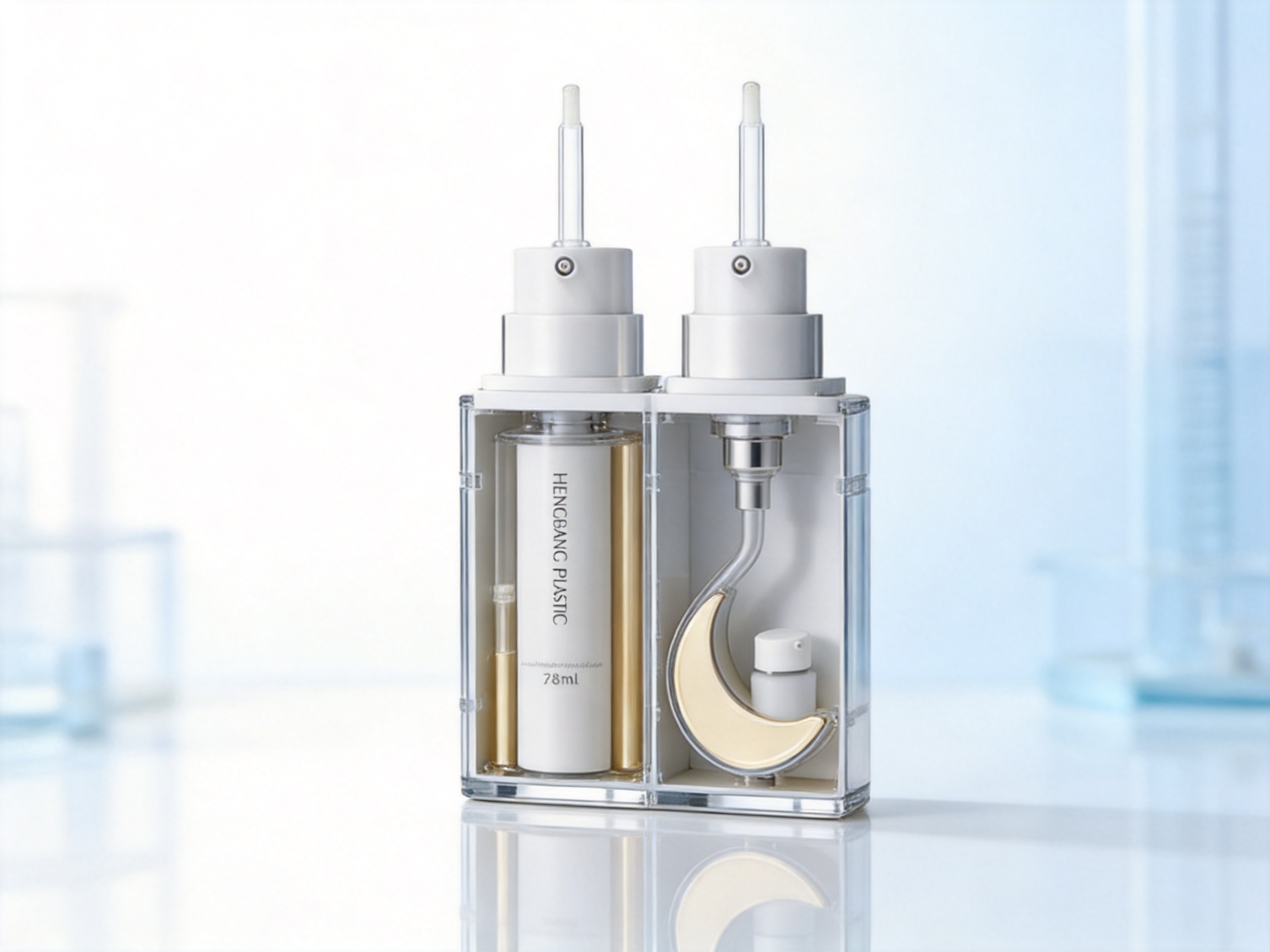
A single-chamber bottle is simpler and may be appropriate for a straightforward formula. However, it does not provide the same built-in separation as a double-chamber design. If a brand wants to offer two complementary formulas, it may otherwise need to place two separate packages in one set. The HB-S003C can present the concept in one coordinated container.
Compared with a cosmetic jar, the pump format can provide a cleaner dispensing experience. Users do not need to remove a wide lid and touch the formula repeatedly. The narrow dispensing area can also create a more controlled presentation at the point of use.
Compared with a basic tube, the bottle can provide a more structured and premium appearance. Tubes are highly practical, but their flexible form may not communicate the same level of sophistication for certain luxury or professional product lines. The HB-S003C’s rigid, architectural form can support a more elevated identity.
Compared with a conventional pump bottle, the double-chamber arrangement provides greater conceptual flexibility. The bottle can accommodate a two-part product story and create a stronger visual point of difference. This distinction can be valuable when competing products are displayed in similar single-reservoir formats.
There are also trade-offs. Double-chamber packaging is more complex than a simple bottle, and the additional structure may require more detailed testing, assembly controls, and filling coordination. The brand must balance the benefits of differentiation and functionality against the requirements of cost, production planning, and end-of-life management.
Before adopting the HB-S003C, a brand should define the intended formula and user experience. Important questions include whether the product needs two separate chambers, whether the formulas will be used together or separately, what output is required, and whether the consumer should activate both channels during one application.
The brand should request samples for physical evaluation. Sample testing can reveal how the bottle feels in the hand, how the pump operates, how the cap fits, how the product looks on a shelf, and whether the dimensions suit the intended secondary packaging.
Formula compatibility should be tested using production-representative materials. Testing only with water or a simple laboratory substitute may not reveal interactions that occur with oils, solvents, fragrances, acids, emulsions, or active ingredients. Long-term and accelerated testing can help identify potential changes over time.
Decoration should be discussed early. The curved and cylindrical surfaces may affect label adhesion, printing alignment, metallic effects, or surface treatments. The brand should establish acceptable standards for color, logo position, surface finish, and inspection under suitable lighting conditions.
Production planning should cover mold availability, sample approval, pilot runs, minimum order quantities, lead times, component sourcing, filling arrangements, and quality documentation. Early communication helps reduce changes after tooling or mass production has begun.
Evaluation area |
Key questions |
Formula compatibility |
Are both formulas stable and compatible with the listed materials? |
Dispensing |
Does the output match the intended 0.07+0.28cc application specification? |
Chamber separation |
Do the two formulas remain in their intended compartments during storage and use? |
Priming |
Does the pump prime reliably after filling and after extended storage? |
Leakage resistance |
Does the package remain sealed during handling, transport, and temperature variation? |
Appearance |
Are color, gloss, transparency, alignment, and decoration consistent? |
User experience |
Can the target consumer hold, open, pump, and apply the product easily? |
End-of-life considerations |
Can the component structure be managed appropriately in the target market? |
A successful cosmetic package depends on more than a product drawing or sample photograph. The supplier must be capable of converting the concept into repeatable production. This requires communication between design, engineering, material management, molding, assembly, quality control, and customer service.
Hengbang’s experience since 2006, its focus on cosmetic and skincare packaging, and its team of more than 300 employees provide a foundation for this type of cooperation. Its 35,000-square-meter building area indicates the scale needed to support multiple activities within a structured manufacturing organization.
The combination of ISO9001:2015 and ISO14001:2015 certifications is also relevant to brands that evaluate suppliers according to quality and environmental management standards. In a competitive packaging market, customers increasingly expect suppliers to demonstrate organized processes rather than relying only on informal inspection or individual expertise.
The company’s design and development services can help bridge the gap between packaging concept and production. This is especially important for advanced formats, where the visual appearance, internal mechanics, and formula requirements must be considered together.
For international buyers, supplier communication is another important factor. Clear technical documents, sample approval procedures, material information, inspection requirements, and production updates can help reduce misunderstandings. A dependable manufacturing partner should be prepared to discuss both opportunities and limitations honestly during development.
The HB-S003C offers several clear advantages. Its double-chamber format supports differentiated product concepts. Its airless pump structure provides a controlled dispensing approach. Its cylindrical and crescent-shaped elements create a distinctive appearance. Its 7+28ml capacity provides a practical balance between a primary formula and a smaller complementary component. Its dimensions support portability and shelf presentation.
The product is also supported by a manufacturer with a long operating history in cosmetic packaging, a significant production base, professional development capabilities, ISO quality and environmental certifications, high-tech enterprise recognition, and multiple invention patents.
At the same time, brands should approach the product with appropriate technical discipline. Double-chamber packaging requires more testing than a simple bottle. The formula must be compatible with the listed materials, the two dispensing channels must perform correctly, and the filling process must be carefully controlled. The package should be evaluated under realistic storage, transport, and consumer-use conditions.
Brands should also consider cost and sustainability in the context of the entire product system. A distinctive package can create commercial value, but the business case should include tooling, decoration, assembly, filling, secondary packaging, freight, and disposal considerations. Open communication with the manufacturer can help identify the most suitable configuration.
The HB-S003C is a 7+28ml cosmetic double-chamber airless lotion bottle. It combines a cylindrical airless pump tube with a crescent-shaped lotion tube inner bottle.
The stated capacity is 7+28ml, giving a combined nominal capacity of 35ml. The two chambers have different volumes and are intended to support a coordinated dual-formula concept.
The bottle is primarily presented for lotions, but it may also be considered for selected creams, serums, skincare treatments, primers, and sun care products. Compatibility depends on the formula, viscosity, ingredients, filling conditions, and regulatory requirements.
It is the stated application or dispensing specification associated with the two chambers. Brands should verify actual output using their intended formulas and confirm that the dosage supports the product’s instructions.
The listed materials are MS/PETG for the cap, ABS+PP for the pump, and PETG+PP or MS+PP for the bottle structure. Final material suitability should be confirmed through formula compatibility testing.
The listed height is 125mm and the diameter is 40mm. These dimensions create a tall, compact format suitable for shelf display, personal skincare routines, travel use, and gift sets.
The double-chamber structure allows two related formulas or product components to be stored in one coordinated package. It can support dual-action, booster, paired-treatment, or multi-step skincare concepts while creating visual differentiation.
Yes, its distinctive geometry, dual-chamber format, and airless pump presentation can support premium positioning. The final premium impression will also depend on decoration, surface finish, formula quality, secondary packaging, and overall brand design.
No packaging format should be treated as a guarantee without testing. An airless design is intended to provide controlled dispensing and reduce certain types of product exposure, but actual protection depends on the complete package, formula, seals, pump, filling process, and storage conditions.
Brands can discuss colors, surface finishes, decoration, labels, printing, and other project requirements with the manufacturer. The feasibility of customization depends on the design, material, production process, order volume, and quality standards.
Recommended evaluations include formula compatibility, dispensing output, priming, leakage, chamber separation, dimensional accuracy, appearance, storage stability, transportation resistance, and consumer-use testing. The exact test plan should be developed according to the formula and target market.
Yuyao Hengbang Plastic Co., Ltd. was established in 2006, has a building area of 35,000 square meters and more than 300 employees, and specializes in plastic packaging for cosmetics and skincare products. The company has passed ISO9001:2015 and ISO14001:2015 certifications, was recognized as a Ningbo High-Tech Enterprise in 2021, and owns multiple invention patents.
The package incorporates plastic materials, so its environmental performance should be assessed according to material quantity, production efficiency, component design, decoration, local recycling systems, and end-of-life handling. ISO14001:2015 certification indicates an environmental management framework at the company level, but product-specific environmental claims require separate evaluation.
The HB-S003C 7+28ml Cosmetic Double Chamber Lotion Bottle is designed for brands that want more than a standard single-chamber container. Its combination of airless dispensing, separated product compartments, compact dimensions, and distinctive cylindrical and crescent-shaped geometry gives it strong potential for modern skincare and cosmetic applications.
The product can help brands create differentiated formulas, premium presentation, and a more controlled consumer experience. Its 7+28ml capacity is suitable for a primary product paired with a smaller complementary component, while its 125mm height and 40mm diameter offer a practical and visually elegant format.
Its value is further supported by the manufacturing capabilities of Yuyao Hengbang Plastic Co., Ltd. The company’s experience in cosmetic packaging, design and development services, 35,000-square-meter building area, workforce of more than 300 employees, ISO9001:2015 and ISO14001:2015 certifications, high-tech enterprise recognition, and invention patents provide a credible foundation for packaging development and production.
For the best results, brands should treat the bottle as part of an integrated packaging and formula system. Proper compatibility testing, filling trials, pump evaluation, leakage testing, transportation assessment, decoration approval, and consumer-use studies are essential. When these steps are completed carefully, the HB-S003C can become a strong packaging platform for differentiated skincare products and premium cosmetic lines.
1. Product specification sheet for HB-S003C 7+28ml Cosmetic Double Chamber Lotion Bottle, including material, capacity, dimensions, and application information.
2. Yuyao Hengbang Plastic Co., Ltd. company profile and manufacturing information.
3. ISO 9001:2015, Quality Management Systems—Requirements.
4. ISO 14001:2015, Environmental Management Systems—Requirements with Guidance for Use.
5. General cosmetic packaging compatibility and stability testing practices for plastic containers, pumps, and airless dispensing systems.
6. General principles of cosmetic product development, filling validation, transport testing, and consumer-use evaluation.


Copyright © Yuyao Hengbang Plastic Co., Ltd.
All Rights Reserved.
 Wholesale Plastic Cosmetic Packaging Manufacturers