English
 中文简体

News
Home > Author > Zhang Yuxin — Plastic Cosmetic Packaging Sales Representative > Blue Plastic Sunscreen Squeeze Bottle: A Practical Packaging Solution for Modern Skincare

 2026.11.07
 Zhang Yuxin — Plastic Cosmetic Packaging Sales Representative
Content
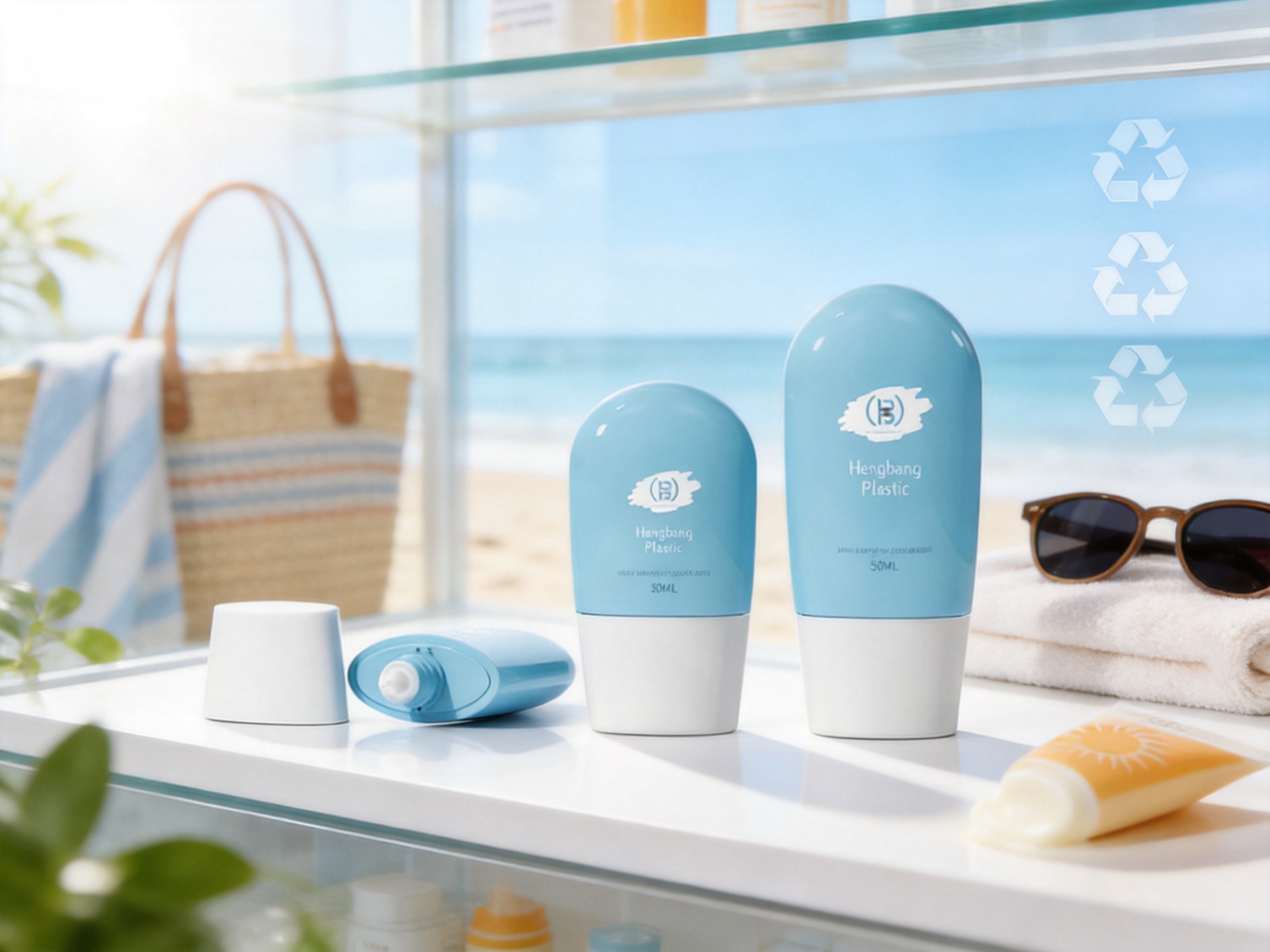
Sunscreen packaging must do more than hold a formula. It must help protect sensitive ingredients, support convenient daily application, withstand repeated handling, and communicate cleanliness and reliability to consumers. The HB-F004 Plastic Blue Sunscreen Squeeze Bottle is designed around these practical requirements. With a soft, squeezable polypropylene-based body, an opaque blue appearance, and compact capacities of 30 ml and 50 ml, it provides a functional packaging option for sunscreen, sun care, lotion, and other personal care products.
The bottle combines a familiar squeeze format with material and design characteristics that are particularly suitable for products used frequently and often carried outside the home. Its blue or opaque body can help reduce direct exposure to ultraviolet light, while its flexible structure enables users to dispense a controlled amount without relying on a pump mechanism. These features make the bottle appropriate for travel sizes, daily-use sunscreen, promotional kits, sample programs, and retail skincare collections.
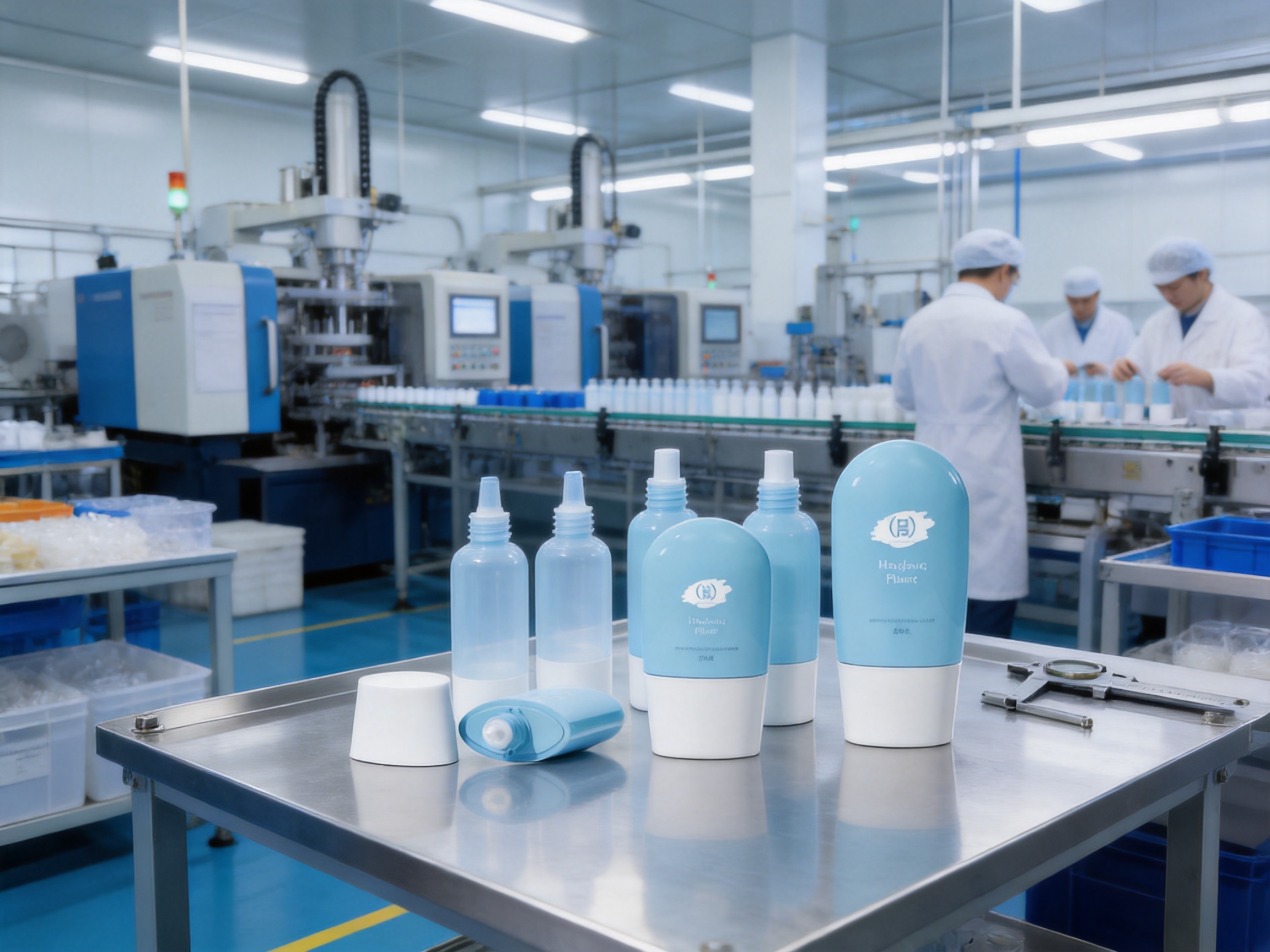
Manufactured by Yuyao Hengbang Plastic Co., Ltd., the product is supported by the experience of a packaging company established in 2006. The manufacturer operates in a 35,000-square-meter facility, employs more than 300 people, and provides design and development services for cosmetic and skincare packaging. Its ISO9001:2015 and ISO14001:2015 certifications, invention patents, and recognition as a Ningbo High-Tech Enterprise demonstrate an established organizational foundation for quality management, environmental management, and technical development.
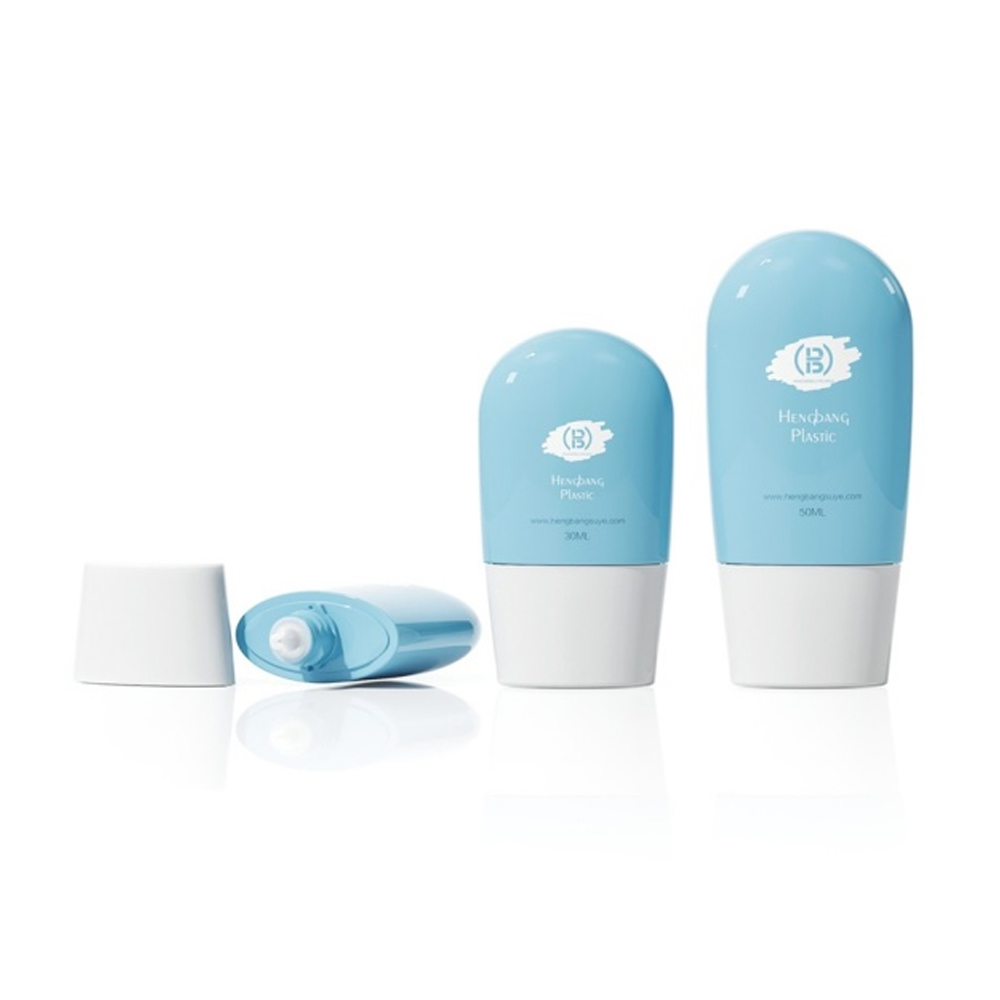
HB-F004 Plastic Blue Sunscreen Squeeze Bottle
Sunscreen is used in a demanding environment. Unlike many cosmetic products that remain in a bathroom or dressing area, sunscreen is frequently carried in handbags, beach bags, sports bags, luggage, and outdoor kits. The packaging may be opened and closed several times a day, exposed to heat, handled with wet or oily hands, and stored in direct or indirect sunlight. A suitable container therefore needs to balance protection, convenience, appearance, durability, and cost.
The package also influences how consumers use the product. If the container is difficult to open, users may apply less sunscreen than recommended. If the opening releases too much product, the result may be waste, mess, or inconsistent dosing. A squeeze bottle offers a direct and intuitive dispensing experience: the user applies moderate pressure to the body, dispenses the desired amount, and releases the pressure. This simple mechanism does not require a complex actuator or a separate airless pump system.
For manufacturers and brand owners, the selection of a sunscreen bottle is also connected with production efficiency. The package must be compatible with filling lines, closing equipment, labeling or decoration processes, secondary packaging, transportation, and storage. It should offer a stable supply format and be available in sizes that match the intended product positioning. The HB-F004 format addresses these considerations with a compact structure, two listed capacity options, and a material combination intended for plastic cosmetic packaging applications.
Many skincare formulas contain ingredients that can be affected by light, heat, oxygen, or moisture. The level of protection required depends on the formulation, but opaque or colored packaging is commonly considered when the product should not be exposed to strong light. The HB-F004 bottle is described as blue and typically opaque, helping limit direct ultraviolet exposure to the sunscreen formula inside.
Packaging color should not be treated as a substitute for formulation testing or stability studies. A brand should evaluate the filled product under appropriate conditions before making a final packaging decision. Nevertheless, an opaque blue appearance can provide a useful first line of visual and physical protection while also creating a recognizable identity for sun care products.
Sunscreen is not normally a one-time-use product. Consumers often reapply it throughout the day, especially during outdoor activities, travel, sports, or extended exposure to sunlight. A squeeze bottle is well suited to this behavior because it can be opened, dispensed, and closed repeatedly without requiring a complicated operating sequence.
The body is described as softer in texture than rigid plastic packaging and easy to squeeze. This flexibility can make dispensing more comfortable, particularly for users who need to apply sunscreen quickly or who are holding the container with one hand. The format is also familiar to consumers, reducing the learning curve associated with a new package design.
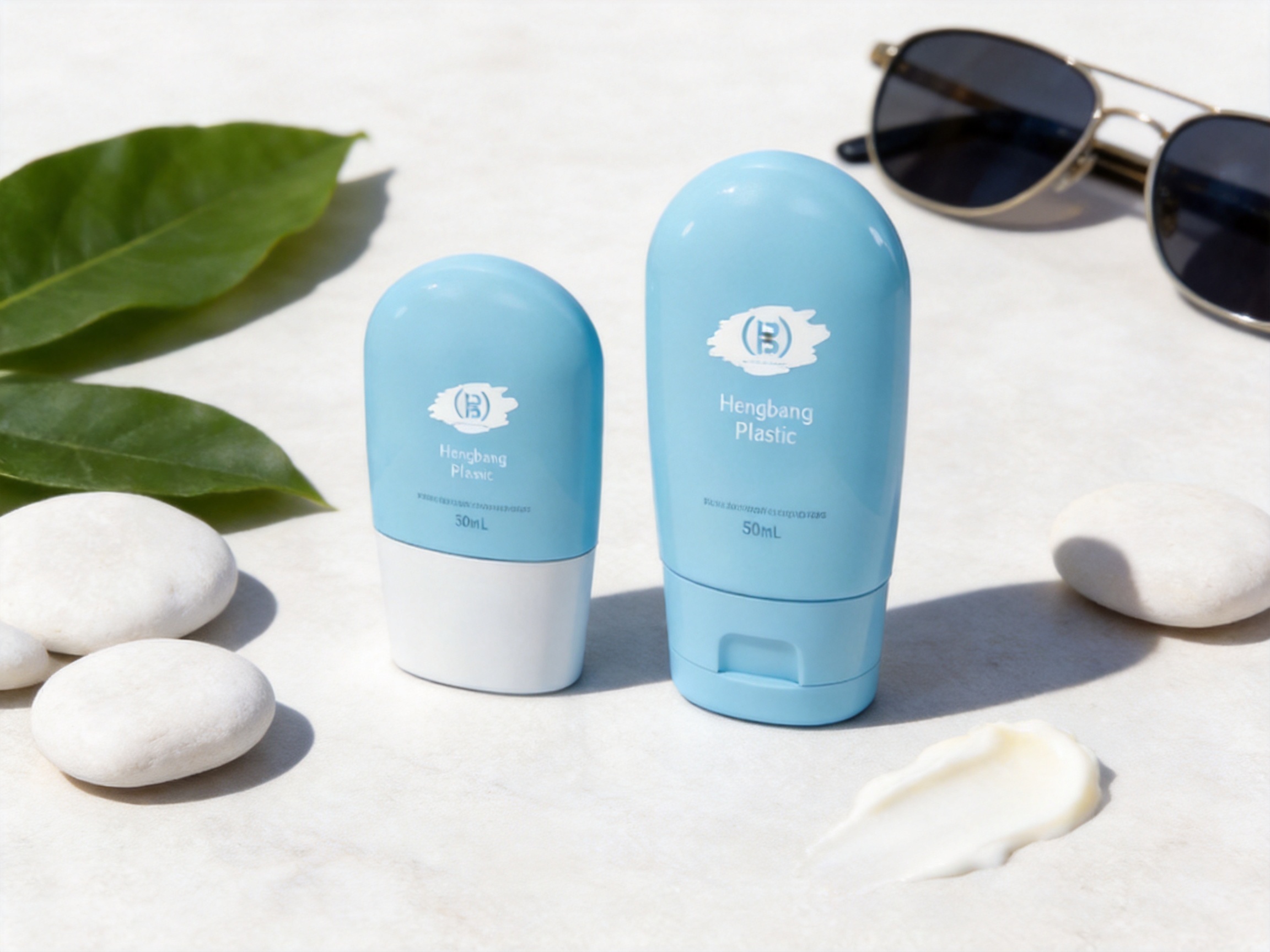
The HB-F004 is a blue plastic sunscreen squeeze bottle intended for cosmetic and skincare packaging. Its primary application is sunscreen, but the same general format can be considered for lotions, body care products, travel skincare, hand creams, cleansing products, and other formulas with compatible viscosity and filling requirements.
| Specification | Provided Information |
|---|---|
| Product model | HB-F004 |
| Product type | Plastic blue sunscreen squeeze bottle |
| Primary material information | PP + SUYLYN + adhesive + PE |
| Available capacities | 30 ml and 50 ml |
| Listed height | 91.2 mm for one capacity; the source also lists 116.2 ml, which should be confirmed as a dimensional value before production |
| Listed diameter information | 53 × 26.5 mm |
| Body characteristics | Soft, flexible, and easy to squeeze |
| Color and appearance | Blue or opaque appearance suitable for sun care packaging |
| Recommended product category | Sunscreen and compatible cosmetic or skincare formulas |
The specification information should be reviewed carefully during the sampling stage. The supplied data lists a height of 91.2 mm and also includes “116.2ml” in the height row. Because milliliters measure volume while millimeters measure length, the second value may represent a height of 116.2 mm or may be a transcription error. Buyers should request a confirmed technical drawing, dimensional sheet, and final tolerance information before approving tooling, artwork, filling-line settings, or mass production.
The listed material structure is PP + SUYLYN + adhesive + PE. Polypropylene, commonly abbreviated as PP, is widely used in cosmetic and personal care packaging because it offers a useful combination of low weight, chemical resistance, processability, and practical durability. The supplied product description also identifies PP as recyclable plastic under recycling symbol number five, although actual recycling outcomes depend on local collection systems, material separation, decoration, and facility capabilities.
The reference to SUYLYN, adhesive, and PE indicates that the finished package may incorporate more than one material layer or component. The exact role of each material should be confirmed with the manufacturer. Depending on the construction, these materials may contribute to flexibility, barrier performance, surface appearance, sealing, or component assembly. A complete material declaration is important for regulatory review, recycling assessment, compatibility testing, and customer sustainability communication.
For brand owners, the most valuable approach is to evaluate the complete packaging system rather than looking only at the main resin. The body, cap, shoulder, seal, decoration, adhesive, and any liner or inner component can all affect product compatibility and end-of-life handling. Hengbang can support this evaluation through technical communication and design-development services, while the final package specification should be approved for the specific formula and market.
The key operating advantage of a squeeze bottle is its direct dispensing mechanism. Instead of pressing a pump repeatedly, the user can apply pressure to the container and release a suitable quantity of product. This is especially practical for sunscreen, where users may need different amounts for the face, arms, legs, neck, or other areas.
The dispensing experience can also be adjusted through the opening size, body flexibility, formula viscosity, and closure design. A thinner lotion may flow easily through a small opening, while a richer cream may require a larger opening or a softer body. These elements should be tested together. The bottle should not be evaluated only when empty or with water, because the actual sunscreen formula may behave differently.
Plastic squeeze bottles are generally lighter than glass containers of comparable capacity. Lower package weight can improve portability for consumers and may reduce handling demands during packing, warehousing, and distribution. A 30 ml format is particularly suitable for handbags, travel sets, airline-style personal care collections, and trial programs. The 50 ml option provides additional product volume while remaining compact enough for routine carrying.
Lightweight packaging can also support efficient secondary packaging. More units may fit into a carton with appropriate protection, and the reduced weight can contribute to a more convenient finished product for consumers. The actual logistics benefit depends on wall thickness, closure selection, decoration, carton design, and transport conditions, so packaging engineers should validate the complete pack rather than assume a fixed result.
The product description emphasizes that the PP bottle body is relatively soft and easy to squeeze. This tactile quality is useful for sunscreen because consumers often apply it outdoors, at the beach, beside a swimming pool, during travel, or after physical activity. A flexible surface can feel more comfortable in the hand than a fully rigid container and may allow the user to extract product even when the remaining quantity is low.
Softness also creates opportunities for differentiated product positioning. A brand may present the bottle as practical, approachable, and easy to use rather than formal or rigid. Combined with a blue appearance, the format can communicate freshness, protection, and outdoor readiness. These impressions are not substitutes for technical performance, but they can contribute to a cohesive consumer experience.
Color is one of the most visible characteristics of cosmetic packaging. The blue surface of HB-F004 is naturally aligned with sunscreen and sun care themes. Blue can suggest clean, cool, refreshing, or protective qualities, while an opaque finish can help reduce the visual impact of the formula and limit direct light exposure.
The appearance can also create a strong base for printing, labeling, or other decoration. Before choosing a decoration method, the brand should assess surface energy, curvature, ink adhesion, rub resistance, and compatibility with sunscreen residue. Packaging that is frequently touched with oily or wet hands needs decoration that can maintain legibility under realistic use conditions.
The 30 ml and 50 ml choices allow product developers to create different selling formats from a related package family. A 30 ml container may be suited to sample-size products, travel retail, gift sets, starter kits, event distribution, or targeted facial sunscreen. The 50 ml size can support a standard portable format for everyday use.
Using related bottle sizes can simplify visual branding and help a company build a coordinated product line. It may also support more efficient artwork development and packaging procurement. However, each size should still be tested for stability, filling speed, label positioning, closure fit, and consumer handling because changes in height or fill volume can affect the package’s behavior.
The HB-F004 should be compared with alternative formats according to the product’s needs, not only by appearance or unit cost. Different packaging systems have different benefits, limitations, and operating requirements.
Rigid plastic bottles provide a firm grip and often offer strong resistance to deformation during storage. They may be suitable for larger volumes or formulas dispensed through pumps. However, they can make it more difficult to remove the final portion of a thick product. A rigid bottle may also take more space if it requires a larger shoulder or pump assembly.
The HB-F004’s squeezable body offers a different user experience. It allows the consumer to apply pressure directly and may help move product toward the opening. Its compact format is well matched with personal carrying and frequent application. For sunscreen brands that prioritize portability and simple dispensing, a squeeze bottle may be more practical than a rigid pump bottle.
Airless packaging is often selected for formulas that require controlled evacuation, reduced air exposure, or a premium dispensing experience. It can offer strong protection in certain applications, but it usually involves a more complex structure, specialized components, and higher technical requirements. The cost, filling process, and recycling considerations may also differ from those of a conventional squeeze bottle.
The HB-F004 is not presented as an airless package. Its advantage is simplicity. A straightforward squeeze structure can be easier for consumers to understand, easier to carry, and potentially more economical for products that do not require an airless dispensing system. Formula compatibility and stability testing should determine whether the simpler package provides adequate protection for the intended product.
Plastic cream jars are useful for thick creams, balms, masks, and products that consumers prefer to scoop. They often provide a wide opening and a substantial visual presence. However, jar use requires the consumer to place fingers or a tool into the product, which may be less convenient for sunscreen used outdoors or repeatedly during the day.
A squeeze bottle offers a more closed dispensing routine. The user can dispense product directly without repeatedly opening a wide container. This may support a cleaner and more portable experience. The narrow format can also fit more easily into pockets, small bags, or travel organizers.
Traditional cosmetic tubes are one of the closest alternatives to a squeeze bottle. Both formats can provide flexible dispensing and compact storage. The differences may involve the body shape, shoulder design, cap type, filling method, artwork area, and visual identity.
The HB-F004 can be considered when a brand wants the practical behavior of a tube-like package while using a specific bottle silhouette and capacity range. Its blue body can create a distinct appearance, and its dimensions may support a stable upright or portable configuration depending on the final design. A direct comparison should include leakage tests, drop tests, squeeze-cycle tests, cap torque, residue retention, and consumer usability.
A packaging product is only as dependable as the manufacturing system that produces it. Consistent dimensions, reliable assembly, clean surfaces, accurate color, and repeatable performance are essential for cosmetic containers. The supplied company information indicates that Yuyao Hengbang Plastic Co., Ltd. has developed an established manufacturing and service foundation for this sector.
The company was established in 2006 and specializes in plastic packaging for cosmetics and skincare products. This long-term focus is relevant because cosmetic packaging requires knowledge of more than general plastic molding. Suppliers must understand appearance standards, surface finish, closure performance, filling compatibility, decoration, and the commercial expectations of beauty and personal care brands.
Experience in a specialized industry can also help shorten communication cycles during development. A supplier familiar with cosmetic packaging is more likely to recognize common concerns such as product seepage, cap fit, color matching, label wrinkling, stress whitening, odor, dimensional variation, and formula-package interaction. These topics should still be confirmed through testing, but an experienced supplier can help identify them earlier.
Hengbang operates a facility with a building area of 35,000 square meters. A manufacturing base of this scale can support organized production areas, tooling management, inspection activities, material storage, assembly, packing, and product development. Facility size alone does not guarantee performance, but it can provide the physical foundation for managing multiple processes and customer programs.
For buyers, the important question is how the facility is organized and how production controls are implemented. A professional evaluation may include review of incoming material inspection, mold maintenance, production records, quality checkpoints, cleanliness procedures, finished-goods inspection, complaint handling, and traceability. These elements help convert manufacturing capacity into reliable supply performance.
The company employs more than 300 people, including a young and professional team. A workforce of this size may support specialized responsibilities across engineering, production, quality control, purchasing, sales, customer service, and product development. For international packaging programs, cross-functional coordination is valuable because a successful product must satisfy technical, visual, commercial, and logistical requirements at the same time.
The company’s stated ability to provide design and development services is particularly relevant to a product such as HB-F004. Customers may require adjustments to color, closure, decoration, dimensions, material structure, or packaging configuration. Development support can help transform a general product concept into a specification suitable for a particular sunscreen formula and market.
Hengbang has passed ISO9001:2015 certification. ISO9001 is associated with quality management systems and a structured approach to processes, customer requirements, documentation, corrective actions, and continual improvement. Certification does not eliminate the need for product-specific inspection, but it indicates that the organization has established a formal framework for managing quality-related activities.
For a cosmetic packaging buyer, this can be useful when evaluating supplier consistency. A quality system may help control raw material purchasing, production instructions, inspection standards, nonconforming products, and corrective actions. The customer should still request relevant quality documents, sample approval procedures, inspection criteria, and batch records for the specific project.
The company has also passed ISO14001:2015 certification. This standard is associated with environmental management systems, including the identification and management of environmental aspects, legal obligations, operational controls, and improvement objectives. For brands seeking more responsible packaging supply chains, an environmental management framework can be an important part of supplier evaluation.
The HB-F004 description also identifies PP as recyclable under recycling symbol number five. Recycling claims should be communicated accurately because real-world recyclability depends on local infrastructure and the complete package design. Buyers should review the material combination, decoration, adhesive content, cap composition, and regional recycling guidance before making consumer-facing claims.
Hengbang was awarded recognition as a Ningbo High-Tech Enterprise in 2021 and owns multiple invention patents. These details suggest an emphasis on technical development and intellectual property. In packaging manufacturing, product innovation can involve container structures, dispensing systems, material combinations, molding approaches, decoration, or production improvements.
Customers should ask which technical capabilities are directly relevant to the HB-F004 program. For example, they may request information about available tooling, dimensional control, color development, assembly processes, material testing, and customized design options. This helps ensure that the supplier’s broader technical strengths are connected to the actual performance requirements of the selected package.
The exact production route for HB-F004 should be confirmed with the manufacturer, but a professional cosmetic packaging development program generally includes several stages. These stages help translate a concept into a stable, repeatable, and commercially suitable package.
The process begins with a review of the intended product, capacity, appearance, dimensions, dispensing behavior, and target market. For sunscreen, the supplier and customer should discuss formula viscosity, fill temperature, filling method, closure requirements, expected shelf life, use environment, and decoration needs.
At this stage, it is important to confirm whether the package will be used for a fluid lotion, a thick cream, a gel, a sprayable liquid, or another texture. A squeeze bottle can support different formulas, but the opening and body flexibility must be matched with the formula’s flow characteristics. An early technical review can reduce the risk of selecting a container that is attractive but difficult to use.
The listed material combination should be verified through a complete material specification. The supplier should identify the grade and role of PP, PE, SUYLYN, adhesive, and any other component. Relevant documentation may include technical data sheets, compliance declarations, colorant information, and applicable regulatory statements.
Material selection should consider chemical compatibility with ultraviolet filters, oils, emollients, alcohols, fragrances, preservatives, and other formulation ingredients. Testing should evaluate swelling, cracking, stress whitening, odor transfer, discoloration, leakage, and changes in dispensing behavior. Testing should be performed with the actual formula or a representative formula under realistic storage conditions.
Plastic packaging quality depends heavily on mold design and maintenance. The mold influences wall thickness, surface appearance, dimensional accuracy, parting lines, gate marks, and overall shape. For a squeezable package, consistent wall distribution is especially important because it affects flexibility and the force required for dispensing.
A professional tooling review should consider shrinkage, draft angles, cooling, ejection, cavity balance, and inspection points. If multiple cavities are used, the manufacturer should monitor whether parts from different cavities remain consistent. Tool maintenance records and preventive maintenance procedures can help reduce variation during long production runs.
The body and other plastic components are formed using a suitable production process selected by the manufacturer. Process parameters may include temperature, pressure, speed, cooling time, and cycle time. The precise method depends on the package structure and the materials involved.
For HB-F004, production control should focus on body flexibility, dimensional accuracy, surface finish, color uniformity, and the absence of defects that could affect sealing or appearance. Typical inspection points may include flash, short shots, sink marks, deformation, contamination, scratches, and inconsistent wall thickness.
If the package includes multiple materials or components, assembly must be controlled carefully. The relationship between the bottle body, opening, cap, liner, adhesive, and any inner layer can affect leakage resistance and user experience. Assembly quality should be assessed through closure-fit checks, torque testing, leak testing, and repeated opening and closing.
A sunscreen package may be exposed to pressure changes during air transportation, heat in vehicles, and movement inside bags. The completed package should therefore be tested as it will be sold, not only as separate components. Inverted storage, horizontal storage, drop testing, and temperature cycling can reveal problems that are not visible during a simple visual inspection.
Blue packaging can be produced in different shades and finishes. The desired color should be defined using an approved physical sample or an agreed color standard. Color variation can occur because of resin batch differences, pigment concentration, processing temperature, lighting conditions, and surface texture.
Decoration quality should include checks for registration, text clarity, adhesion, rub resistance, and coverage. The brand should assess the package after exposure to sunscreen residue, oils, water, sweat, and common handling conditions. If a label is used, the adhesive should be tested on the actual plastic surface and under the intended temperature and humidity range.
Before mass production, the buyer should approve a golden sample that represents the accepted appearance, dimensions, component fit, and dispensing performance. Production samples can then be compared with the approved standard. Inspection criteria should be documented so that the supplier and buyer share the same understanding of acceptable and unacceptable variation.
Useful inspection categories include visual appearance, dimensions, weight, color, cap fit, leakage, squeeze force, opening size, print quality, cleanliness, and packaging quantity. The inspection plan may also define sampling levels, defect classifications, and procedures for handling nonconforming goods.
Choosing a suitable cosmetic container requires more than confirming that the bottle can hold the product. Compatibility testing evaluates whether the formula and package remain stable together during the expected storage and use period.
The sunscreen formula should be filled into production-representative bottles and stored under appropriate conditions. The evaluation may monitor color, odor, viscosity, pH where relevant, active ingredient stability, weight loss, leakage, and package appearance. The bottle should also be checked for deformation, brittleness, swelling, stress cracking, and changes in squeeze behavior.
Different sunscreen formulas may contain oils, silicones, alcohols, powders, emulsifiers, or ultraviolet filters with different interactions with plastic. A package that performs well with one formula may not perform identically with another. Product-specific testing is therefore essential.
Leakage testing should assess both the bottle and the closure system. Samples can be inspected in upright, inverted, and horizontal positions. Pressure, vacuum, heat, and drop conditions may be included according to the product’s distribution and use environment.
The closure must remain secure during transport but should not be excessively difficult for the consumer to open. Cap torque should be controlled within an agreed range. If the package is intended for children, sports use, or travel, the customer may require additional evaluations related to accidental opening and leakage prevention.
Dispensing tests should use the actual sunscreen or a representative formula. The test can measure the force required to begin dispensing, the amount released per squeeze, the consistency of the opening, and the ease of extracting the remaining product. Repeated squeeze cycles can help assess whether the body maintains its flexibility after regular use.
Consumer trials may be useful because technical measurements alone cannot fully capture usability. Test users can comment on grip, opening, dispensing control, mess, portability, and the ability to use the bottle with wet or oily hands. These findings can guide final decisions about body softness, opening size, and closure design.
Sunscreen packaging can experience vibration, compression, drops, and temperature changes during distribution. A suitable test program may include carton compression, vibration, impact, high-temperature storage, low-temperature storage, and temperature cycling. The package should be inspected afterward for cracks, cap loosening, leakage, label damage, and changes in appearance.
Because consumers may leave sunscreen in a hot vehicle or use it at the beach, heat exposure deserves special attention. Actual limits depend on the formula and package, but the brand should define realistic worst-case scenarios. The blue opaque structure can help limit light exposure, but it does not prevent all effects associated with high temperature.
The HB-F004 provides a practical base for a sun care identity. Its blue color can be used as a central visual element or combined with white, silver, green, yellow, coral, or other colors depending on the brand’s positioning. A clean design may communicate dermatological care, while brighter graphics may support an active outdoor or family-oriented product line.
The package can potentially carry product information such as product name, SPF level, broad-spectrum statements where legally permitted, usage directions, warnings, volume, batch information, expiry information, ingredients, manufacturer details, and recycling guidance. The available decoration area and legal requirements should be confirmed through a packaging drawing before artwork is prepared.
For premium products, restrained typography and carefully controlled color matching can create a sophisticated appearance even on a compact package. For mass-market sunscreen, clear communication and high contrast may be more important than elaborate decoration. The flexibility of the squeeze format also supports product lines with multiple variants, such as facial sunscreen, children’s sunscreen, sport sunscreen, moisturizing sunscreen, and after-sun lotion.
Packaging designers should avoid making unsupported protection claims based solely on the blue color or plastic structure. Claims about UV protection, formula preservation, sustainability, recyclability, or environmental benefit should be supported by appropriate technical evidence and comply with the regulations of the destination market.
Packaging sustainability is increasingly evaluated across the full life cycle. Important factors include material quantity, manufacturing energy, transportation weight, product protection, service life, recycled content, recyclability, and end-of-life infrastructure. A lightweight PP-based squeeze bottle may offer useful advantages in material efficiency and portability, but the complete construction must be assessed.
PP is widely recognized by recycling symbol number five. This identification can assist sorting where suitable recycling infrastructure exists. However, a package containing multiple bonded materials may be more difficult to process than a simple single-material package. The role of SUYLYN and adhesive, as well as the composition of the cap and decoration, should therefore be reviewed when assessing recyclability.
Brands should consider whether the package can be simplified without reducing product protection or user experience. They may also examine the potential for reduced wall thickness, optimized cap weight, responsible colorant selection, or compatible recycled material options. Any change must be tested carefully because thinner walls or alternative materials may affect squeeze force, barrier performance, appearance, and leakage resistance.
The company’s ISO14001:2015 environmental management certification provides a relevant foundation for discussing environmental controls with the supplier. Buyers can ask about material waste management, process efficiency, energy use, scrap handling, packaging materials, and improvement programs. Transparent documentation helps ensure that sustainability statements are based on verifiable information.
Cosmetic brands often need more than a container catalog. They need a supplier that can help coordinate design, materials, tooling, manufacturing, decoration, inspection, and delivery. A manufacturer with a focused product range and development capability can provide continuity from the first concept through mass production.
Hengbang’s stated strengths include design and development services, a professional team, a large production facility, quality and environmental certifications, technical recognition, and invention patents. Together, these capabilities can support customers that want to develop customized cosmetic packaging rather than purchase a completely generic package.
Supplier cooperation is particularly important when a product must achieve a specific squeeze feel, color, capacity, or filling performance. Small changes in wall thickness, opening geometry, material grade, or cap fit can produce noticeable differences in consumer use. Early communication with the manufacturer can help clarify what is standard, what is customizable, what requires new tooling, and what must be validated through testing.
A strong supplier relationship also supports future product expansion. Once a brand has approved a package family, related capacities or colors may be developed for additional products. Consistent manufacturing controls can help maintain a recognizable appearance across a product portfolio while allowing each formula to receive the testing it requires.
A practical purchasing workflow begins with a clear product brief. The brief should identify the formula type, target capacity, market, expected annual volume, preferred color, decoration method, closure requirements, filling process, target price, and required delivery schedule. The more complete the brief, the more accurately the manufacturer can recommend a configuration.
The next step is sample review. Buyers should examine the bottle’s appearance, weight, dimensions, squeeze force, opening, cap fit, stability, and compatibility with the intended filling equipment. Samples should be evaluated both empty and filled. If the product will be used outdoors, testing should reflect outdoor handling conditions.
After sample approval, the buyer should request a technical drawing and complete specification. This is especially important for HB-F004 because the supplied information includes a height entry that requires clarification. The final drawing should identify all key dimensions, tolerances, material layers, capacity, neck or opening details, and closure specifications.
Formula compatibility testing should then be performed using production-intent materials and representative filling conditions. Once the package passes the agreed tests, artwork and decoration can be finalized. A decorated approval sample should be retained for production comparison.
Before mass production, both parties should agree on quality standards, inspection methods, packaging configuration, shipment terms, and procedures for handling defects or changes. Change control is important: any alteration to resin grade, pigment, mold, adhesive, cap, decoration, or production location may require renewed approval.
The 30 ml bottle can serve as a travel-friendly facial sunscreen, a sample product, a promotional item, or a component of a skincare gift set. Its compact volume may appeal to consumers who want to carry sunscreen in a small bag or test a new formula before purchasing a larger size.
The 50 ml version can support daily-use sunscreen for face and body, particularly where portability remains important. It can also be used for specialized products such as moisturizing sun lotion, tinted sunscreen, outdoor protective lotion, or after-sun care, provided that the formula is compatible with the bottle materials and dispensing system.
Beauty brands may use the same package family for coordinated seasonal collections. A blue bottle can represent a core sun protection product, while other colors may distinguish moisturizing, sensitive-skin, sport, or children’s variants. The manufacturer should confirm available colors, minimum order quantities, decoration choices, and the effect of customization on lead time.
Before placing an order, buyers should ask for the exact material specification and confirmation of each material’s role. They should request information about food, cosmetic, or applicable market compliance where relevant, as well as any available declarations for colorants, adhesives, and additives.
Buyers should also ask how capacity is measured. Nominal capacity, overflow capacity, and recommended filling volume may not be identical. The usable fill level should be confirmed with the formula and closure to avoid overflow, air entrapment, or insufficient headspace.
Dimensional information should be checked against an approved drawing. The stated diameter of 53 × 26.5 mm may refer to width and depth rather than a circular diameter, so the supplier should clarify the package profile. Height values should likewise be confirmed in millimeters. Accurate dimensions are needed for labels, cartons, filling equipment, and retail shelf planning.
Additional questions may address mold ownership, tooling charges, sample lead time, production lead time, minimum order quantity, color matching, decoration options, inspection standards, shipment packaging, and after-sales support. Clear answers reduce project risk and help establish realistic expectations before production begins.
The HB-F004 is designed primarily as a plastic sunscreen squeeze bottle. It may also be suitable for compatible lotions, creams, gels, and other skincare products, subject to formula compatibility and dispensing tests.
The supplied information lists 30 ml and 50 ml capacities. The final nominal and usable fill volumes should be confirmed with the manufacturer because capacity can vary according to filling level, headspace, and closure configuration.
The material information lists PP + SUYLYN + adhesive + PE. PP is the principal material identified in the product description, but the exact structure and function of the other materials should be confirmed through the supplier’s technical specification.
The blue or opaque appearance can help reduce direct light exposure and creates a visual identity associated with sun care. It should not replace formula stability testing or be treated as an independent guarantee of ultraviolet protection.
The product description states that the PP body is relatively soft and easy to squeeze. Actual squeeze force depends on the body structure, material grade, opening, closure, and filled formula. Buyers should evaluate production samples with the intended sunscreen.
PP is commonly identified by recycling symbol number five. Whether the complete bottle can be recycled depends on local collection systems, the full material construction, decoration, adhesives, cap composition, and recycling facility capabilities. Sustainability claims should be confirmed for the destination market.
Customization may be possible in areas such as color, decoration, dimensions, closure, and material configuration. The available options, minimum quantities, tooling requirements, and lead times should be confirmed directly with the manufacturer.
The supplied specification lists a height of 91.2 mm and also includes “116.2ml” in the height row. Since milliliters measure volume, the second value should be clarified, likely as a dimensional entry in millimeters or as a data transcription issue. The listed 53 × 26.5 mm measurement should also be confirmed as width, depth, or diameter-related dimensions.
The HB-F004 is presented as a squeeze bottle, not an airless bottle. It may be appropriate for formulas that do not require an airless dispensing system. Compatibility, stability, and oxygen-sensitivity requirements should be assessed before final selection.
Yuyao Hengbang Plastic Co., Ltd. is stated to have passed ISO9001:2015 and ISO14001:2015 certifications. The company is also described as a Ningbo High-Tech Enterprise recognized in 2021 and as holding multiple invention patents.
Buyers should request a confirmed technical drawing, complete material declaration, approved color sample, closure and leakage specifications, capacity definition, quality inspection standard, compatibility test plan, production schedule, and decorated golden sample.
The HB-F004 Plastic Blue Sunscreen Squeeze Bottle offers a practical balance of portability, simple dispensing, flexible handling, and sun care-oriented appearance. Its 30 ml and 50 ml capacities address common personal care packaging needs, while the blue or opaque body can support both visual differentiation and reduced direct light exposure. The squeeze format is particularly suitable for products used frequently and carried outside the home.
Compared with rigid bottles, jars, and more complex airless systems, the format emphasizes simplicity, lightweight handling, and direct user control. Its PP-based construction can support a practical combination of flexibility, durability, and processability. The stated material composition should be verified in detail, especially when the product is intended for markets with specific regulatory, recycling, or material disclosure requirements.
The manufacturing foundation behind the product is also significant. Yuyao Hengbang Plastic Co., Ltd. brings experience in cosmetic and skincare packaging, a 35,000-square-meter building area, more than 300 employees, design and development services, ISO9001:2015 and ISO14001:2015 certifications, high-tech enterprise recognition, and multiple invention patents. These strengths provide a useful basis for customers seeking coordinated packaging development and production support.
For the best result, buyers should treat HB-F004 as a starting point for technical collaboration. Formula compatibility, squeeze performance, leakage resistance, dimensional accuracy, decoration durability, and environmental claims should all be validated with production-intent samples. The ambiguous height entry and diameter information should be clarified before artwork, tooling, and filling-line approval. With these steps completed, the bottle can become a dependable and visually coherent package for modern sunscreen and skincare products.
1. Product specification information supplied for HB-F004 Plastic Blue Sunscreen Squeeze Bottle.
2. Company information supplied for Yuyao Hengbang Plastic Co., Ltd., including establishment date, facility area, employee count, certifications, patents, and service capabilities.
3. ISO 9001:2015, Quality Management Systems — Requirements.
4. ISO 14001:2015, Environmental Management Systems — Requirements with Guidance for Use.
5. General technical guidance on plastic packaging material identification and recycling symbol number five for polypropylene.
6. General cosmetic packaging development practices covering compatibility testing, leakage testing, dimensional inspection, decoration evaluation, and transportation simulation.


Copyright © Yuyao Hengbang Plastic Co., Ltd.
All Rights Reserved.
 Wholesale Plastic Cosmetic Packaging Manufacturers