English
 中文简体
中文简体
News
Home > Author > Zhang Yuxin — Plastic Cosmetic Packaging Sales Representative > Blue Plastic Sunscreen Squeeze Bottles: Functional Packaging for Modern Sun Care

 2026.08.23
 Zhang Yuxin — Plastic Cosmetic Packaging Sales Representative
Content
Sunscreen packaging must do more than hold a formula. It needs to protect sensitive ingredients, support convenient daily application, communicate product quality, and remain reliable throughout transportation, storage, and repeated use. The HB-F004 Plastic Blue Sunscreen Squeeze Bottle is designed around these practical requirements. With a soft, squeezable polypropylene body, an opaque blue appearance, and compact capacities of 30 ml and 50 ml, this package is suitable for sunscreen, sun lotion, facial protection products, body care formulas, and other cosmetic preparations that require controlled dispensing.
For cosmetic brands, selecting the right container is an important part of product development. A package influences how consumers experience a product, how effectively the formula is protected, and how efficiently the finished goods can be manufactured and distributed. A well-designed squeeze bottle can help users dispense an appropriate amount without unnecessary contact between their hands and the remaining product. It can also offer a lightweight alternative to glass or rigid plastic packaging while supporting a clean and practical visual identity.
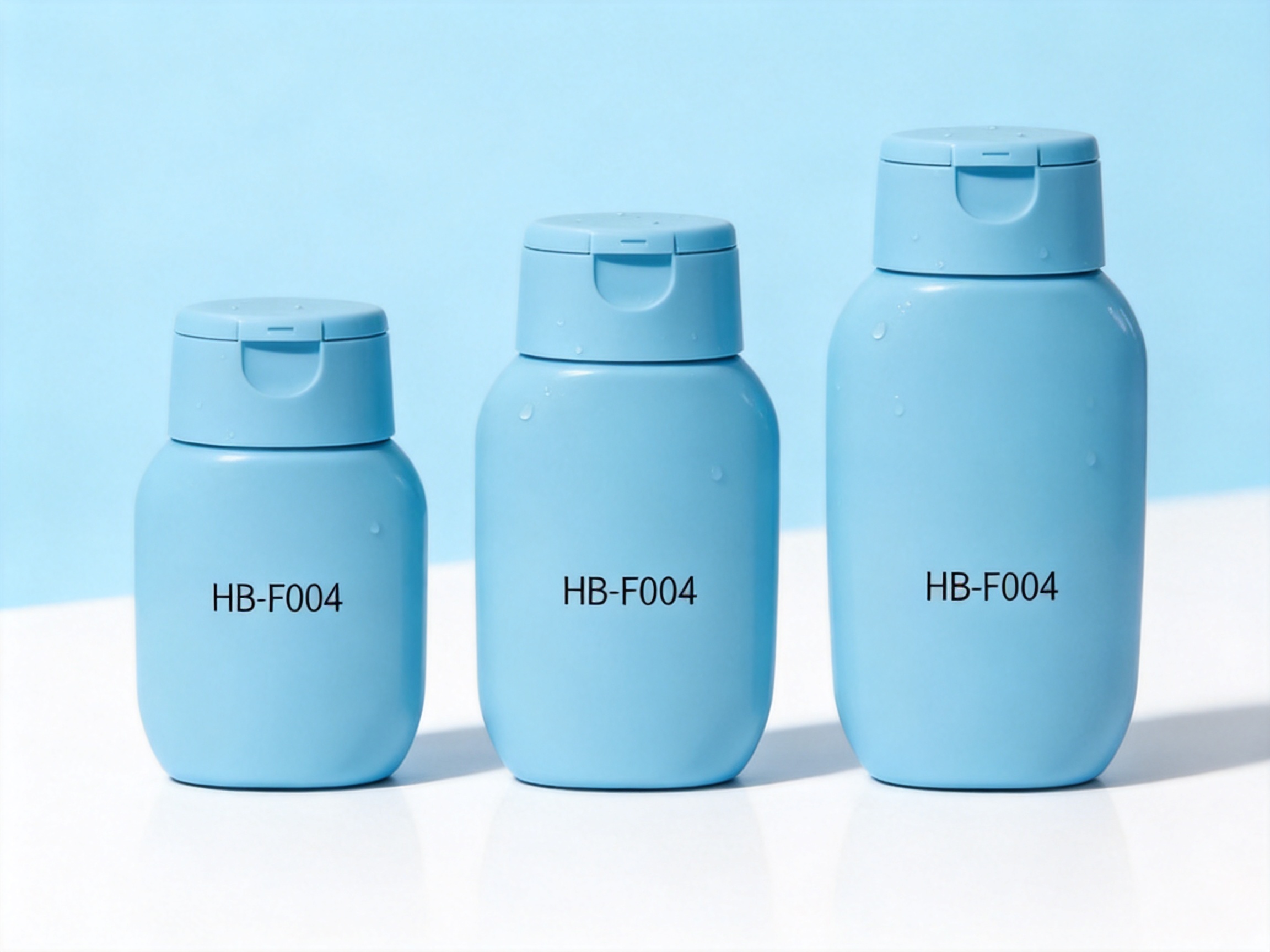
The HB-F004 combines these characteristics in a compact format. Its blue body can help limit direct exposure to light, while the PP-based construction offers a balance of flexibility, durability, and processing efficiency. The bottle is especially appropriate for sunscreen products used frequently during outdoor activities, travel, commuting, sports, and everyday skincare routines.
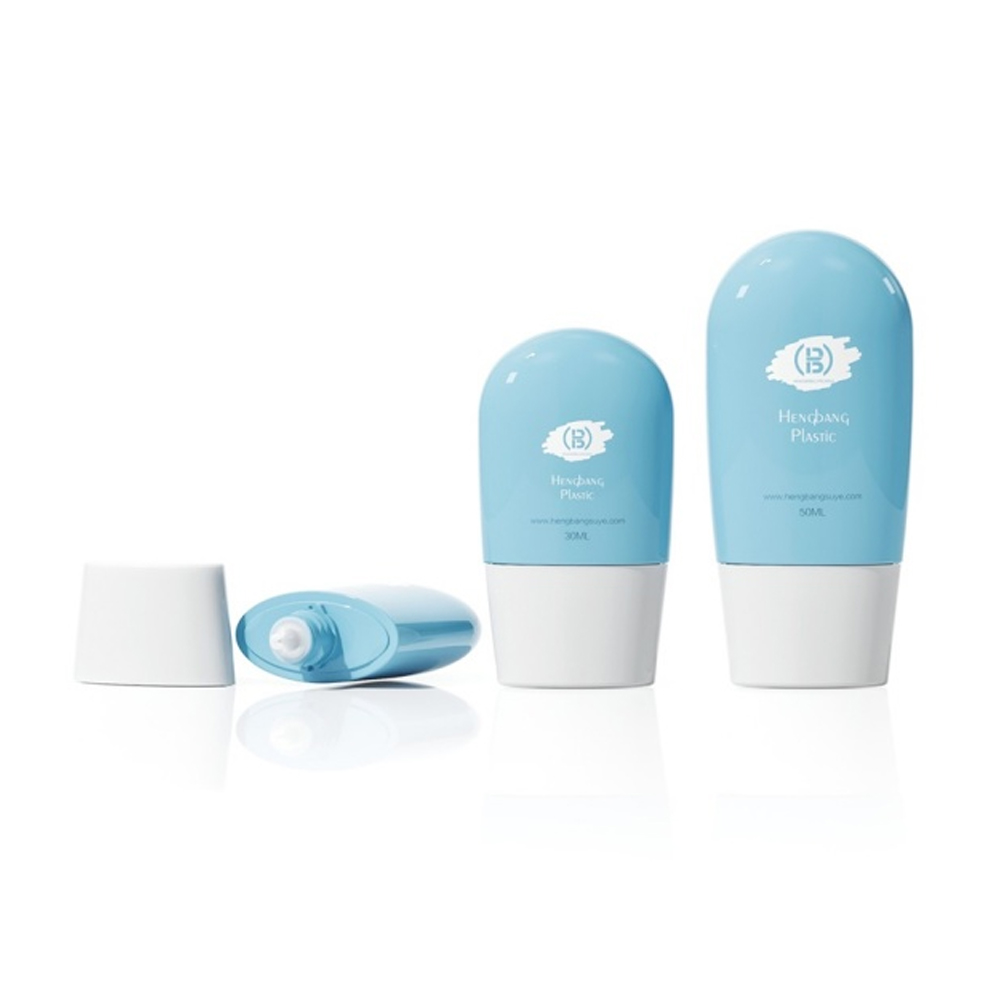
HB-F004 Plastic Blue Sunscreen Squeeze Bottle
The HB-F004 is a plastic blue sunscreen squeeze bottle categorized as a cosmetic sunscreen container. It is developed for products that benefit from a soft bottle body and direct manual dispensing. By applying gentle pressure to the package, the user can encourage the formula to move toward the opening and dispense the desired quantity.
The bottle is available in two listed capacities: 30 ml and 50 ml. The smaller format can be suitable for handbags, travel kits, sample programs, trial sizes, and facial sunscreen products. The larger format can provide additional product for daily use while remaining compact enough for personal care applications.
The appearance is typically blue and opaque or semi-opaque, depending on the final design and material configuration selected for a specific project. Blue packaging is widely associated with freshness, clean beauty, water-based skincare, outdoor protection, and cooling sensory benefits. At the same time, the use of an opaque or strongly colored body may help reduce the amount of light reaching the contents. The level of protection depends on the final color, wall thickness, formulation, closure, and product testing, so brands should validate the complete package and formula combination before commercial launch.
The listed material structure is PP+SUYLYN+ADHESIVE+PE. The exact layer arrangement and processing method should be confirmed with the manufacturer during technical development. In general, a structure incorporating polypropylene, polyethylene, and an adhesive or bonding layer can be selected to combine body strength, flexibility, appearance, and compatibility with the intended product.
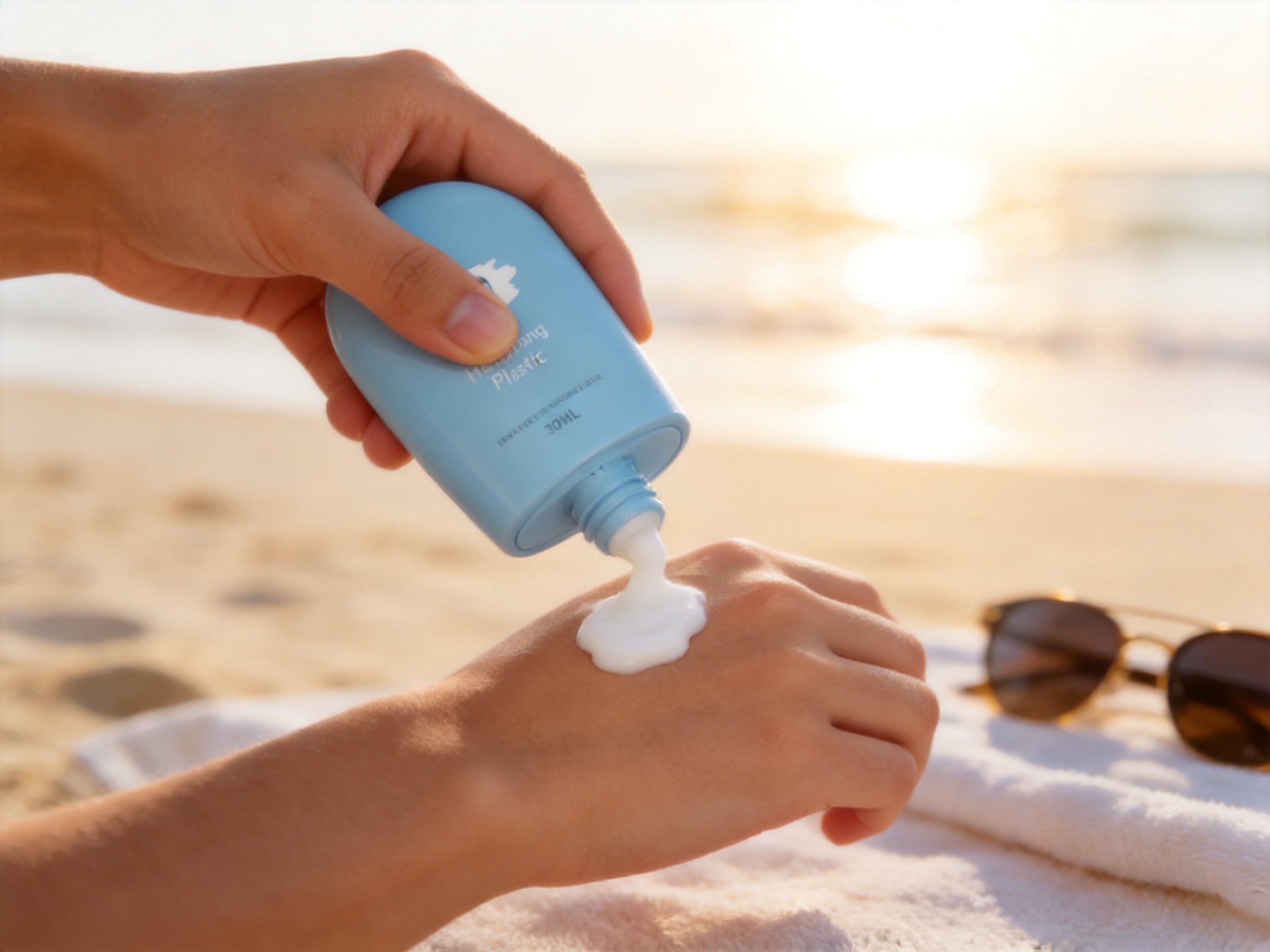
Sunscreen is often applied repeatedly and in relatively precise quantities. Consumers may use it on the face, neck, arms, legs, shoulders, hands, or other exposed areas. A package must therefore be easy to hold, open, dispense, and close. The squeeze format supports these needs with a simple and familiar operating method.
Unlike a wide-mouth jar, a squeeze bottle does not require the user to insert fingers into the container. This can help reduce direct contact with the remaining product and may support a cleaner experience during repeated use. It also allows a brand to create a more controlled dispensing system when the opening and formula viscosity are properly matched.
The soft body is another important benefit. Users can apply pressure without needing a separate pump mechanism. This may be useful for products that are used outdoors, where consumers want a quick application process. A squeeze bottle can also continue to dispense product as the fill level decreases, provided the package geometry and formula rheology are properly designed.
The design is particularly practical for sunscreen lotions, creams, milks, and fluid emulsions. However, dispensing performance depends on viscosity, particle content, surface tension, closure geometry, orifice size, and the interaction between the formula and the inner package surface. Compatibility and usability testing should therefore be conducted with the finished formulation rather than relying only on empty-package evaluation.
Many cosmetic and sun-care formulas contain ingredients that require protection from environmental conditions. Ultraviolet and visible light can influence the stability of some ingredients, colors, fragrances, and emulsions. Although the level of sensitivity differs from one formula to another, package selection is an important part of a product protection strategy.
The blue appearance of the HB-F004 can provide a visual barrier against direct light. When the bottle is manufactured as an opaque or sufficiently light-blocking structure, it may reduce exposure to the contents compared with a clear container. This can be especially valuable for sunscreen formulas containing light-sensitive components or formulas whose appearance needs to remain consistent throughout the intended shelf life.
It is important to distinguish visual color from measured light protection. A blue package may look protective, but the actual barrier performance depends on pigments, opacity, resin composition, wall thickness, and production consistency. Cosmetic brands should perform light transmission studies, stability testing, and accelerated aging tests when a formula is sensitive to light. The bottle should be evaluated as part of the complete packaging system, including the cap and dispensing area.
When correctly specified, a colored plastic bottle can provide a useful combination of appearance and function. It can support a strong sunscreen identity while helping brands develop a package that is visually recognizable on retail shelves and practical in daily use.
Polypropylene, commonly identified as PP, is widely used in cosmetic packaging because it offers a useful balance of chemical resistance, strength, low density, and processing flexibility. The product information identifies PP as a principal material in the bottle structure. PP is also associated with recycling symbol number 5 in applicable material identification systems.
One benefit of PP is its relatively low weight. Compared with many glass containers, a plastic squeeze bottle can reduce packaging weight and simplify handling. Lower weight can help brands manage shipping, warehousing, and retail logistics. It may also make the final product more comfortable for consumers to carry during travel or outdoor activities.
PP can also offer good resistance to many cosmetic ingredients. Nevertheless, compatibility cannot be assumed for every formula. Certain solvents, oils, fragrances, pigments, active ingredients, or preservatives may interact with packaging materials over time. For this reason, compatibility testing should include appearance, odor, weight change, leakage, stress cracking, deformation, and dispensing behavior.
The material is also suitable for high-volume plastic processing. This can support consistent production when the correct resin grade, tooling design, molding conditions, and quality controls are applied. The ability to produce lightweight components efficiently is one reason PP remains common in personal-care packaging.
From a sustainability perspective, the use of a recyclable material can support a brand’s environmental communication, but recyclability depends on local collection systems, package design, labeling, material separation, and consumer behavior. If the final package combines multiple materials or layers, the practical recycling pathway should be assessed in the target market. Responsible sustainability claims should be based on verified package characteristics rather than material selection alone.
The HB-F004 is described as softer to the touch and easy to squeeze. This characteristic is important because the dispensing action should feel controlled rather than difficult or unpredictable. A bottle that is too rigid may require excessive pressure. A bottle that is too soft may collapse easily or dispense more product than intended. The ideal balance depends on wall thickness, resin characteristics, bottle geometry, formula viscosity, and closure design.
A comfortable squeeze action can improve the perceived quality of the sunscreen. Consumers often associate smooth, controlled dispensing with thoughtful product design. The package should return to its intended shape after use, resist permanent deformation, and maintain its appearance throughout normal handling. These factors can be evaluated through repeated squeeze testing and simulated consumer-use studies.
The bottle’s compact shape can also support ergonomic handling. Users may hold it with one hand while opening or closing the cap with the other. A textured, shaped, or appropriately proportioned surface may help improve grip, especially when the package is used near water, during exercise, or outdoors. The final design should be assessed with both dry and moisturized hands.
For brands offering multiple sunscreen products, the same bottle platform can potentially support a family of formulas. For example, a facial sunscreen, children’s sunscreen, body lotion, or after-sun product may use related package architecture while differing in color, decoration, label information, and closure specifications. Any shared platform should still be tested for each formula and fill weight.
The listed capacities are 30 ml and 50 ml. These sizes provide flexibility for different positioning strategies. A 30 ml bottle may be appropriate for premium facial care, portable sunscreen, travel retail, promotional sets, and introductory products. It can fit easily into many cosmetic bags and personal-care kits.
A 50 ml bottle offers a larger fill volume while preserving a compact form. It may be used for daily facial sunscreen, hand and body protection, or products intended to remain portable but provide more applications than a smaller travel format.
Capacity should be considered together with the recommended fill level, headspace, product density, package dimensions, and labeling area. The nominal volume does not necessarily equal the maximum physical volume of the bottle. The final fill specification should allow sufficient space for manufacturing variation, temperature changes, product expansion, and closure assembly.
Brands should also verify the actual usable output of the package. Two containers with the same nominal capacity may deliver different amounts per squeeze depending on the formula and dispensing opening. Testing should measure the number of applications, residual product, dispensing consistency, and the quantity delivered under realistic use conditions.
The supplied information lists a height of 91.2 mm for one configuration and a second figure of 116.2, which appears to be recorded with a unit or formatting inconsistency. The listed diameter information is 53*26.5 mm. Because packaging dimensions are critical for tooling, filling lines, cartons, labels, and shipping cases, these measurements should be confirmed against the manufacturer’s current technical drawing before production.
Dimension verification is a normal and necessary part of packaging development. A final drawing should identify overall height, body width, thickness, shoulder profile, neck finish, opening diameter, cap dimensions, decoration area, and tolerance ranges. If several capacities or closures are available, each version should receive its own approved drawing.
Accurate dimensions help ensure that the bottle fits correctly on filling equipment and packaging lines. They also reduce the risk of label misalignment, cap interference, carton mismatch, and unstable packing. For export orders, brands should review both metric measurements and the tolerances required by their manufacturing partners.
A rigid plastic bottle may provide a firm premium feel, but it can be less comfortable to use when the product becomes difficult to pump or pour. The squeeze format gives consumers direct control over product movement. It may also reduce the need for a mechanical pump, which can simplify the package structure and lower the number of separate components.
Rigid bottles may be advantageous for very fluid products or formulas requiring a pump, but the HB-F004 can be more suitable for creams, lotions, and emulsions that benefit from manual pressure. The correct choice depends on product viscosity, consumer expectations, dosing requirements, and the intended brand position.
Glass can communicate premium quality and provide strong dimensional stability, but it is heavier and more vulnerable to breakage than a plastic squeeze bottle. For sunscreen used at beaches, pools, gyms, hiking locations, or travel destinations, lightweight plastic can offer practical advantages.
A plastic bottle can be easier to transport and less likely to create sharp fragments if dropped. It can also provide a softer hand feel and a more convenient dispensing action. Glass remains valuable for certain cosmetic categories, but it may be less suitable when portability, impact resistance, and repeated outdoor handling are major priorities.
Jars provide a broad opening and can be useful for thick creams. However, they require users to remove a lid and access the product directly. This may increase contact between fingers and the formula. A squeeze bottle can provide a more hygienic-feeling dispensing experience and may reduce exposure to air during routine use, depending on the closure and opening design.
Jars also occupy a wider footprint and may require more secondary packaging to prevent leakage or contamination. The slim, compact profile of a squeeze bottle can support more efficient packing and convenient storage in cosmetic bags.
Single-use sachets can be useful for samples and promotional distribution, but they create a different user experience and may be less convenient for regular use. A 30 ml or 50 ml squeeze bottle can provide multiple applications in a reusable primary package. It can also carry more detailed product information through labels, printing, or secondary cartons.
The product is manufactured by Yuyao Hengbang Plastic Co., Ltd., a Chinese plastic packaging company established in 2006. The company has a building area of approximately 35,000 square meters and more than 300 employees. Its stated specialization is plastic packaging for cosmetics and skincare products, including design and development services.
Experience in cosmetic packaging production is valuable because cosmetic containers must satisfy more than basic dimensional requirements. They need to support appearance consistency, functional performance, product compatibility, decoration quality, filling efficiency, and reliable delivery. A manufacturer familiar with skincare packaging can better understand the relationship between bottle design, formula behavior, closure performance, and brand presentation.
The company’s stated certifications include ISO9001:2015 and ISO14001:2015. ISO 9001 is associated with quality management systems, while ISO 14001 is associated with environmental management systems. Certification alone does not guarantee that every individual package will meet a particular project’s requirements, but an established management framework can support documented procedures, traceability, corrective action, process monitoring, and continual improvement.
The company was also recognized as a Ningbo High-Tech Enterprise in 2021 and reports ownership of multiple invention patents. These details indicate an emphasis on technical development and manufacturing capability. For customers developing custom cosmetic packaging, such resources may be useful when adapting an existing bottle platform, refining dispensing performance, or creating a new package shape.
A professional manufacturing partner should be able to discuss resin selection, mold design, wall thickness, production tolerances, decoration methods, assembly, inspection, packing, and shipping. This technical communication is especially important when the package will be used with active sunscreen formulas or when a brand requires a consistent appearance across multiple sizes.
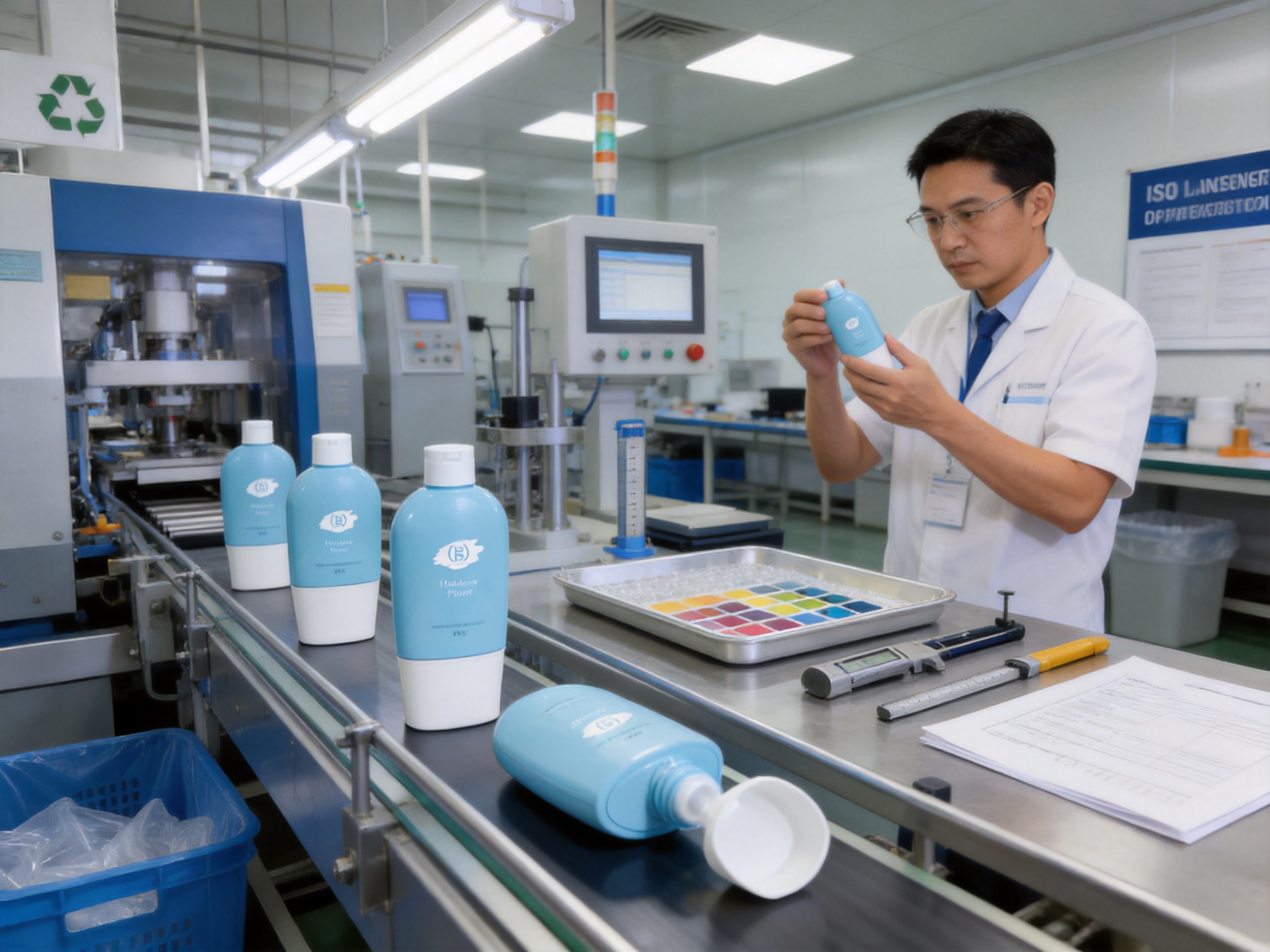
The production of a cosmetic squeeze bottle generally involves several connected stages. These may include product design, engineering review, mold development, raw material preparation, molding, trimming or finishing, component assembly, decoration, inspection, and packing. Each stage can influence the final package.
During design development, engineers evaluate the intended capacity, body shape, squeeze behavior, closure system, label area, and production method. The design should balance visual appeal with manufacturability. Sharp transitions, unnecessarily thin walls, complex undercuts, or difficult-to-release features may increase production risk or tooling cost.
For a squeeze bottle, engineers must consider how the bottle deforms under pressure. The body needs enough flexibility for dispensing but sufficient strength to avoid accidental collapse during filling, packing, and transport. The shoulder and neck area should remain stable so that the closure can seal correctly.
Tooling quality directly influences dimensions, surface finish, parting lines, and repeatability. A well-designed mold can support efficient cycle times and consistent bottle geometry. Tool maintenance is also essential because wear, contamination, or damage can affect flash, wall thickness, sealing surfaces, and visual quality.
Before mass production, sample parts should be evaluated against approved drawings. Mold trials may be used to confirm material flow, cooling, demolding, squeeze performance, and appearance. Any changes to the mold or process should be documented and approved through a controlled development process.
Material control begins with the correct resin and additive specifications. For a blue bottle, color consistency is important. A brand may define an approved color sample, color tolerance, gloss level, opacity, and surface finish. Production teams should monitor these factors so that different batches maintain a consistent visual identity.
Processing conditions can influence shrinkage, warpage, surface appearance, and mechanical performance. Temperature, pressure, cooling time, and cycle settings should be controlled within appropriate operating ranges. Consistent process monitoring helps reduce variation in bottle weight, dimensions, and squeeze response.
The bottle and closure must work together as a complete dispensing system. The closure should attach securely, resist loosening during transport, and maintain an effective seal. Depending on the selected design, the package may use a flip-top, screw cap, disc-top, or another closure style.
Assembly inspections may include cap fit, torque, leakage, opening force, hinge function, orifice condition, and visual alignment. The package should be tested in both upright and inverted orientations when relevant. Transport simulation can help identify problems caused by vibration, compression, temperature variation, or repeated handling.
Quality control should be planned around the risks associated with the product and the customer’s specifications. Typical checks may include material verification, appearance inspection, dimensional measurement, weight measurement, closure testing, leak testing, squeeze testing, and functional dispensing evaluation.
Appearance inspection can identify color variation, black spots, contamination, scratches, sink marks, weld lines, short shots, flash, deformation, and other defects. Not every visual characteristic has the same importance, so brands and manufacturers should agree on acceptable quality limits before production.
Dimensional inspection confirms that the bottle remains within the approved tolerance range. Important measurements may include height, width, neck dimensions, opening dimensions, wall thickness, and cap fit. A stable dimensional process supports reliable filling, labeling, and assembly.
Leak testing is particularly important for sunscreen lotions and creams because leakage can damage labels, cartons, and other products during shipping. Testing may be performed under pressure, vacuum, inversion, thermal cycling, or simulated transport conditions. The chosen test method should reflect the final package design and shipping environment.
Functional testing should evaluate whether consumers can open the closure, squeeze the bottle, dispense the formula, and close the package without excessive effort. Testing should include the beginning, middle, and end of the product life cycle. A package that performs well when full may behave differently after repeated use or when the bottle has been exposed to heat and sunlight.
Packaging cannot be selected independently of the sunscreen formula. The formula may contain oils, emollients, alcohols, fragrances, botanical extracts, UV filters, silicones, pigments, or other ingredients that interact differently with plastic materials and closures.
A compatibility program may include short-term and long-term storage at different temperatures. Samples can be inspected for swelling, softening, embrittlement, discoloration, odor transfer, stress cracking, leakage, label lifting, and changes in dispensing. The formula itself should also be examined for changes in appearance, odor, viscosity, pH, phase separation, and active ingredient stability.
Light exposure testing is useful when the product or color system is sensitive to ultraviolet or visible radiation. The blue bottle may contribute to protection, but the complete package should be tested under the expected storage and use conditions. Stability studies should follow the brand’s quality procedures and applicable regulatory expectations.
Because sunscreen is often carried in hot environments, elevated-temperature testing can be valuable. A vehicle, beach bag, bathroom, or outdoor storage location may expose the package to temperatures higher than standard room conditions. Heat can change formula viscosity, internal pressure, squeeze response, closure sealing, and material behavior.
The blue body provides a strong foundation for a recognizable sunscreen design. Brands may use labels, direct printing, sleeves, embossing, or other decoration methods depending on the selected surface and production requirements. The decoration should remain legible and resistant to moisture, oils, friction, and sunscreen residue.
Important information may include the product name, sun protection factor, broad-spectrum or regional regulatory claims where permitted, directions for use, warnings, net contents, ingredient information, batch identification, manufacturer details, and recycling or disposal information. The available decoration area should be confirmed using the final dimensional drawing.
Color can be used to organize a product range. For example, a brand may assign different shades to facial, children’s, sport, sensitive-skin, or after-sun products. If the same bottle platform is used across a range, consistent proportions can strengthen brand recognition while color and graphics distinguish individual formulas.
The package can also support premium or minimalist positioning. A clean blue body with restrained typography may communicate clinical care or dermatological focus. Bright graphics and high-contrast decoration may be more suitable for family or outdoor products. The bottle shape offers a practical base for different visual strategies without requiring a completely new container for every product.
A compact plastic bottle can be suitable for automated or semi-automated filling operations, subject to the final neck finish and equipment configuration. Before launch, the bottle should be tested on the customer’s filling line or on representative equipment. This helps verify alignment, stability, fill accuracy, closure application, and handling speed.
Lightweight plastic packaging may reduce the total weight of finished goods compared with heavier alternatives. This can support more efficient case packing and simplify manual handling. However, the package must still have sufficient compression strength and protection against deformation during stacking.
Secondary packaging should be designed around the confirmed bottle dimensions. Cartons, trays, dividers, and shipping cases should prevent excessive movement while avoiding unnecessary material. Drop, vibration, compression, and temperature tests can help establish suitable packaging for domestic and international distribution.
The 30 ml and 50 ml formats may support different merchandising and shipping arrangements. Smaller bottles can be included in kits or promotional collections, while larger bottles may be sold as individual daily-use products. A brand can evaluate both options according to market needs, retail positioning, and expected usage frequency.
Environmental performance should be evaluated across the complete package life cycle. The PP material identified for the bottle is commonly associated with recycling code 5, and its relatively low weight may support material efficiency. These are useful considerations, but they should be communicated accurately.
Package sustainability can involve material reduction, recyclability, recycled content, responsible manufacturing, efficient transport, and product longevity. A durable bottle that prevents product loss can also contribute to resource efficiency because the formula itself is not wasted prematurely through leakage or package failure.
Brands should review whether the complete package is mono-material or includes multiple layers and components. The listed structure includes PP, SUYLYN, adhesive, and PE, so the practical recycling pathway may depend on the final construction and local recycling infrastructure. If sustainability is a central marketing claim, the brand should obtain material documentation and conduct an appropriate assessment.
Manufacturing environmental management is another consideration. The stated ISO 14001 certification reflects the company’s environmental management framework. Customers may request further information about energy use, waste reduction, resin management, water use, packaging materials, and factory environmental procedures when these issues are part of their supplier qualification program.
Cosmetic packaging development involves coordination among product developers, designers, regulatory teams, filling facilities, quality departments, and logistics providers. An experienced supplier can help reduce communication gaps by addressing multiple technical questions during the development process.
Yuyao Hengbang Plastic Co., Ltd. states that it provides design and development services in addition to plastic packaging production. This type of support can be valuable when a brand needs to adjust the capacity, modify the body shape, select a closure, develop a color, or adapt the bottle to a specific filling line.
A supplier with dedicated cosmetic packaging experience may also understand common market expectations for appearance, surface quality, leak resistance, and consumer handling. The company’s stated history since 2006, workforce of more than 300 employees, production area, quality certification, environmental certification, and patent activity indicate an established base for supplier evaluation.
Brands should still conduct their own qualification process. This may include factory audits, sample approval, material documentation, production capability review, social compliance assessment, quality agreement negotiation, and verification of relevant certifications. Supplier strengths are most valuable when they are matched with clear project requirements and documented acceptance criteria.
The brand should identify the formula type, target capacity, intended market, closure preference, decoration method, expected annual volume, distribution conditions, and product claims. Sunscreen viscosity and dispensing behavior should be described as early as possible.
Physical samples should be assessed for appearance, hand feel, squeeze force, opening and closing action, stability, and overall suitability. Samples should be filled with a representative formula or a close viscosity substitute before final approval.
All dimensions, tolerances, materials, closure specifications, color standards, decoration areas, and capacity options should be recorded in an approved technical document. The apparent unit inconsistency in the supplied height data should be clarified at this stage.
The formula and package should be stored under normal, elevated, low-temperature, light-exposure, and transportation-related conditions as appropriate. Results should be reviewed for both product quality and package performance.
The bottle should be tested on the intended filling and capping equipment. Filling accuracy, line speed, cap application, label positioning, carton packing, and case stability should be verified before mass production.
The final approval package should include a golden sample, color standard, technical drawing, inspection requirements, packaging instructions, and sampling plan. This documentation helps maintain consistency across future production batches.
The primary application is sunscreen packaging. The bottle can be considered for facial sunscreen, body sunscreen, moisturizing sun lotion, daily UV protection products, sport sunscreen, children’s sun-care products, and travel sunscreen. Final suitability must be confirmed through formula and package testing.
The format may also be suitable for related skincare products such as after-sun lotion, hand cream, body lotion, facial moisturizer, primer with sun protection, or other emulsions that benefit from squeeze dispensing. A brand should not assume that a sunscreen package is automatically suitable for every cosmetic formula. Each product should be checked for chemical compatibility, viscosity, filling behavior, and stability.
The two capacity choices can support different commercial formats. A 30 ml version can be used for portable or premium products, while a 50 ml version may serve as a standard daily-use package. Offering multiple sizes can help a brand address different consumer needs without changing the overall visual language of its product range.
Packaging is one of the first points of contact between a consumer and a skincare product. A blue squeeze bottle can communicate a clear sun-care identity while offering a practical interaction. The consumer can see the package, hold it securely, open the closure, squeeze the body, and apply the product with a familiar motion.
A successful package should feel dependable over time. The cap should not become loose, the bottle should not crack under ordinary handling, and the decoration should remain readable. The squeeze response should remain predictable as the formula level decreases. These details may seem small, but they strongly influence repeat purchase and customer confidence.
The portable format also supports modern routines. Sunscreen is often reapplied away from home, making size and convenience important. A compact container can be carried to work, school, travel destinations, sporting events, and outdoor recreation. Its light weight and soft body may make it easier to handle than a rigid or breakable alternative.
The HB-F004 is a blue plastic sunscreen squeeze bottle designed for cosmetic and skincare products. It has a soft body intended to be compressed manually for controlled dispensing.
The supplied product information lists 30 ml and 50 ml capacity options. The final capacity, fill weight, and usable output should be confirmed according to the selected bottle configuration and formula.
The listed material specification is PP+SUYLYN+ADHESIVE+PE. The exact construction and layer arrangement should be confirmed with the manufacturer through the final technical documentation.
Blue supports a recognizable sunscreen and skincare appearance. When the body is made opaque or sufficiently light-blocking, the colored structure may also help reduce light exposure to the formula. Actual protection should be verified through light transmission and stability testing.
Polypropylene is commonly identified by recycling symbol number 5. Actual recyclability depends on the complete package construction, local collection systems, material separation, and regional recycling capabilities.
It may be suitable for lotions, creams, and emulsions, but dispensing performance depends on viscosity, orifice design, and closure configuration. The final formula should be tested in the bottle before approval.
The supplied information does not specify the final closure type. Cap selection should be confirmed according to the required dispensing behavior, sealing performance, opening force, decoration, and filling process.
The 30 ml format may be appropriate for facial sunscreen, particularly when portability is important. Compatibility, stability, dosing, and regulatory labeling requirements should be verified for the specific product.
Cosmetic packaging projects commonly involve customization of color, decoration, capacity, closure, and surface treatment. Available options, minimum order quantities, tooling requirements, and technical limitations should be discussed with the manufacturer.
The supplied data lists a height of 91.2 mm and another figure of 116.2 with an apparent unit inconsistency, as well as a diameter of 53*26.5 mm. The manufacturer should provide a current technical drawing with complete dimensions and tolerances before tooling, filling-line validation, or mass production.
Testing should include visual inspection, dimensional checks, leak testing, closure testing, squeeze and dispensing evaluation, formula compatibility, light exposure, thermal aging, and transportation simulation. The specific test plan should reflect the formula and distribution conditions.
The manufacturer states that it has passed ISO9001:2015 and ISO14001:2015 certifications. These relate to quality management and environmental management systems, respectively. Customers should request current certification documents during supplier qualification.
The manufacturer is located in Yuyao City, Zhejiang Province, China. Its stated address is No. 7 Zhenbei Road, Mazhu Town, Yuyao City, Zhejiang Province, China.
The HB-F004 Plastic Blue Sunscreen Squeeze Bottle provides a practical packaging solution for brands seeking a lightweight, portable, and easy-to-use container for sunscreen and related skincare formulas. Its 30 ml and 50 ml capacity options offer flexibility for travel, facial care, daily use, promotional programs, and product-line development.
The bottle’s principal advantages include a soft squeezable body, a compact design, a blue appearance suitable for sun-care branding, and a PP-based material structure. Compared with glass, it can offer lower weight and improved impact practicality. Compared with jars, it can support a cleaner dispensing experience. Compared with some rigid bottles, it can provide direct manual control without relying on a pump mechanism.
The package also benefits from the manufacturing background of Yuyao Hengbang Plastic Co., Ltd., which reports experience in cosmetic and skincare packaging, design and development capabilities, a substantial production facility, more than 300 employees, ISO9001:2015 and ISO14001:2015 certifications, high-tech enterprise recognition, and invention patents.
For the best result, brands should treat the bottle and formula as one integrated system. Technical dimensions, material construction, closure details, color standards, filling compatibility, light protection, leakage resistance, and stability performance should all be confirmed before commercial production. When these steps are completed carefully, the HB-F004 can support a dependable sunscreen package that balances user convenience, visual appeal, manufacturing efficiency, and practical product protection.
1. Product information supplied for the HB-F004 Plastic Blue Sunscreen Squeeze Bottle, including material, capacity, dimensions, category, and application details.
2. Company information supplied for Yuyao Hengbang Plastic Co., Ltd., including establishment history, facility size, employee count, certifications, patents, and design-development capabilities.
3. ISO 9001:2015, Quality Management Systems—Requirements.
4. ISO 14001:2015, Environmental Management Systems—Requirements with Guidance for Use.
5. General technical guidance for cosmetic packaging compatibility, stability evaluation, leak testing, and dispensing performance assessment.
6. General material identification guidance for polypropylene and recycling symbol number 5.


Copyright © Yuyao Hengbang Plastic Co., Ltd.
All Rights Reserved.
 Wholesale Plastic Cosmetic Packaging Manufacturers