English
 中文简体

News
Home > Author > Zhang Yuxin — Plastic Cosmetic Packaging Sales Representative > How Triple Chamber Airless Bottles Improve Modern Skincare Packaging

 2026.10.02
 Zhang Yuxin — Plastic Cosmetic Packaging Sales Representative
Content
Modern skincare products are increasingly designed around sophisticated formulas, multi-step routines, and highly targeted active ingredients. As brands develop more advanced serums, creams, anti-aging treatments, whitening products, and other high-value formulations, packaging must do more than simply hold a product. It must help protect the formula, support accurate dispensing, improve the user experience, and communicate technical value.
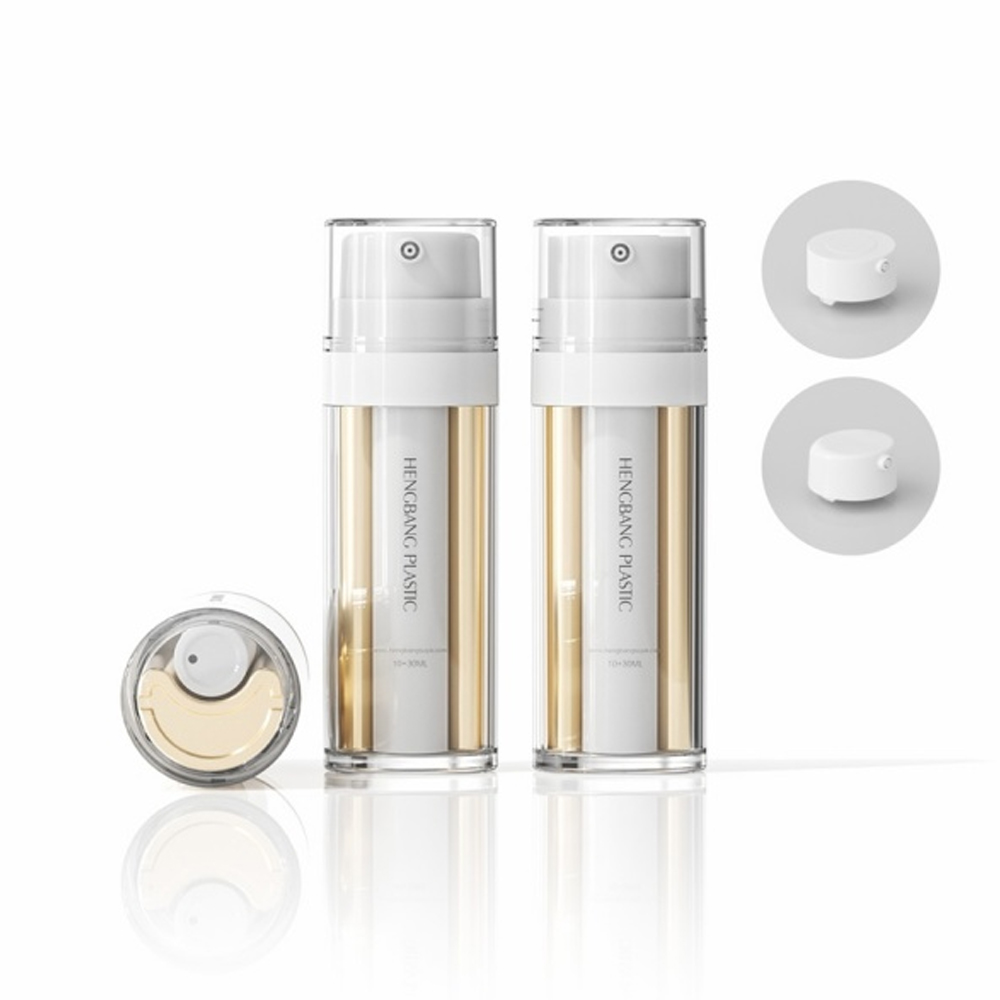
The HB-S007 30ml triple chamber airless bottle is designed for this changing environment. Its structure combines three independent product chambers and three separate outlets in one compact package. With a total capacity of 30ml, arranged as 10ml + 10ml + 10ml, it enables skincare brands to package two or three compatible liquids separately and dispense them through a coordinated system.
This configuration gives the product a meaningful advantage over conventional single-chamber packaging. A traditional bottle or jar generally stores one formula in one container. A dual-chamber design increases flexibility, but the HB-S007 extends that concept further by providing three independent chambers. This allows brands to separate ingredients until the moment of application, create customized combinations, or offer a convenient multi-formula routine within one portable package.
The result is a packaging solution that addresses both functional and commercial requirements. It can help brands differentiate premium products, improve formulation flexibility, and deliver a more convenient experience to consumers. Its airless structure, multi-chamber format, compact capacity, and professional appearance make it suitable for modern skincare collections that emphasize innovation and performance.
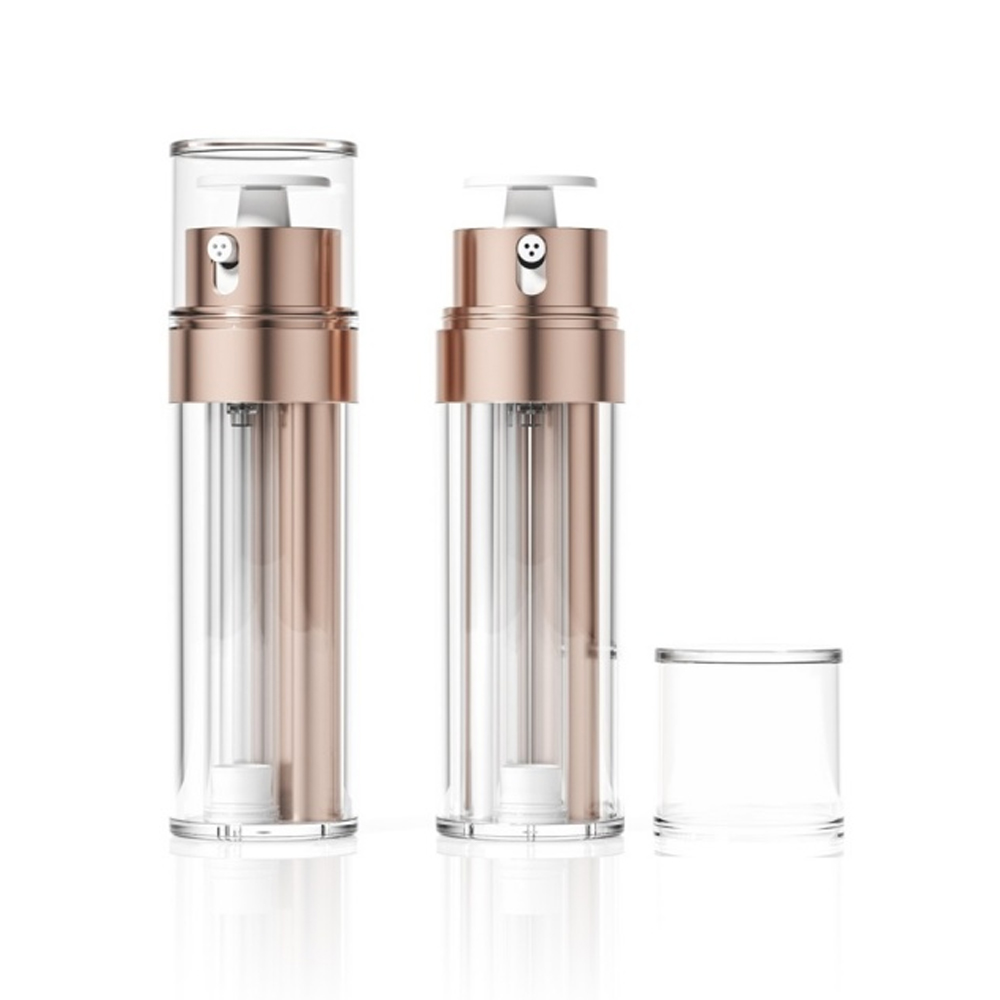
HB-S007 30ml Triple Chamber Airless Bottle
A triple chamber airless bottle is a packaging system containing three separate internal reservoirs. Each reservoir is designed to hold an individual liquid or semi-liquid formulation. Rather than mixing all ingredients together during filling, the formulas remain isolated inside the package. The user can then dispense the selected chambers through the pump system according to the product design.
The HB-S007 uses three independent outlets, creating a functional structure for dispensing two or three liquids. Depending on the formula and product concept, a brand may use all three chambers or develop a combination involving only two chambers. This provides a wider range of packaging strategies than a standard bottle.
Independent storage is particularly valuable for formulations containing ingredients that may be unstable when stored together for long periods. Certain active ingredients, botanical extracts, vitamins, oils, or specialized treatment components may have different stability requirements. By separating them into individual chambers, the packaging can support a formulation concept in which ingredients are combined closer to the time of application.
The design also supports customization. One chamber may contain a serum, another may contain a moisturizing base, and the third may contain a concentrated booster. The user may dispense the three components together or use them according to the recommended skincare routine. This creates a product experience that is more interactive and more distinctive than using a single pre-mixed formula.
For cosmetic brands, this structure can simplify the development of product families. The same basic package may support multiple combinations, such as serum plus cream, anti-aging concentrate plus lotion, or brightening essence plus hydration treatment. The packaging therefore becomes a platform for innovation rather than a passive container.
The HB-S007 has a total nominal capacity of 30ml, divided into three 10ml chambers. This arrangement gives each formula a clearly defined space while maintaining a compact external profile. The 10ml + 10ml + 10ml format is suitable for concentrated skincare products, trial-size premium collections, treatment kits, and targeted daily-use formulas.
The bottle has a height of 158mm and a diameter of 44mm. These dimensions provide enough internal volume for three separate chambers while preserving a practical shape for retail display, transportation, and hand-held use. The cylindrical format can fit naturally into skincare packaging lines and can be adapted to a variety of branding treatments, including labeling, printing, decorative finishes, and customized color schemes, subject to project requirements.
The listed material structure includes MS and PETG with ABS for the bottle components, while the cap and pump system use ABS and PP. These materials are widely used in cosmetic packaging because they offer a balance of appearance, structural performance, processability, and design flexibility.
| Specification | Details | Packaging Significance |
|---|---|---|
| Product model | HB-S007 | Identifies the triple chamber airless bottle design |
| Total capacity | 30ml | Suitable for concentrated and premium skincare products |
| Chamber capacity | 10ml + 10ml + 10ml | Allows three formulas to remain separately stored |
| Height | 158mm | Provides a tall, compact presentation for retail packaging |
| Diameter | 44mm | Supports comfortable handling and stable placement |
| Application rate | 0.24cc / 0.36cc | Offers dispensing options for different dosage requirements |
| Cap material | MS | Supports a refined exterior appearance |
| Pump material | ABS + PP | Combines rigidity, processability, and functional suitability |
| Bottle material | MS + PETG + ABS | Supports multi-component construction and visual customization |
The two listed application rates, 0.24cc and 0.36cc, provide flexibility for product developers. The appropriate dosage depends on the formula viscosity, recommended amount, outlet configuration, and intended user experience. A smaller output may be suitable for concentrated serums or precision treatments, while a higher output may be appropriate for creams, lotions, or products designed to dispense a larger combined amount.
The most direct advantage of the HB-S007 is its ability to contain three separate formulas in one package. With a single-chamber bottle, a brand must either pre-mix all ingredients or use several separate packages. Both options may create limitations. Pre-mixing can affect formulation stability or reduce the opportunity for customized use, while multiple packages can increase product complexity and reduce convenience.
The triple chamber system offers a middle path. It keeps the formulations separate while presenting them as one coordinated skincare product. The consumer receives the benefits of multiple formulas without needing to carry three unrelated bottles.
Formula separation can be important when ingredients have different stability profiles or when the product concept is based on fresh combination. Keeping components independent may help brands develop more specialized product architectures. It can also create a stronger marketing story around active ingredients, customization, and application technology.
Packaging cannot replace proper formulation testing, compatibility assessment, or stability validation. However, a multi-chamber airless package can give cosmetic formulators an additional tool when designing products with separate components. This can be especially useful for premium serums, anti-aging treatments, brightening systems, and other products in which the relationship between ingredients and storage conditions is commercially important.
Consumers increasingly expect skincare products to fit individual preferences and routines. Some users may want a richer combination, while others may prefer a lighter application. Some may use a concentrated active component only at night, while using a moisturizing or soothing component during the day.
A triple chamber format can support these different usage patterns. Brands can provide instructions for combining all three outputs, using two components together, or selecting a particular chamber for a specific step. This makes the package suitable for personalized skincare concepts and premium treatment systems.
Using separate bottles for separate formulas can create practical problems. The consumer must purchase, store, open, and carry several packages. The order of application may also become confusing. A single integrated bottle reduces the number of individual items in the routine.
The HB-S007 combines three chambers within a 44mm diameter body. This compact arrangement is convenient for bathroom storage, travel kits, cosmetic bags, and retail displays. It also gives brands the ability to present a coordinated product system without requiring a large box containing multiple primary containers.
Packaging innovation is an important way for a skincare brand to stand out in a crowded market. A triple chamber bottle immediately communicates a different product architecture. Its vertical form and advanced dispensing concept can attract attention from consumers who are looking for novel beauty technology.
The design is especially appropriate for products positioned as professional, high-performance, customized, or next-generation. When combined with appropriate decoration, color coding, and clear usage instructions, the bottle can help a product communicate technical value before the consumer even reads the full formulation story.
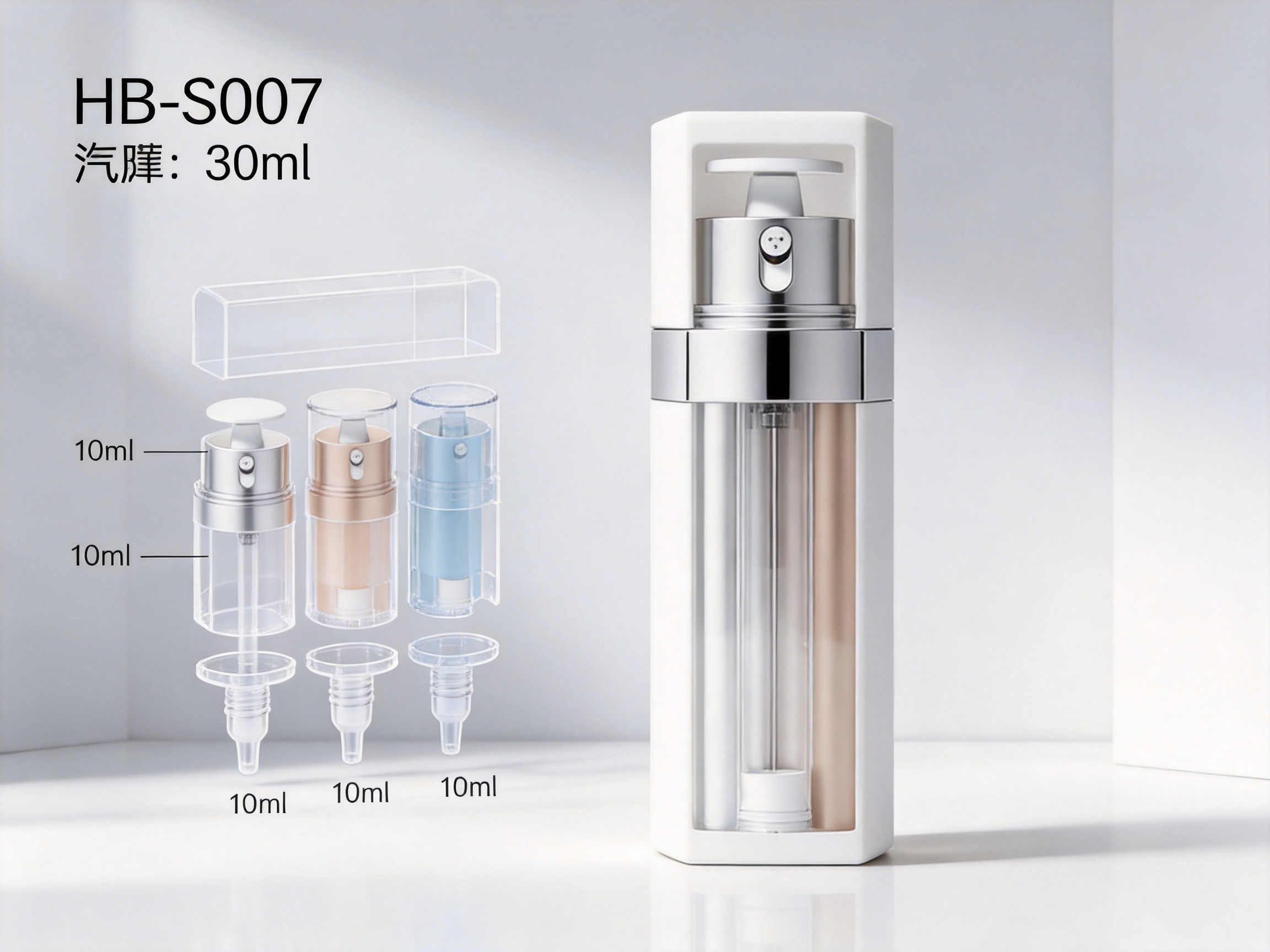
Airless packaging is widely associated with controlled dispensing and reduced exposure to the surrounding environment. Instead of relying on a simple open bottle or wide-mouth jar, an airless system uses an internal mechanism to move the product toward the outlet as the package is pumped. This structure can help limit unnecessary contact between the product and external air during regular use.
For skincare formulas, reduced exposure may be desirable because repeated opening and handling can affect product cleanliness, texture, and user confidence. The exact protection provided depends on the full package design, the formulation, the closure system, the manufacturing process, and the results of compatibility and stability testing. Nevertheless, an airless format is generally well suited to products that require a more controlled dispensing environment.
The HB-S007 combines this airless concept with three independent chambers. Each chamber can be treated as a separate product space, allowing the brand to maintain formula organization within one package. This is a more advanced approach than simply placing several ingredients in a single open container.
The airless structure may also help reduce product waste. Conventional packages sometimes require the user to tilt, shake, or squeeze the container repeatedly to access the remaining product. A pump-based airless package is designed to deliver product through controlled actuation, which can make daily use more predictable. The amount dispensed per actuation is influenced by the selected application rate, formula properties, and pump performance.
For premium skincare brands, controlled dispensing has another benefit: it can help consumers follow the recommended dosage. This is important for concentrated products, where applying too much may be wasteful and applying too little may reduce the perceived performance of the product. The 0.24cc and 0.36cc options give product developers a basis for matching package output to the intended formula and routine.
The three-outlet design is the central functional feature of this bottle. Each chamber has its own route toward dispensing, making it possible to manage separate liquids in a coordinated way. Depending on the final configuration and formula requirements, the outlets may be used to deliver the contents independently or in a combined application.
This creates several potential product concepts. A brand may use one chamber for a water-based essence, one for a treatment serum, and one for a moisturizing or protective component. Another brand may package three complementary anti-aging concentrates. A sun-care brand could consider a combination of skincare preparation, hydration, and protective support, subject to regulatory requirements and formulation validation.
The system is also suitable for two-formula products. One chamber may remain unused or be assigned to a separate version within a product family, depending on the filling and development plan. The ability to accommodate two or three liquids gives brands more freedom than a fixed single-formula bottle.
Because different formulas may have different viscosities, product developers should evaluate pump compatibility, filling accuracy, output consistency, and consumer instructions during development. A professional packaging manufacturer can support this process by providing samples, technical information, and test coordination. The correct formula-package relationship is essential for achieving a reliable user experience.
Essences and serums are among the most suitable applications for the HB-S007. These product categories frequently include concentrated active ingredients and are often positioned as advanced treatments. A three-chamber format allows a brand to separate complementary components and build a more compelling product story.
For example, a product may combine a hydrating essence, a treatment serum, and a lightweight finishing concentrate. The consumer can dispense the prescribed combination in one application or use the components in a specific order. This format may also support limited-edition treatment systems and professional-inspired skincare programs.
Anti-aging products often combine multiple functional objectives, such as hydration, skin conditioning, firmness support, and tone improvement. A triple chamber bottle can make it possible to organize these functions into separate components while keeping the overall routine compact.
The format can also help communicate a high-value treatment concept. Instead of presenting a complex formula as one undifferentiated mixture, the brand can explain the role of each chamber and show how the components work together. This type of educational packaging may increase consumer understanding and strengthen the premium positioning of the product.
Brightening and whitening products may include multiple formula components that require careful development and usage guidance. The HB-S007 can support a system in which brightening ingredients, moisturizing ingredients, and skin-conditioning ingredients are organized separately.
All claims and ingredient combinations must comply with the regulations of the target market. The packaging itself does not establish product efficacy. However, the three-chamber design can provide a practical platform for presenting a carefully tested multi-component treatment.
Although triple chamber packaging is often associated with serums, it can also be used for selected creams and lotions. The 0.36cc output option may be appropriate for formulas that require a more generous application than a concentrated essence. Brands can use the chambers for a lotion, cream, and booster combination or for several textures designed to be layered.
Viscosity testing is particularly important for cream and lotion applications. The pump system must be evaluated with the actual formula to ensure smooth dispensing, acceptable recovery, and consistent output throughout the product life cycle.
The product category list includes sunscreen bottle applications, and the multi-chamber concept may be considered for sun-care-related skincare systems. A brand could use separate chambers for a preparatory essence, hydration component, or complementary treatment. Any product making sun-protection claims must be developed and labeled according to applicable regulations, testing standards, and market requirements.
The bottle may also be used for products applied before or after sunscreen, such as moisturizing preparations or protective skincare treatments. Its flexible structure enables brands to explore more advanced routines while maintaining a unified package format.
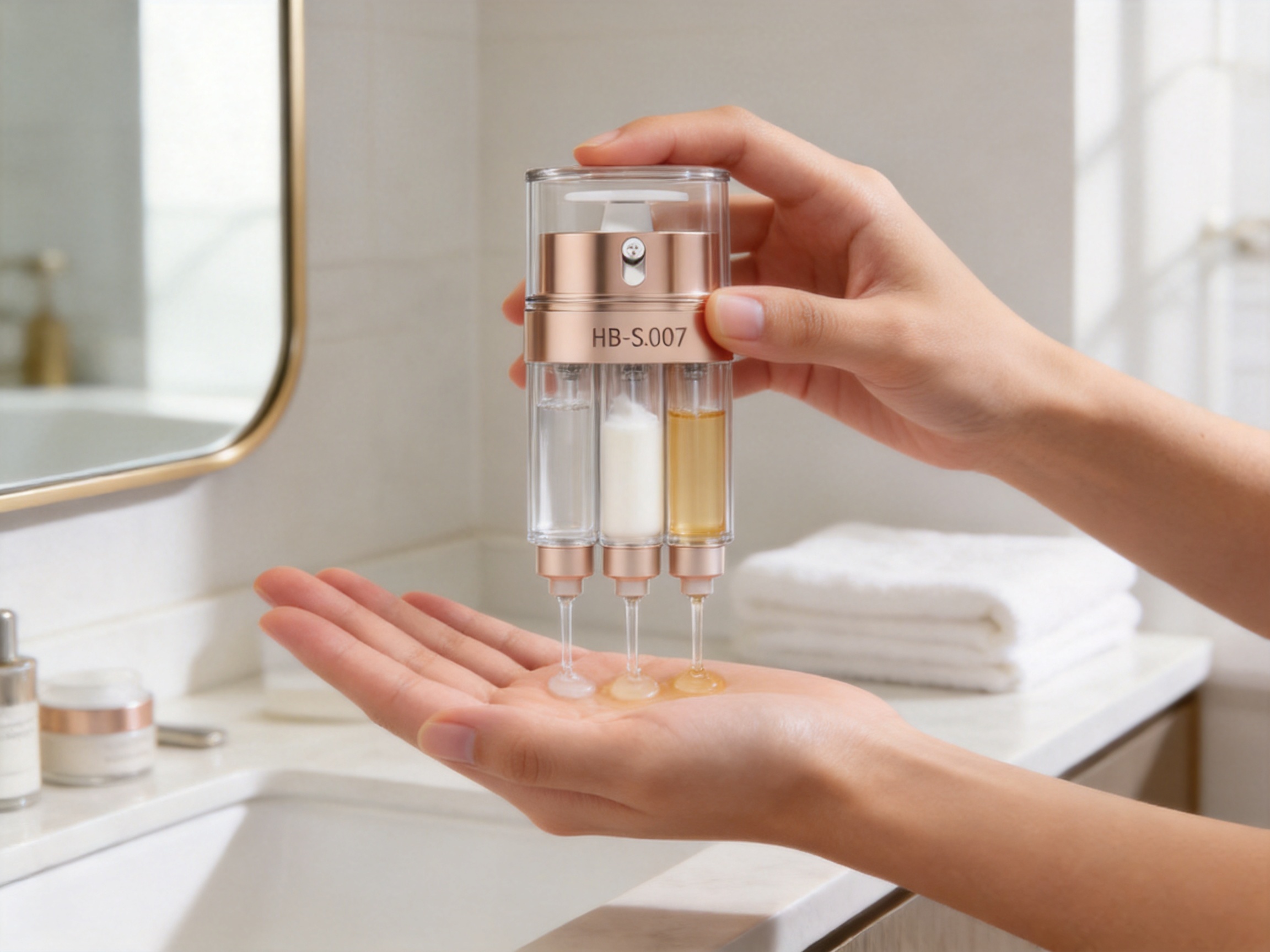
Material selection is an important part of cosmetic packaging design because the container must satisfy appearance, durability, compatibility, processing, and user-experience requirements at the same time. The HB-S007 uses a combination of MS, PETG, ABS, and PP across its different components.
MS is used in the cap and forms part of the bottle material structure. It is valued in cosmetic packaging for its visual clarity, surface quality, and ability to support a refined appearance. Depending on the selected grade and processing conditions, MS can contribute to a premium look suitable for skincare products.
PETG is included in the bottle construction. It is commonly used where clarity, toughness, and design versatility are required. Its presence can support a carefully engineered internal or external component while helping the package achieve a high-quality appearance.
ABS is used in the pump and bottle structure. It is known for its rigidity, impact resistance, and suitability for molded components. In a pump system, a stable material can help support the functional housing and external handling experience.
PP is used in the pump system. Polypropylene is widely used in cosmetic packaging components because of its chemical resistance, low density, and suitability for precision molding. The final compatibility of any material depends on the specific formulation, storage conditions, temperature range, and testing program.
The combination of materials allows the bottle to balance different requirements. The visible components can be designed for attractive presentation, while the internal and functional elements can be selected for mechanical performance and reliable operation. This multi-material approach is common in advanced cosmetic packaging, where no single material necessarily provides every required characteristic.
Yuyao Hengbang Plastic Co., Ltd. was established in 2006 and has developed substantial experience in plastic packaging for cosmetics and skincare products. The company operates in a facility with a building area of approximately 35,000 square meters and employs more than 300 people. This scale provides a foundation for coordinated design, development, production, quality management, and customer service.
The company specializes in plastic cosmetic packaging rather than treating packaging as a secondary product category. This specialization is important for brands that need a supplier familiar with cosmetic containers, skincare dispensing systems, decorative requirements, and product development timelines.
The company provides design and development services in addition to manufacturing. This can be valuable when a brand is creating a new multi-chamber product because the package must be considered together with the formula, dispensing requirements, filling process, visual identity, and consumer instructions.
Development support may include discussions about capacity, chamber arrangement, material selection, pump output, appearance, and decoration. For a product such as the HB-S007, early technical communication helps ensure that the bottle is matched with suitable formula viscosities and that the final user experience is consistent with the brand concept.
A triple chamber bottle is more technically demanding than a simple single-wall container. It requires coordinated internal spaces, multiple flow paths, a compatible pump structure, and careful assembly. The company’s focus on cosmetic packaging and its portfolio of bottle formats provide a relevant foundation for handling this type of project.
Complex packaging also requires attention to details that may not be visible to the consumer. These include dimensional control, component matching, sealing performance, assembly consistency, outlet alignment, and compatibility between the formula and the dispensing system. Each element contributes to the reliability of the finished product.
Yuyao Hengbang Plastic Co., Ltd. has passed ISO9001:2015 and ISO14001:2015 certifications. ISO9001:2015 is associated with quality management systems, while ISO14001:2015 is associated with environmental management systems. These certifications indicate that the company has established documented management frameworks related to quality and environmental responsibilities.
Certification does not eliminate the need for product-specific inspection and testing. However, it gives customers an important indication that the supplier works within recognized management systems. For international cosmetic brands, this can support supplier evaluation and quality assurance processes.
The company was recognized as a Ningbo High-Tech Enterprise in 2021 and owns multiple invention patents. These details reflect an orientation toward technical development and product innovation. Such capabilities are relevant to advanced packaging formats that require more than standard molding and assembly.
Innovation in packaging can involve the structure of the bottle, the arrangement of chambers, the dispensing process, assembly methods, material combinations, or the interaction between packaging and formula. A supplier with technical development experience is better positioned to help brands evaluate these factors during product planning.
The company describes its business philosophy through the principles of quality, integrity, and customer first. These principles are particularly meaningful for custom cosmetic packaging projects, where communication, sampling, production scheduling, and after-sales support can affect the success of a product launch.
For brands purchasing a multi-chamber bottle, reliable communication is essential. Questions about filling, output, compatibility, customization, inspection, and packaging logistics should be addressed before mass production. A supplier with a customer-oriented approach can help coordinate these stages and reduce avoidable misunderstandings.
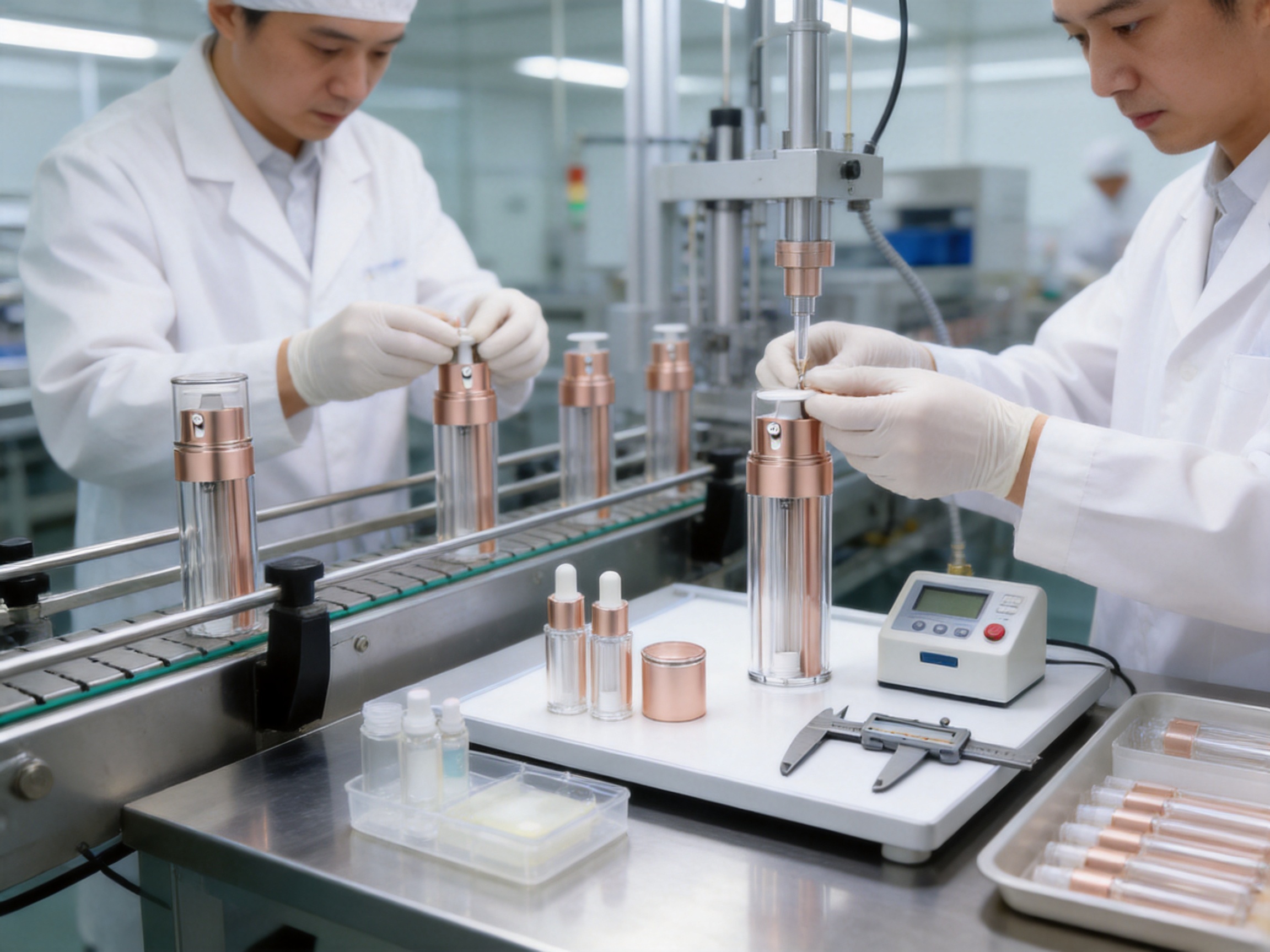
The production of a triple chamber airless bottle involves several coordinated stages. Although the exact process may vary according to the final specification, the general workflow begins with product design and engineering review. At this stage, the bottle dimensions, chamber capacities, material structure, pump mechanism, outlet arrangement, and appearance requirements are assessed.
Tooling and mold development follow the approved design. The molds must support accurate formation of the external body and internal chamber architecture. Dimensional precision is important because even small variations can affect assembly, sealing, pump fit, or product capacity.
Plastic components are then produced through controlled molding processes appropriate to the selected materials. Each material may require different processing conditions. The production team must manage factors such as temperature, pressure, cooling, cycle time, surface finish, and dimensional consistency.
After molding, components may undergo inspection before assembly. Inspection can include visual checks, dimensional verification, component matching, and evaluation of surface quality. For a multi-part package, ensuring that the correct components are combined is an important quality requirement.
Assembly brings the chambers, bottle body, pump, cap, and related components together. The three independent outlets must remain correctly aligned with the corresponding internal chambers. Assembly control is therefore essential to prevent cross-connection, leakage, incorrect dispensing, or inconsistent operation.
Functional testing may include pump actuation, output measurement, recovery behavior, sealing evaluation, and appearance inspection. When the bottle is tested with a real formula, additional assessments may include compatibility, storage stability, leakage, stress, temperature exposure, and transportation simulation.
Packaging decoration and branding can be completed according to the project specification. Options may include labels, printing, color matching, surface treatment, or other cosmetic packaging finishes. The chosen decoration should be evaluated for adhesion, abrasion resistance, chemical resistance, and compatibility with the product’s storage and handling conditions.
Finally, finished products are packed for shipment. Protective inner packaging is important because cosmetic containers may be transported through multiple stages before reaching the filling facility or brand warehouse. Proper packing helps reduce the risk of scratches, deformation, component separation, and other damage during logistics.
Quality control for a triple chamber airless bottle should cover both visible appearance and hidden functional performance. A package may look attractive but still require improvement if the pump output varies significantly, if the chambers are not properly isolated, or if the formula interacts negatively with an internal component.
Dimensional inspection is one important area. The height, diameter, chamber capacity, pump fit, cap fit, and connection points should be checked against approved specifications. Consistent dimensions help maintain assembly efficiency and reliable operation.
Leakage testing is also important. Each independent chamber and the complete assembled package should be evaluated under appropriate conditions. The testing method may include pressure, inversion, temperature, vibration, or transportation simulation, depending on the final product requirements.
Output consistency should be evaluated using the actual pump and suitable test media or the final formula. The selected 0.24cc or 0.36cc application rate should be confirmed, and the relationship between actuation force and output should be considered from a user perspective.
Compatibility testing is essential because cosmetic formulas can vary widely in acidity, alcohol content, oil content, surfactant level, solvent system, viscosity, and active ingredient concentration. The bottle materials and dispensing components should be tested with the intended formula over the expected shelf life and storage conditions.
Appearance inspection includes checking for color consistency, scratches, flow marks, flash, deformation, contamination, printing defects, and other cosmetic issues. Premium skincare packaging is often judged closely by consumers, so visual consistency contributes directly to brand perception.
Quality control should also include traceability and production records. A documented quality system helps identify the production batch, materials, inspection results, and process conditions associated with finished goods. This information supports continuous improvement and effective response if a quality issue is identified.
Before ordering samples, the brand should define what each chamber will contain and how the consumer will use the product. The three chambers might represent three simultaneous components, a two-component system with an auxiliary chamber, or a collection of related products under one package concept.
The brand should also decide whether consumers will dispense the components together, separately, or in a prescribed sequence. Clear product architecture makes it easier to evaluate formula compatibility, dosing, labeling, and marketing communication.
Not every formula flows in the same way. A watery essence, gel serum, emulsion, lotion, and cream may require different dispensing conditions. The selected pump output and package structure should be tested using the actual formulas rather than relying only on general assumptions.
Formula developers should assess priming, actuation, output consistency, residual product, and consumer handling. The product should remain easy to use from the first pump through the final applications.
Compatibility testing should evaluate the interaction between the formula and all relevant package components. This may include color change, odor change, viscosity change, leakage, swelling, cracking, stress, pump performance, and other potential effects.
Stability testing should reflect the target market and expected storage conditions. Testing may involve elevated temperature, low temperature, cycling, light exposure, vibration, and long-term storage. The final testing program should be established by the brand and its technical partners according to regulatory and commercial requirements.
A triple chamber bottle offers more functionality than a standard bottle, but the consumer must understand how to use it. Instructions should explain the purpose of each chamber, the recommended dosage, whether components should be used together, and the appropriate order of application.
Visual icons, color coding, short directions, and carefully designed outer packaging can make the experience easier. The package should be innovative without becoming confusing. Simple instructions are especially important when the product is sold internationally or used by consumers with different skincare habits.
Multi-chamber packaging may require specialized filling procedures. The filling facility should confirm that it can fill each chamber accurately and maintain the required separation. The order of filling, equipment compatibility, cleanliness, sealing, and inspection should be reviewed before production.
Logistics planning should consider the assembled package, individual components, protective packaging, carton dimensions, and transportation conditions. Early planning helps reduce delays and ensures that the finished product reaches the consumer in the intended condition.
Environmental performance is becoming increasingly important in cosmetic packaging decisions. A triple chamber bottle uses a more complex structure than a basic single-chamber package, so brands should consider the total material use, product efficiency, manufacturing process, shipping requirements, and end-of-life pathway.
The integrated design may reduce the need for consumers to purchase and carry multiple separate primary containers. It may also support concentrated product concepts, which can influence the amount of product required for an effective routine. These potential benefits should be evaluated together with the package’s material composition and recycling conditions in the target market.
ISO14001:2015 certification at the manufacturing company indicates the presence of an environmental management framework. This can be relevant for brands that evaluate suppliers according to environmental management practices. However, environmental claims about the finished package should be based on verified information, local recycling infrastructure, life-cycle assessment, and applicable regulations.
Brands can also explore responsible improvements through decoration selection, packaging weight optimization, efficient carton design, reduced secondary packaging, and clear disposal information. The most appropriate approach depends on the product category, market, formula requirements, and consumer expectations.
In a crowded skincare market, a package must support more than visual appeal. It should help create a clear reason for the product to exist. The HB-S007 provides several positioning opportunities because its technology is directly connected to product functionality.
First, the package can support premium performance positioning. A three-chamber system suggests precision, advanced formulation, and controlled application. This can complement products designed around specialized active ingredients or professional-inspired skincare routines.
Second, it can support customization. Consumers may perceive the ability to combine two or three formulas as more personal and flexible than a conventional pre-mixed product. Brands can use this feature to develop targeted routines for different skin concerns or times of day.
Third, it can support convenience. Instead of asking consumers to buy and manage several packages, the brand can deliver a coordinated system in one bottle. This benefit is especially relevant for travel, limited-space storage, and simplified daily routines.
Fourth, it can support product storytelling. Each chamber can have a defined role, allowing brands to explain the relationship between hydration, treatment, conditioning, and protection. The package provides a physical structure for a more educational and engaging brand narrative.
These advantages do not automatically guarantee market success. The formulas, claims, design, price, instructions, and consumer testing must all support the package concept. Nevertheless, a well-developed triple chamber bottle can give a skincare product a meaningful point of differentiation.
The HB-S007 reflects several important trends in the beauty industry. Consumers are seeking products that feel personalized, effective, convenient, and technologically advanced. Brands are also exploring more concentrated formulas, multi-step routines, and packaging that actively contributes to the product experience.
Its 30ml total capacity is appropriate for premium treatment products that are used in relatively small amounts. The 10ml + 10ml + 10ml distribution provides a balanced structure for three complementary formulas. The 158mm height and 44mm diameter create a recognizable package profile that can be presented as a sophisticated skincare device rather than an ordinary container.
The use of three independent outlets expands the possibilities for formula combination. The airless design supports controlled dispensing, while the multi-material construction allows the manufacturer to balance appearance and functionality. The company’s experience, certifications, technical development capability, and dedicated cosmetic packaging focus further support the product’s suitability for professional brand projects.
For brands that want to move beyond conventional bottles and jars, the HB-S007 offers a practical foundation. It is not simply a larger or more decorative package. Its value comes from the way its structure can influence formulation, application, product education, and market positioning.
The total capacity is 30ml. It is divided into three independent 10ml chambers, creating a 10ml + 10ml + 10ml configuration.
Yes. The design includes three independent chambers and three independent outlets, allowing two or three compatible liquids to be stored and dispensed through one integrated package.
The bottle is suitable for essence, serum, cream, anti-aging, whitening, brightening, lotion, and selected sun-care-related skincare products. The final suitability depends on the formula’s viscosity, ingredients, stability requirements, and compatibility with the package.
An airless package uses a pump-based structure to move product toward the outlet while helping reduce unnecessary exposure to surrounding air during normal use. Performance depends on the complete package design, formula, storage conditions, and testing results.
The listed application options are 0.24cc and 0.36cc. The appropriate option should be selected according to the formula viscosity, desired dosage, and intended consumer application.
The cap uses MS, the pump uses ABS and PP, and the bottle construction includes MS, PETG, and ABS. Final material compatibility should be confirmed through product-specific testing.
The bottle has a listed height of 158mm and a diameter of 44mm.
The structure can be considered for cosmetic packaging customization, including appearance, decoration, color, labeling, and other project-specific requirements. The available options should be confirmed during technical development and sampling.
Yes. Its triple chamber architecture, airless dispensing concept, compact 30ml capacity, and ability to support multiple formulas make it appropriate for premium serums, anti-aging treatments, whitening products, and innovative skincare systems.
Brands should evaluate formula compatibility, stability, leakage, pump output, actuation, chamber separation, filling accuracy, appearance, transportation performance, and consumer usability. Testing should use the actual formulas and final package configuration whenever possible.
The manufacturer has specialized in plastic cosmetic packaging since 2006, operates a facility with approximately 35,000 square meters of building area, employs more than 300 people, provides design and development services, holds ISO9001:2015 and ISO14001:2015 certifications, and owns multiple invention patents.
The product description states that the structure allows flexible combination of two or three liquids. The exact filling and usage plan should be confirmed with the manufacturer and validated through product-specific testing.
The HB-S007 30ml triple chamber airless bottle offers a practical response to the growing demand for more advanced cosmetic packaging. Its three independent 10ml chambers allow brands to separate, coordinate, and dispense multiple formulas within one compact package. This supports greater formulation flexibility, improved convenience, and a more distinctive skincare experience.
Compared with conventional single-chamber bottles and jars, the triple chamber system provides a broader platform for customization and product innovation. It is suitable for essence, serum, cream, anti-aging, whitening, lotion, and selected sun-care-related applications. Its airless dispensing structure, multiple outlets, 0.24cc and 0.36cc application options, and balanced material selection further enhance its suitability for modern skincare products.
The value of the product is also supported by the manufacturing capabilities of Yuyao Hengbang Plastic Co., Ltd. Since 2006, the company has focused on plastic packaging for cosmetics and skincare products. Its 35,000-square-meter building area, workforce of more than 300 employees, design and development support, ISO9001:2015 and ISO14001:2015 certifications, high-tech enterprise recognition, and invention patents provide a strong foundation for advanced packaging production.
For brands, the most successful development process will combine the bottle with appropriate formulas, compatibility testing, clear consumer instructions, accurate filling, and a well-defined market position. When these elements are coordinated, the HB-S007 can become more than a container. It can serve as a functional part of the product concept, helping brands deliver a more convenient, customized, and technologically distinctive skincare experience.
1. Product specification sheet for HB-S007 30ml Triple Chamber Airless Bottle.
2. Technical information supplied for cosmetic packaging materials including MS, PETG, ABS, and PP.
3. ISO 9001:2015, Quality Management Systems — Requirements.
4. ISO 14001:2015, Environmental Management Systems — Requirements with Guidance for Use.
5. General cosmetic packaging development principles covering formula compatibility, dispensing performance, stability testing, and transport evaluation.
6. Company information regarding manufacturing history, facility scale, workforce, design services, certifications, patents, and cosmetic packaging specialization.


Copyright © Yuyao Hengbang Plastic Co., Ltd.
All Rights Reserved.
 Wholesale Plastic Cosmetic Packaging Manufacturers