English
 中文简体
中文简体
News
Home > Author > Chen Xiaotong — Key Account Sales Manager > Refillable Airless Serum Bottles: Sustainable Protection for Modern Skincare Packaging

 2026.07.22
 Chen Xiaotong — Key Account Sales Manager
Content
In the skincare and cosmetics market, packaging is no longer judged only by appearance. Brands, formulators, retailers, and consumers increasingly evaluate a container according to its ability to protect the formula, support convenient dispensing, reduce material waste, and communicate a responsible approach to product development. The HB-K022A/B Plastic Refillable Airless Serum Bottle is designed to address these expectations through a combination of airless technology, a replaceable inner bottle, a durable outer structure, and flexible capacity options.
This packaging solution is intended for serums, lotions, creams, and other sensitive cosmetic formulations that benefit from controlled exposure to air and contamination. Its permanent outer bottle provides the visible and structural foundation of the package, while its disposable inner bottle can be replaced after the contents have been used. Instead of discarding the entire package every time a product is finished, the user can purchase a replacement inner bottle and continue using the outer component.
The result is a packaging format that combines the premium appearance of a complete cosmetic bottle with the practical and environmental advantages of a refill system. For cosmetic companies seeking a reliable packaging partner, this design also offers opportunities for product differentiation, customized visual identity, and efficient product-line planning.
Skincare formulas can be sensitive to oxygen, airborne contaminants, light, moisture, and repeated contact with the environment. Ingredients commonly used in serums and creams may gradually lose performance when exposed to unsuitable conditions. Even when the formula itself is carefully developed, an inappropriate package can shorten its usable life, affect its texture, or reduce consumer confidence.
Traditional open-mouth jars require the user to remove a lid and access the formula directly. Each opening can expose the contents to air, dust, and contact with fingers or applicators. A conventional bottle with a dip tube may reduce some forms of exposure, but it can leave product behind and may not provide the same level of controlled delivery as a piston-based airless system.
Airless packaging addresses these issues by separating the product from the surrounding air. The container uses a piston at the base that moves upward as the product is dispensed. Because the piston rises with each use, the formula can be pushed toward the actuator without relying on a dip tube. This structure helps reduce the amount of air entering the package and supports a more hygienic dispensing experience.
For manufacturers, the package must also work reliably throughout filling, transportation, storage, shelf display, and consumer use. It should provide consistent dosing, resist accidental leakage, remain visually attractive, and be compatible with the intended formula. The HB-K022A/B design responds to these practical requirements while introducing a refillable structure that is not available in many standard single-use airless packages.
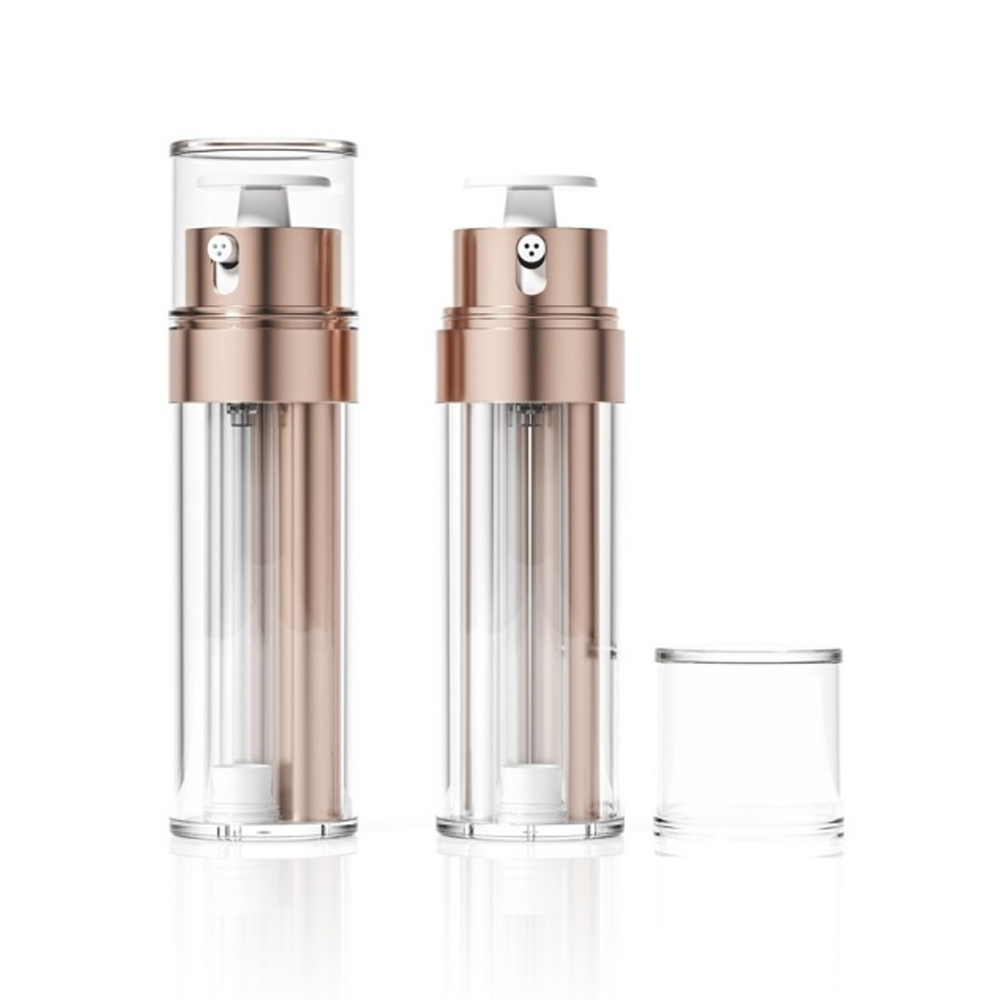
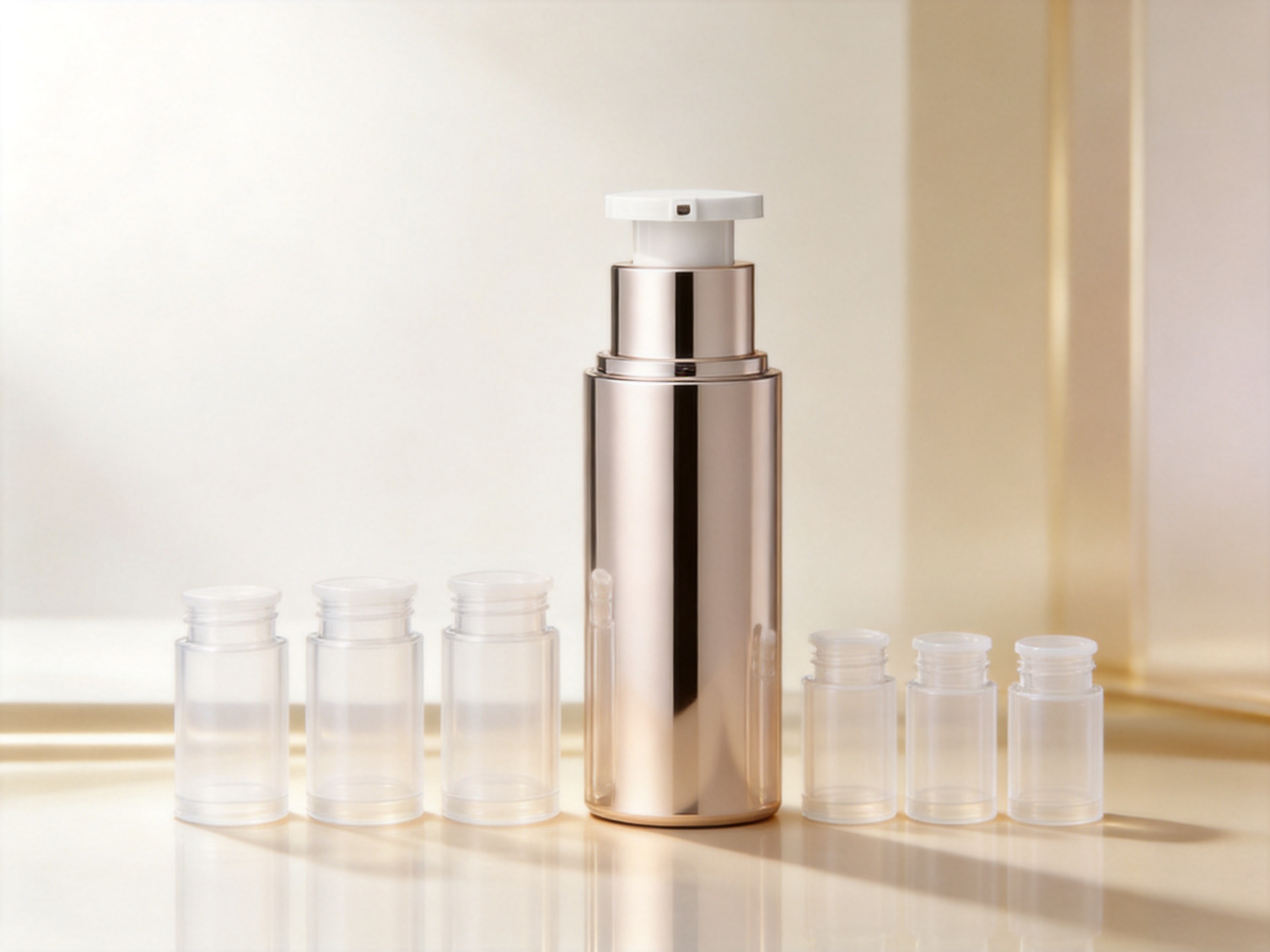
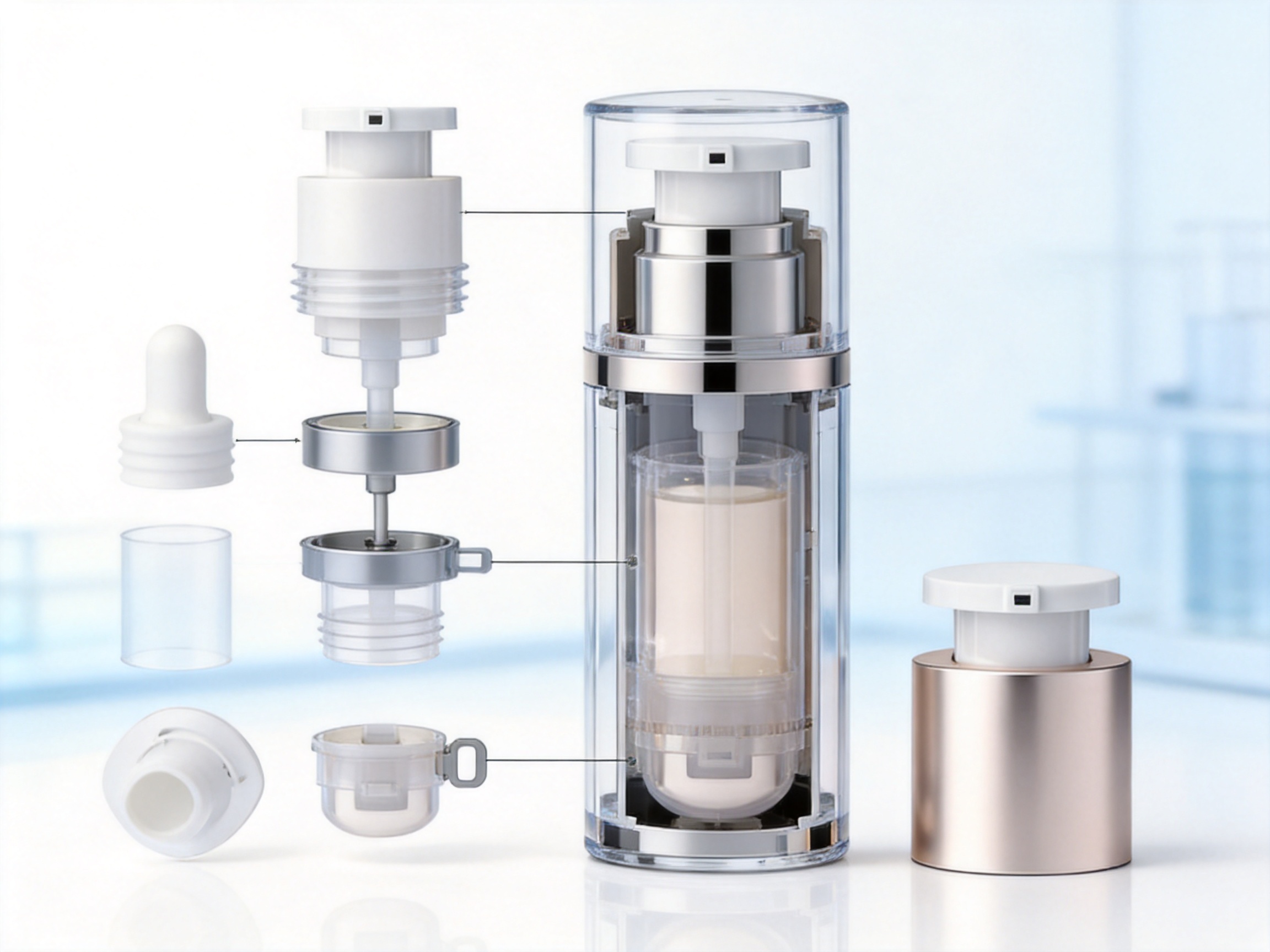
The HB-K022A/B Plastic Refillable Airless Serum Bottle is composed of two main bottle elements: a permanent outer bottle and a disposable inner bottle. The outer bottle functions as the durable housing and visual presentation component. The inner bottle contains the cosmetic formula and can be removed and replaced after the product has been consumed.
This two-part construction supports a repeat-use packaging model. Consumers purchase the complete package for the first use and then purchase replacement inner bottles for future refills. The outer bottle can remain in service for multiple product cycles, reducing the frequency with which the full package must be discarded.
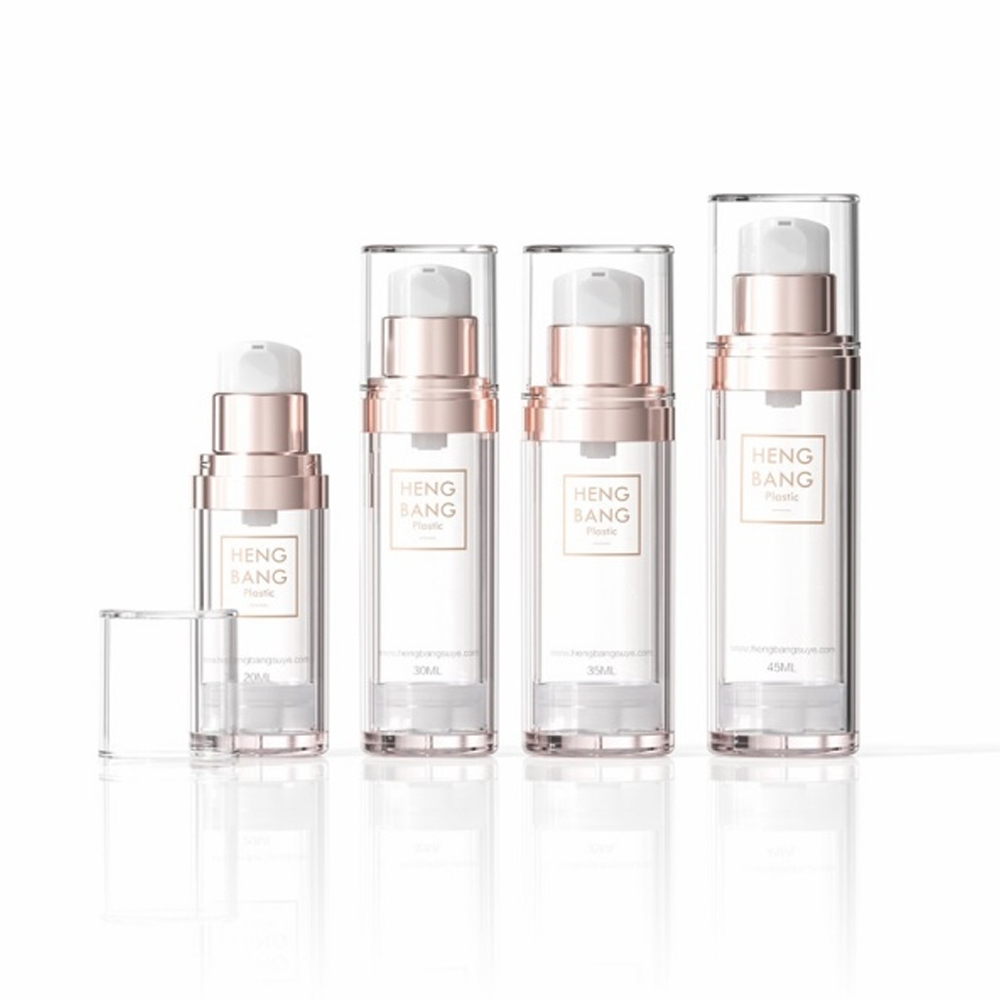
The product is available in 20 ml, 30 ml, 50 ml, and 70 ml capacities. These options allow brands to use the same general packaging concept for travel sizes, introductory products, concentrated serums, daily-use skincare, and larger lotion or treatment formats. Multiple sizes can also help a brand create a coordinated packaging family across several products.
The listed material structure includes a PP retaining clip, a PP and ABS pump, an MS outer bottle, and a PP inner bottle. This combination balances functional performance, appearance, and manufacturing practicality. Polypropylene is commonly used for cosmetic packaging components because of its useful combination of chemical resistance, processability, and relatively low weight. ABS can contribute to the strength and finish of pump-related components, while the metal outer structure provides a distinctive, premium visual and tactile character.
The nozzle includes a retaining clip. This detail helps prevent unintended activation during storage, packing, transportation, or retail handling. It is particularly useful for products that may be shipped in cartons, included in promotional kits, or carried in handbags and travel cases.
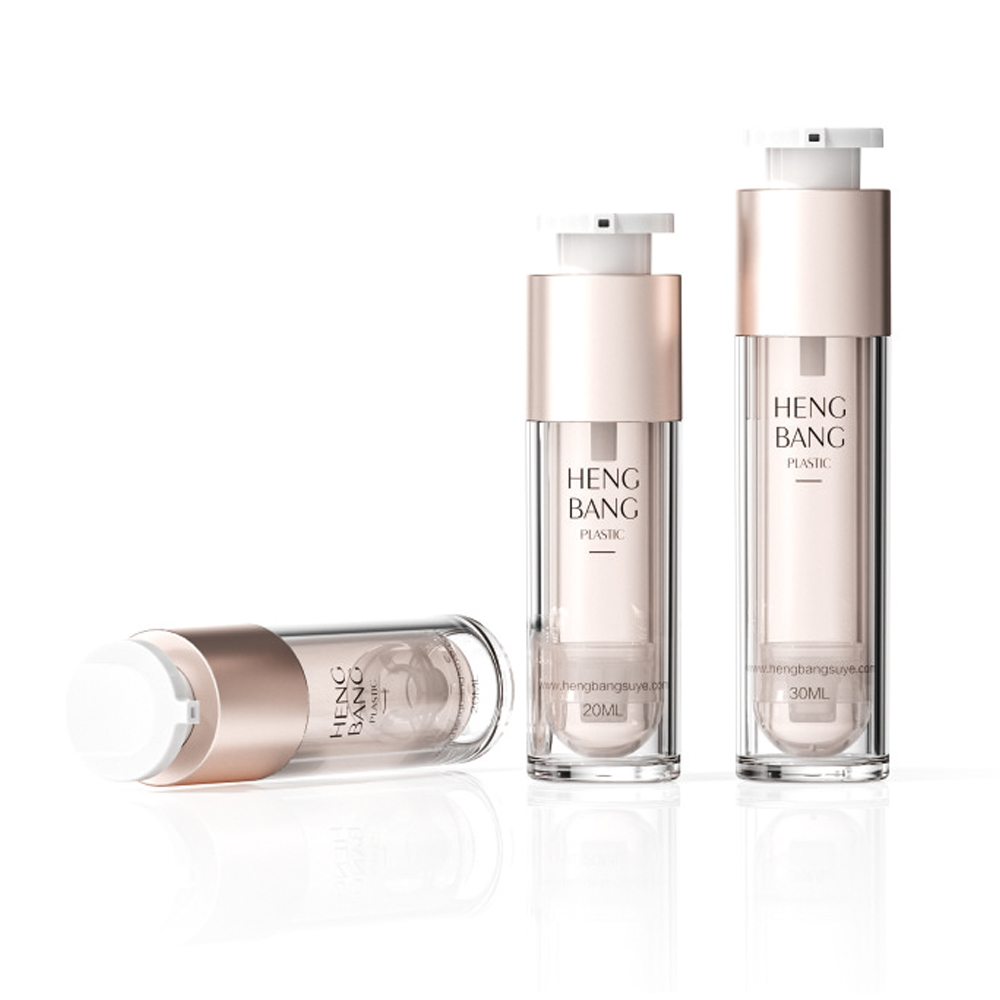
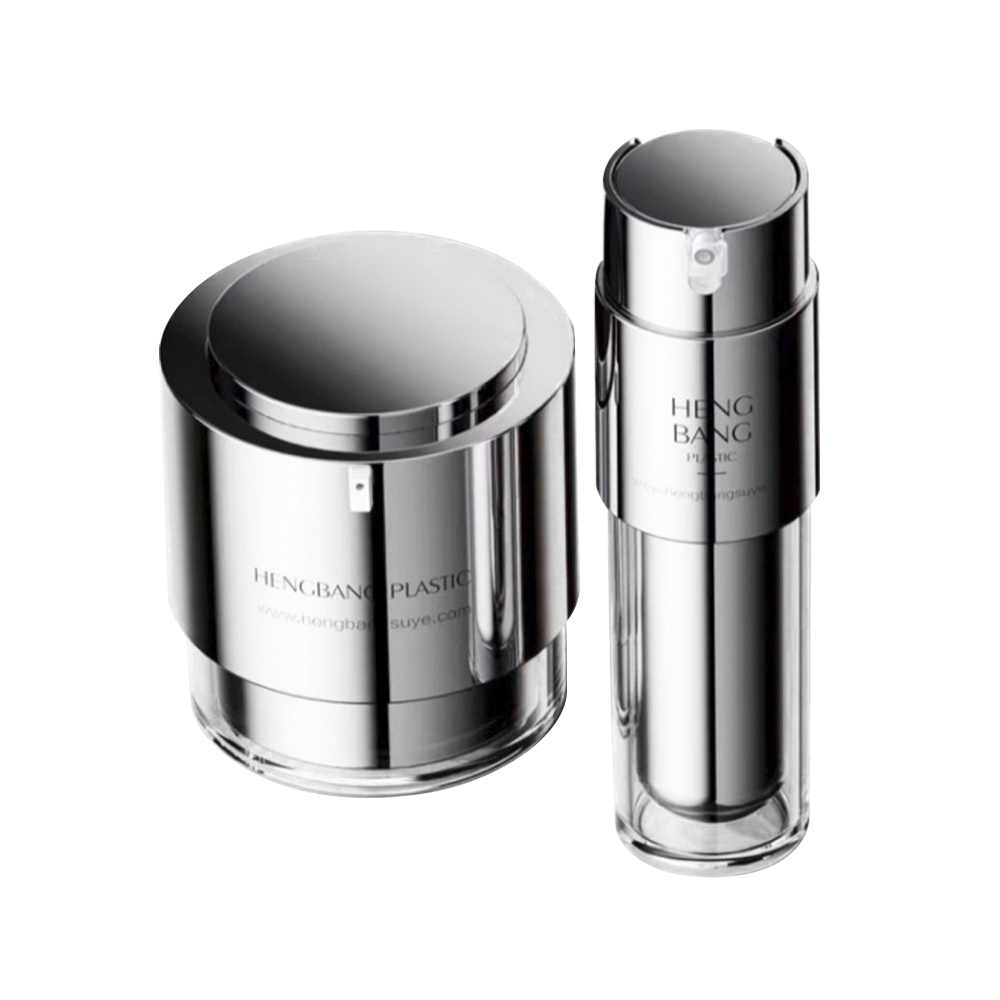
HB-K022A/B Plastic Refillable Airless Serum Bottle
An airless bottle is a vacuum-sealed dispensing container that uses pressure generated by a moving piston. When the pump is pressed, the product is delivered through the nozzle. As the internal product volume decreases, the piston moves upward, keeping the formula positioned for dispensing.
Unlike a conventional pump bottle, the airless design does not depend on a long dip tube extending into the product. This can help improve product evacuation and reduce the possibility of a tube failing to reach the remaining formula. The piston-based mechanism also limits the amount of air that enters the container during normal use.
Reducing air contact is important for formulas that are sensitive to oxidation or contamination. While the actual compatibility and shelf-life performance must always be verified through product-specific testing, an airless format is widely considered suitable for many serums, creams, lotions, and other high-value cosmetic products.
The refillable construction distinguishes this model from a conventional disposable airless bottle. Once the original inner bottle is empty, the consumer does not need to throw away the complete external package. The inner bottle can be replaced with a new filled component while the outer bottle continues to provide the package’s structure and appearance.
This system can reduce the amount of material associated with repeated purchases. The greatest reduction depends on the weight of the outer bottle, the design of the replacement insert, the efficiency of the refill process, and consumer participation. Nevertheless, keeping the outer component in use for multiple product cycles can offer a practical way to reduce packaging turnover.
The replaceable inner bottle can also support a broader product strategy. A brand may use one outer package design for multiple formulas, then offer different inner bottle options according to skin concern, fragrance, active ingredient, or product strength. This approach can make a product family easier to recognize while allowing the formula portfolio to remain flexible.
The nozzle retaining clip is a small but meaningful feature. During transportation, pump pressure can occasionally be applied unintentionally if a package is compressed or handled roughly. A retaining clip helps keep the nozzle secured until the product is ready for use.
For retailers and logistics teams, this feature can help reduce accidental dispensing inside cartons and shipping containers. For consumers, it provides reassurance when the bottle is stored in a cosmetic bag or carried during travel. The clip can also help create a clear distinction between the shipping condition and the ready-to-use condition.
One of the principal advantages of the HB-K022A/B system is its airless dispensing structure. The rising piston helps isolate the formula from the surrounding environment. This is especially valuable for products that are sensitive to oxygen, repeated opening, or contamination from external contact.
Compared with a jar, the airless bottle can provide a more enclosed experience. Compared with a standard bottle using a dip tube, the piston mechanism offers a different product-delivery method that does not rely on the tube reaching the bottom of the package. These characteristics may help brands present their formulas as carefully protected and hygienically dispensed.
The piston moves upward as the product is used, helping position the remaining formula near the pump outlet. This design can support efficient product evacuation. The exact residual amount depends on formula viscosity, filling accuracy, pump performance, and user behavior, so brands should conduct compatibility and evacuation tests with their actual product.
For premium serums and treatment products, reducing residual product can have a direct effect on perceived value. Consumers expect to access as much of the purchased formula as possible. A package that delivers consistent doses and minimizes inaccessible residue can improve the overall user experience.
The refillable structure provides a clear advantage over complete-package replacement. In a conventional bottle, the outer shell, actuator, and internal product container are typically discarded together when the product is finished. With the HB-K022A/B system, only the replaceable inner bottle needs to be changed.
This can help reduce the amount of packaging waste created over multiple purchase cycles. It may also allow brands to communicate a more responsible packaging story, provided that the refill system is explained clearly and supported by appropriate disposal instructions.
The MS outer bottle gives the package a distinctive appearance compared with an entirely plastic bottle. Its structure can contribute to a more substantial feel in the hand and may help position the product in premium skincare, professional beauty, and prestige cosmetic segments.
Packaging appearance influences first impressions. A well-structured outer bottle can support a brand’s visual identity on retail shelves, online product photography, and social media content. The outer component may also offer an attractive platform for decoration, labeling, finishing, and coordinated color development, subject to the manufacturer’s available customization processes.
The four listed capacities—20 ml, 30 ml, 50 ml, and 70 ml—cover several common cosmetic packaging requirements. A 20 ml size can be used for trial products, travel formats, concentrated treatments, or gift sets. A 30 ml bottle is suitable for many facial serums and targeted skincare products. A 50 ml format can serve daily-use creams, larger serum products, or premium treatments. A 70 ml option provides additional capacity for lotion or extended-use products.
Using a coordinated family of sizes may help a brand establish consistent shelf recognition. It can also simplify packaging development when multiple products require a similar dispensing system but different fill volumes.
The following information summarizes the principal specifications provided for the HB-K022A/B model. Final dimensions, tolerances, filling methods, and compatibility should be confirmed with the manufacturer before mass production.
| Specification | Available Information |
|---|---|
| Product model | HB-K022A/B |
| Product type | Plastic refillable airless serum bottle |
| Structure | Permanent outer bottle with replaceable disposable inner bottle |
| Capacities | 20 ml, 30 ml, 50 ml, and 70 ml |
| Clip material | PP |
| Pump material | PP + ABS |
| Outer bottle material | MS |
| Inner bottle material | PP |
| Listed pump dosage | 0.23 cc |
| Listed heights | 118.5 mm, 136.5 mm, 132.5, and 160 mm as supplied; final dimensional mapping should be confirmed |
| Listed diameters | 33 mm and 40 mm |
| Primary applications | Serums, creams, lotions, and other suitable cosmetic or skincare formulas |
The supplied specification table contains a dimensional entry written as “132.5ml” under height. Because height is normally expressed in millimeters, this value should be verified during technical confirmation. The same applies to the relationship between the listed heights and capacities. Accurate drawings and approved samples should be used for packaging design, filling-line setup, carton development, and transport testing.
The listed application or pump dosage is 0.23 cc. This figure provides a useful starting point for calculating the approximate number of doses in each capacity. For example, a nominal 20 ml bottle contains approximately 86.9 doses at 0.23 cc per actuation, while a 30 ml bottle contains approximately 130.4 doses. A 50 ml bottle contains approximately 217.4 nominal doses, and a 70 ml bottle contains approximately 304.3 nominal doses.
These calculations are theoretical and do not replace actual pump testing. The delivered quantity may vary according to pump tolerance, formula viscosity, temperature, filling level, actuation speed, and the user’s pressing behavior. Brands should establish their own dose claims after testing the finished package with the final formula.
Serums are among the most natural applications for an airless refillable bottle. They often contain concentrated active ingredients and are sold in relatively small quantities. The 20 ml, 30 ml, and 50 ml options can be matched to different positioning strategies, from trial-size products to complete treatment programs.
The pump format allows the consumer to dispense a measured amount without placing fingers directly into the formula. This can support a clean and convenient routine, especially when the product is used daily. The enclosed airless structure may also be appropriate for formulas that require protection from repeated environmental exposure.
Airless packaging is suitable for many creams because the piston mechanism can help move thicker products toward the pump. The 50 ml and 70 ml capacities may be appropriate for moisturizers, night creams, firming products, and targeted treatment creams.
Formula viscosity must be evaluated carefully. Very thick, highly structured, or particle-containing products may require specific pump and inner-bottle testing. The package should be tested for priming, continuous dispensing, dose consistency, leakage, and product evacuation under different temperatures.
Lotions and emulsions can benefit from a controlled pump package that reduces direct contact. The larger capacity options may provide an efficient format for daily-use body care or face-and-neck products. Brands can also use the refillable structure to offer seasonal, fragrance-free, sensitive-skin, or specialty lotion variations within one packaging platform.
Sun care products, after-sun treatments, and targeted cosmetic treatments may also be considered for this package, subject to formulation compatibility and regulatory requirements. Product developers should confirm that the formula does not interact adversely with the materials, seals, pump components, or inner-bottle structure.
For sunscreen products in particular, testing should include formula stability, package compatibility, dispensing performance, and any applicable regional requirements for product claims. The packaging can support a convenient and enclosed dispensing experience, but packaging alone does not determine the protection level or regulatory status of the finished sunscreen.
The inner bottle is made from PP. Polypropylene is widely used in cosmetic packaging because it can be molded into precise shapes and generally offers useful resistance to many cosmetic ingredients. Its relatively low density can also support lightweight packaging development.
Compatibility cannot be assumed solely from the material name. Essential oils, solvents, high concentrations of active ingredients, fragrances, acids, and other components may behave differently depending on their concentration and storage conditions. The finished formula should be stored in production-intent components for an appropriate period and tested for changes in appearance, odor, viscosity, color, and performance.
The pump uses PP and ABS components. PP can provide a practical material for fluid-contact or structural parts, while ABS can contribute to dimensional stability and a refined surface finish in suitable pump components. The pump must be evaluated as a complete mechanism rather than as separate materials.
Important tests include initial priming, actuation force, dose repeatability, recovery after storage, leakage resistance, and performance after transportation. The pump should also be tested with the actual formula because a pump that performs well with a low-viscosity serum may behave differently with a rich cream or lotion.
The MS outer bottle provides the permanent housing for the refillable system. Its presence can create a more premium impression and offer the package a firm, stable structure. The outer component also protects the replaceable inner bottle during normal handling.
Brands should discuss surface treatment, decoration, color, coating, printing, and resistance requirements with the manufacturer. If the outer bottle is intended for repeated use, its surface should be evaluated for scratch resistance, staining, wear, and visual durability. The outer component is an important part of the refill experience because it remains visible across multiple product cycles.
The PP retaining clip helps secure the nozzle. It should be easy for the consumer to remove when the product is first opened while remaining secure enough to prevent accidental activation before use. The clip can be incorporated into packaging instructions and quality-control checks.
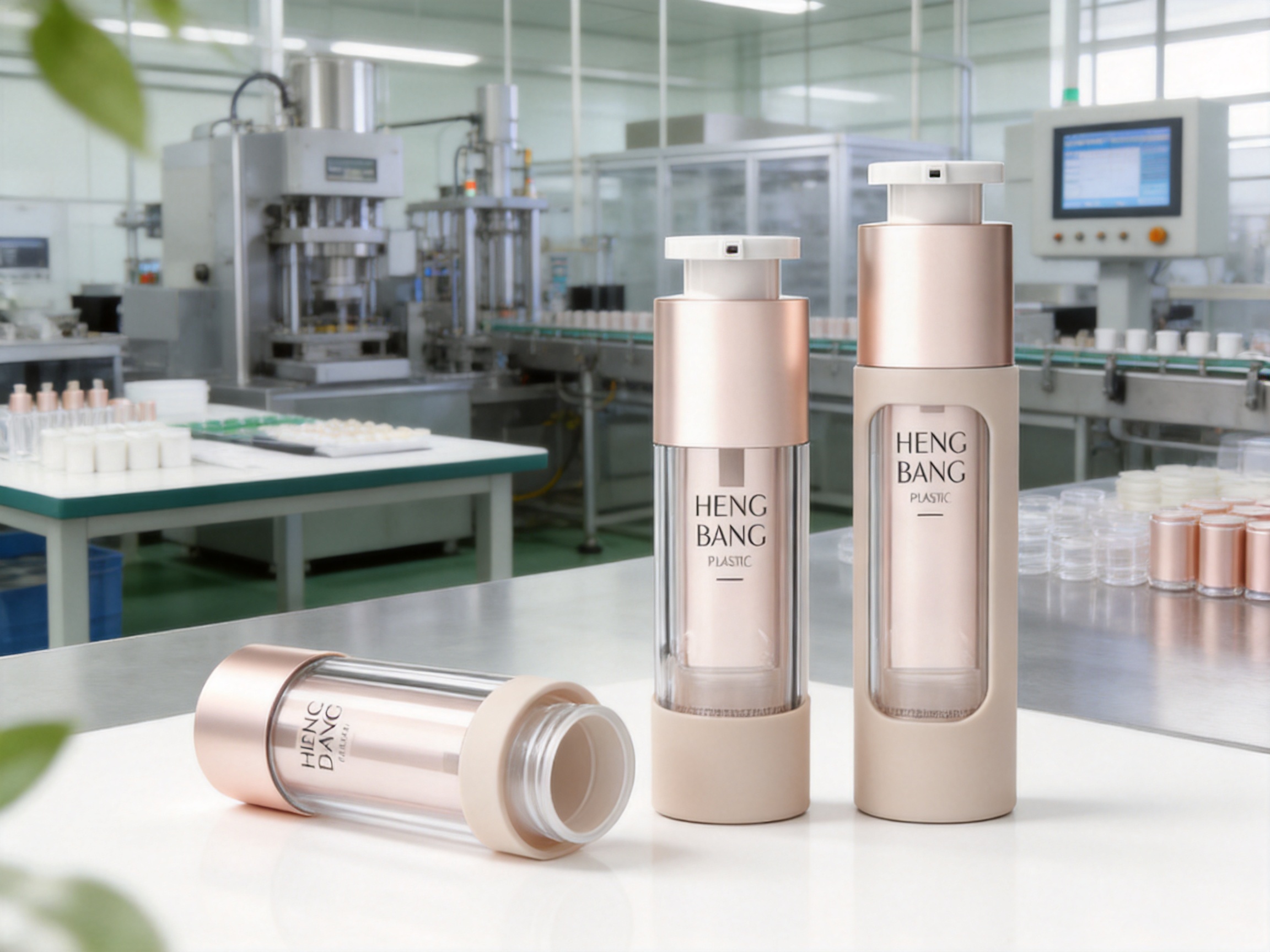
Yuyao Hengbang Plastic Co., Ltd. was established in 2006 and operates in a 35,000-square-meter building area with more than 300 employees. The company specializes in plastic packaging for cosmetics and skincare products. This focused industry experience is valuable because cosmetic packaging requires coordinated knowledge of mold design, component assembly, visual quality, formula compatibility, filling requirements, and market presentation.
A manufacturer with dedicated experience in cosmetic packaging can support more than the production of individual components. It can help connect the design concept with the realities of mass production. This includes reviewing part geometry, evaluating assembly methods, considering pump and bottle tolerances, planning decoration, and identifying potential problems before large-scale manufacturing.
The company provides design and development services. This capability can be important for brands that require packaging beyond a standard catalog selection. Development support may include early concept discussion, structural review, sample preparation, component matching, and production planning.
For the HB-K022A/B bottle, development discussions can focus on the refill interface, inner-bottle replacement process, pump performance, outer-bottle finish, capacity selection, and compatibility with the customer’s intended formula. Addressing these issues early can reduce the risk of expensive changes after molds, filling equipment, or printed materials have been finalized.
Plastic cosmetic packaging depends on accurate molds and stable molding conditions. Small variations in dimensions can affect pump fit, seal performance, appearance, and assembly. Professional mold development is therefore central to reliable airless packaging production.
For an airless refillable bottle, the manufacturer must control the interfaces between the inner bottle, outer housing, pump, clip, and associated sealing elements. The piston and inner-bottle geometry must work together so that the product can be delivered smoothly. Dimensional control is also important for ensuring that replacement inner bottles fit the permanent outer component as intended.
Injection-molding parameters can influence part quality. Temperature, pressure, cooling time, material drying where applicable, and cycle stability should be managed according to the selected material and component design. Consistent processing helps reduce warpage, sink marks, flash, incomplete filling, surface defects, and dimensional variation.
The product is not simply a collection of separate molded parts. Its performance depends on the accurate assembly of the pump, inner bottle, outer bottle, piston, and retaining clip. Assembly processes should be designed to prevent incorrect insertion, damage to seals, cosmetic scratches, and variation in pump operation.
Quality control may include visual inspection, component fit checks, pump actuation checks, leakage tests, and sampling of dosage consistency. For refillable packaging, the replacement procedure should also be evaluated. A refill system must be intuitive for the customer and robust enough to maintain the expected package integrity after the inner bottle is changed.
Yuyao Hengbang Plastic Co., Ltd. has passed ISO9001:2015 and ISO14001:2015 certifications according to the provided company information. ISO9001:2015 is associated with quality-management systems, while ISO14001:2015 is associated with environmental-management systems. These certifications indicate that the company has established documented management frameworks in these areas.
Certification is one part of supplier evaluation, not a substitute for product-specific approval. Buyers should still request samples, inspection standards, technical drawings, material information, testing records, and quality agreements for each project. However, a structured management system can provide a useful foundation for controlled production, corrective action, traceability, and continuous improvement.
The company owns multiple invention patents and was awarded as a Ningbo High-Tech Enterprise in 2021, according to the supplied information. These details suggest an emphasis on technical development and innovation. In a competitive packaging market, innovation can involve dispensing systems, refill structures, component integration, material use, appearance, or manufacturing efficiency.
The HB-K022A/B refillable airless concept reflects the type of product development that combines mechanical functionality with sustainability-oriented packaging goals. The commercial value of such innovation depends on reliable production, convenient consumer use, and successful compatibility with real cosmetic formulas.
The refillable structure is designed to reduce plastic waste by keeping the outer bottle in use. Rather than replacing a complete package after every purchase, the consumer replaces the inner bottle. This can reduce the mass of material consumed over the life of a product system, particularly when the outer component is used for several refill cycles.
It is important to communicate the sustainability benefit accurately. A refillable package is not automatically a low-impact package in every situation. The result depends on the weight and materials of the outer bottle, the replacement insert, manufacturing energy, transportation, the number of refills used, and end-of-life treatment. Consumer behavior also matters. If consumers purchase the refill but discard the outer bottle after one use, the potential benefit is reduced.
Brands can support responsible use by providing clear instructions. The packaging should explain how to remove the empty inner bottle, install the replacement, retain the outer bottle, and dispose of the used inner component according to local rules. Instructions should be concise and accessible, and they may be included on the carton, label, insert, or digital product information.
The company’s ISO14001:2015 environmental-management certification is relevant to discussions about environmental management at the organizational level. Product-specific sustainability claims should still be supported by appropriate data. Brands may consider comparing the material weight of a refill system with that of repeated complete-package purchases, using transparent assumptions and a clearly defined use scenario.
A refill program succeeds when the replacement process is simple. Consumers should understand which component is replaced and which component is retained. The inner bottle should be easy to identify, and the replacement should fit securely without requiring specialized tools.
The refill experience can become part of the product’s identity. A brand may sell replacement inner bottles in protective cartons or compact formats that require less secondary packaging than a complete bottle. It may also offer subscriptions or multipacks for customers who use the product regularly. These commercial approaches should be evaluated alongside shipping protection and product hygiene.
| Packaging format | Air exposure control | Refill potential | Typical strengths | Key considerations |
|---|---|---|---|---|
| Open-mouth jar | Lower, because the product is exposed during opening and use | Usually limited | Wide opening and familiar use | Direct contact, possible residue, and repeated exposure |
| Standard pump bottle with dip tube | Moderate | Usually limited | Convenient pumping and broad availability | Tube reach, residue, and air exchange may vary |
| Single-use airless bottle | High potential for controlled dispensing | Generally no | Product protection and premium positioning | Complete package may be discarded after use |
| Refillable airless bottle | High potential for controlled dispensing | Yes, through replaceable inner bottle | Airless delivery, repeat-use outer housing, premium presentation | Requires compatible refill supply and clear replacement instructions |
| Dropper bottle | Variable | Usually limited | Precise visual dosing and serum identity | More exposed handling and possible formula contact with air |
The HB-K022A/B bottle competes most directly with single-use airless bottles and conventional pump packages. Its principal differentiator is the replaceable inner bottle. A single-use airless package may offer strong formula protection but requires the complete container to be replaced. A standard pump bottle may be cost-effective but may not provide the same combination of airless protection and refill capability.
The correct choice depends on the formula, target market, price point, brand identity, filling process, and sustainability objectives. The HB-K022A/B system is especially attractive when a brand wants a premium, hygienic, repeat-use package with multiple capacity choices.
A refillable airless bottle can support a clear product architecture. A brand may use the same outer bottle for a complete skincare routine, including hydrating serum, brightening serum, barrier cream, eye treatment, and lotion. Different inner-bottle labels, colors, or decorative details can distinguish the formulas while maintaining a unified visual language.
The 20 ml size can introduce a product to new customers through trial kits or travel collections. The 30 ml size can serve as a standard serum format. The 50 ml and 70 ml options can support larger treatment products or products intended for longer-term daily use.
Refill packaging can also support limited editions. A durable outer bottle may be decorated with a seasonal finish, while the replacement inner bottle carries the formula-specific identity. This can help reduce the need to reproduce a heavy or highly decorated outer component for every purchase cycle.
For professional skincare brands, salons, clinics, and treatment programs, the refillable system may offer a practical balance between presentation and ongoing supply. The outer bottle can remain part of the professional display, while replacement inner bottles simplify replenishment.
Before commercial launch, the bottle should be evaluated with the exact formula and filling process. Cosmetic products vary widely in viscosity, pH, oil content, solvent content, fragrance composition, active ingredients, and particle load. Packaging performance must therefore be verified through product-specific testing.
Compatibility testing should examine whether the formula causes swelling, cracking, discoloration, odor transfer, stress, or other changes in the inner bottle, pump, seals, or outer components. The formula should also be monitored for changes caused by contact with the packaging.
Testing conditions may include room temperature, elevated temperature, low temperature, freeze-thaw cycles where relevant, humidity exposure, and light exposure. The appropriate test plan depends on the formula and intended market. Samples should be inspected at defined intervals and compared with controls.
The pump should be tested for the number of actuations needed to prime the package, the consistency of the first doses, and the stability of dosage during continued use. Consumers expect the pump to work smoothly from the first use until the product is nearly empty.
Viscosity can change with temperature. A serum that pumps well at room temperature may become more difficult to dispense in a cold environment, while a thinner product may behave differently after warming. Testing across the expected storage range can help identify suitable formula and pump combinations.
Leakage testing is important for all cosmetic bottles, especially packages intended for online sales, travel, or international transportation. The assembled bottle should be evaluated in different orientations and subjected to vibration, compression, drop, and temperature conditions appropriate to the distribution system.
The retaining clip should be checked as part of this process. It should remain secure during transportation but be removable without damaging the pump or creating an inconvenient opening experience.
Because the outer bottle is intended to remain in use, refill-cycle testing can provide valuable information. The manufacturer and brand can evaluate whether the outer component maintains its appearance, structural integrity, and fit after repeated inner-bottle replacement.
The replacement interface should be checked for looseness, deformation, contamination, and incorrect installation. Clear instructions and sample-based user testing can help determine whether the refill procedure is sufficiently intuitive.
Quality control should be applied at multiple stages. Incoming materials can be checked for identity, appearance, and conformity to approved specifications. Molded components can be inspected for dimensions, flash, short shots, sink marks, color variation, and surface defects. Assembled products can be evaluated for pump operation, fit, leakage, and visual quality.
Critical dimensions should be identified during the design stage. These may include the inner-bottle interface, pump connection, seal-related features, clip engagement, piston movement area, and outer-bottle fit. Measurement tools and inspection frequency should be selected according to the risk associated with each feature.
Cosmetic packaging quality includes both function and appearance. A package may pass a dimensional check but still be unacceptable because of scratches, uneven decoration, contamination, color mismatch, or poor assembly alignment. A clear approved sample and written quality standard can help align the expectations of the manufacturer and the purchasing brand.
Traceability supports efficient investigation when a production issue occurs. Lot information, material records, machine information, inspection results, and assembly records can help identify the source and scope of a problem. A structured quality system can also support corrective and preventive action.
Customers should discuss quality documentation during supplier approval. Depending on the project, this may include inspection reports, material declarations, production samples, compatibility results, packaging tests, and certificates of analysis for relevant materials.
When evaluating the HB-K022A/B bottle for a new product, buyers should confirm the desired capacity, height, diameter, pump dosage, decoration method, and color requirements. The supplied dimensions should be reviewed against the brand’s label, carton, filling line, and shipping case requirements.
Buyers should also clarify whether the first shipment includes a complete bottle and whether subsequent orders can be supplied as replacement inner bottles. The refill supply chain should be planned before launch. A refillable package creates an expectation that replacement components will remain available for the intended product life.
Other useful questions concern minimum order quantities, sampling procedures, production lead times, mold ownership, packaging for transport, inspection standards, and the availability of technical drawings. These details influence both project cost and launch timing.
The outer bottle offers an important surface for visual branding. Depending on the selected production method and finish, a brand may consider printing, labeling, coating, color matching, metallic effects, or other decoration options. The final choice should account for adhesion, abrasion resistance, formula contact, and repeated handling.
For refillable packaging, the decorative treatment should be durable because the outer bottle is expected to remain in service. If the bottle’s appearance deteriorates after only one use cycle, the perceived value of the refill system may decline. Testing should include rubbing, handling, storage, and exposure to common cosmetic substances.
A successful refillable package must be easy to understand. The consumer should know when the inner bottle is empty, how to remove it, where to obtain a replacement, and how to install the new component. The replacement should be secure and should not require excessive force.
Instructions may explain that the permanent outer bottle should be retained, while the empty inner bottle should be disposed of according to local waste-management guidance. If the inner bottle contains residual product, the instructions may recommend emptying it as completely as practical before disposal.
The nozzle clip should be identified as a transport or storage lock. Consumers should be told when to remove it and whether it should be retained for future transportation. Clear communication can prevent confusion and reduce the risk of accidental pump activation.
Cosmetic packaging combines industrial design, material selection, mechanical function, visual quality, and formula compatibility. A supplier that specializes in this field can understand the relationship between these requirements more effectively than a general-purpose plastics producer.
Yuyao Hengbang Plastic Co., Ltd. has focused on plastic packaging for cosmetics and skincare products since its establishment in 2006. Its more than 300 employees and 35,000-square-meter building area provide an industrial foundation for product development and production. The company’s stated services include design and development, allowing customers to discuss packaging concepts as well as manufacturing requirements.
The company’s ISO9001:2015 and ISO14001:2015 certifications, high-tech enterprise recognition, and multiple invention patents further support its positioning as a technically organized packaging manufacturer. These strengths are relevant to brands that require repeatable quality, development support, and a supplier capable of handling evolving packaging expectations.
For the HB-K022A/B bottle, the combination of refillable construction and airless dispensing requires coordinated control of several components. A specialized manufacturer can help evaluate the complete system rather than treating the outer bottle, inner bottle, pump, and clip as unrelated items.
It is designed as a plastic refillable airless bottle for cosmetic and skincare products, including serums, creams, lotions, and other suitable formulas that benefit from controlled dispensing and reduced exposure to air.
The package includes a permanent outer bottle and a replaceable disposable inner bottle. Once the product in the inner bottle is used, the inner component can be replaced while the outer bottle is retained for future use.
The listed capacity options are 20 ml, 30 ml, 50 ml, and 70 ml. The appropriate size depends on the product dosage, target market, usage period, and desired package dimensions.
Airless means that the product is dispensed through a piston-based system rather than through a conventional dip tube that remains immersed in the formula. The piston moves upward as the product is used, helping limit air entry and position the formula for dispensing.
The listed materials are PP for the retaining clip, PP and ABS for the pump, MS for the outer bottle, and PP for the inner bottle.
No packaging system can guarantee a specific shelf life by itself. Airless packaging can help reduce exposure to air and contamination, but the finished product must be evaluated through stability, compatibility, and regulatory testing with the actual formula.
The listed dosage is 0.23 cc per actuation. Actual dosage should be confirmed through testing because pump output can vary according to component tolerances, formula viscosity, temperature, and actuation conditions.
It may be suitable for certain creams, but the formula must be tested with the package. Thick or highly structured formulas can require specific evaluation of priming, actuation force, dispensing consistency, and product evacuation.
The clip helps prevent unintended nozzle activation during transportation, storage, or handling. It should be removed when the product is ready for use.
The design is intended to allow the outer bottle to remain in use. The replaceable inner bottle is changed after the product is consumed. Disposal procedures should follow the instructions provided by the brand and applicable local regulations.
The concept is specifically based on replacing the inner bottle. Brands should confirm the availability, supply conditions, packaging, and ordering process for replacement inner bottles with the manufacturer before launching the product.
Recommended evaluations include formula compatibility, stability, pump priming, dosage consistency, leakage, drop resistance, vibration, temperature exposure, decoration durability, inner-bottle replacement, and repeated refill-cycle performance.
Customization possibilities should be discussed with the manufacturer. Potential areas may include color, surface finish, decoration, labeling, capacity selection, and coordinated packaging for a product family. Technical feasibility should be confirmed using production-intent samples.
A specialized manufacturer understands the relationship between cosmetic formulas, pump systems, molded parts, visual standards, filling operations, and retail requirements. This can help reduce development risks and support more consistent mass production.
The HB-K022A/B Plastic Refillable Airless Serum Bottle offers a practical response to several major needs in modern cosmetic packaging. Its piston-based airless system helps protect the formula from unnecessary exposure to air and external contamination. Its pump provides controlled dispensing, while the retaining clip supports safer transportation and storage. Most importantly, its permanent outer bottle and replaceable inner bottle create a refillable structure that can reduce packaging turnover over repeated purchases.
The product’s 20 ml, 30 ml, 50 ml, and 70 ml capacities provide flexibility for different skincare formats and market positions. Its PP, ABS, and MS component structure supports a balance of functionality, durability, and premium appearance. The design is suitable for many serums, creams, lotions, and treatment products, provided that formula-specific compatibility and performance testing are completed.
Behind the product is a manufacturer with experience in cosmetic and skincare packaging, a 35,000-square-meter building area, more than 300 employees, design and development capabilities, ISO9001:2015 and ISO14001:2015 certifications, high-tech enterprise recognition, and multiple invention patents. These strengths provide a foundation for supporting packaging projects from concept development through production.
For brands seeking packaging that combines formula protection, premium presentation, convenient dispensing, and a more responsible refill model, the HB-K022A/B bottle is a strong option for consideration. Its greatest value is achieved when the package, formula, refill supply chain, consumer instructions, and quality-control program are developed as one integrated system.
1. Product information supplied for the HB-K022A/B Plastic Refillable Airless Serum Bottle, including material, capacity, dimensional, and application data.
2. Company information supplied for Yuyao Hengbang Plastic Co., Ltd., including company history, facility size, employee number, certifications, patents, and design-development capabilities.
3. ISO 9001:2015, Quality Management Systems—Requirements.
4. ISO 14001:2015, Environmental Management Systems—Requirements with Guidance for Use.
5. General principles of cosmetic packaging compatibility, stability testing, dispensing evaluation, and packaging quality control.
6. General industry practices for refillable packaging design, consumer instructions, material evaluation, and end-of-life communication.


Copyright © Yuyao Hengbang Plastic Co., Ltd.
All Rights Reserved.
 Wholesale Plastic Cosmetic Packaging Manufacturers