English
 中文简体

News
Home > Author > Chen Xiaotong — Key Account Sales Manager > Travel-Size PETG Lotion Bottles for Modern Skincare Packaging

 2026.10.10
 Chen Xiaotong — Key Account Sales Manager
Content
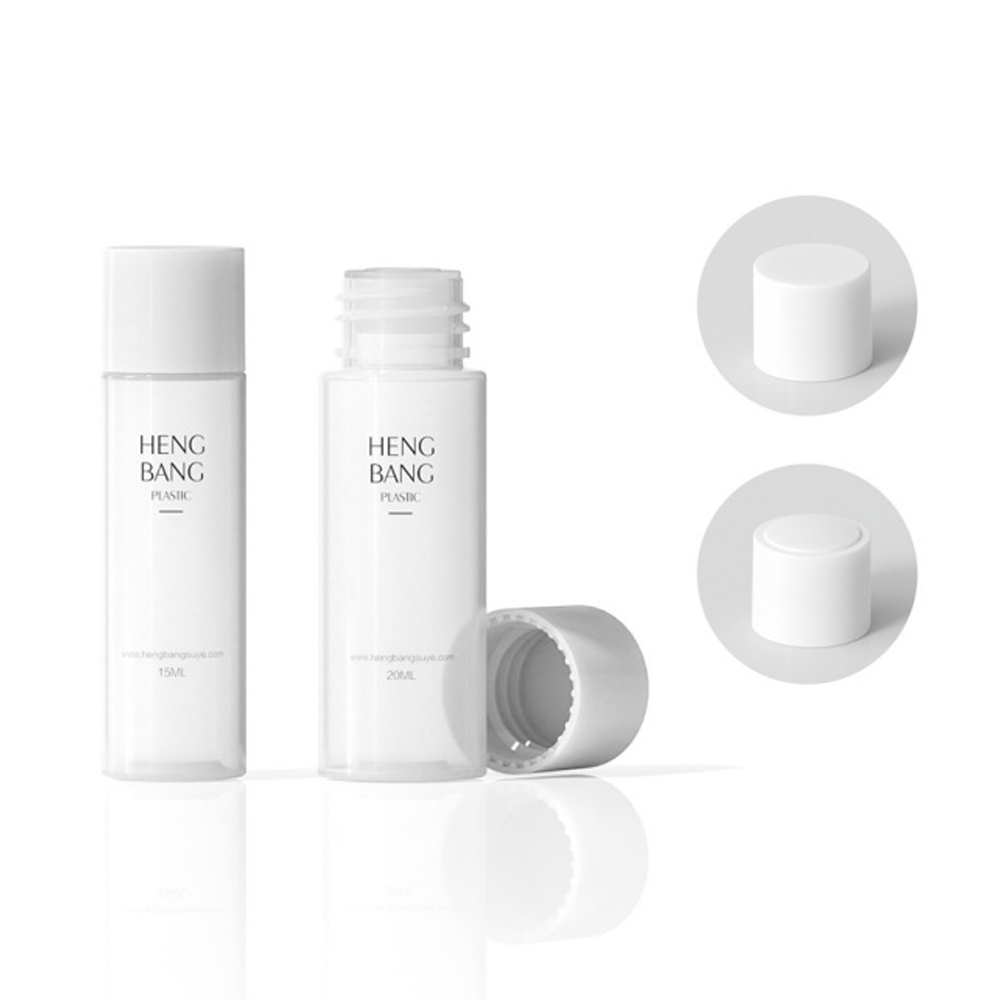
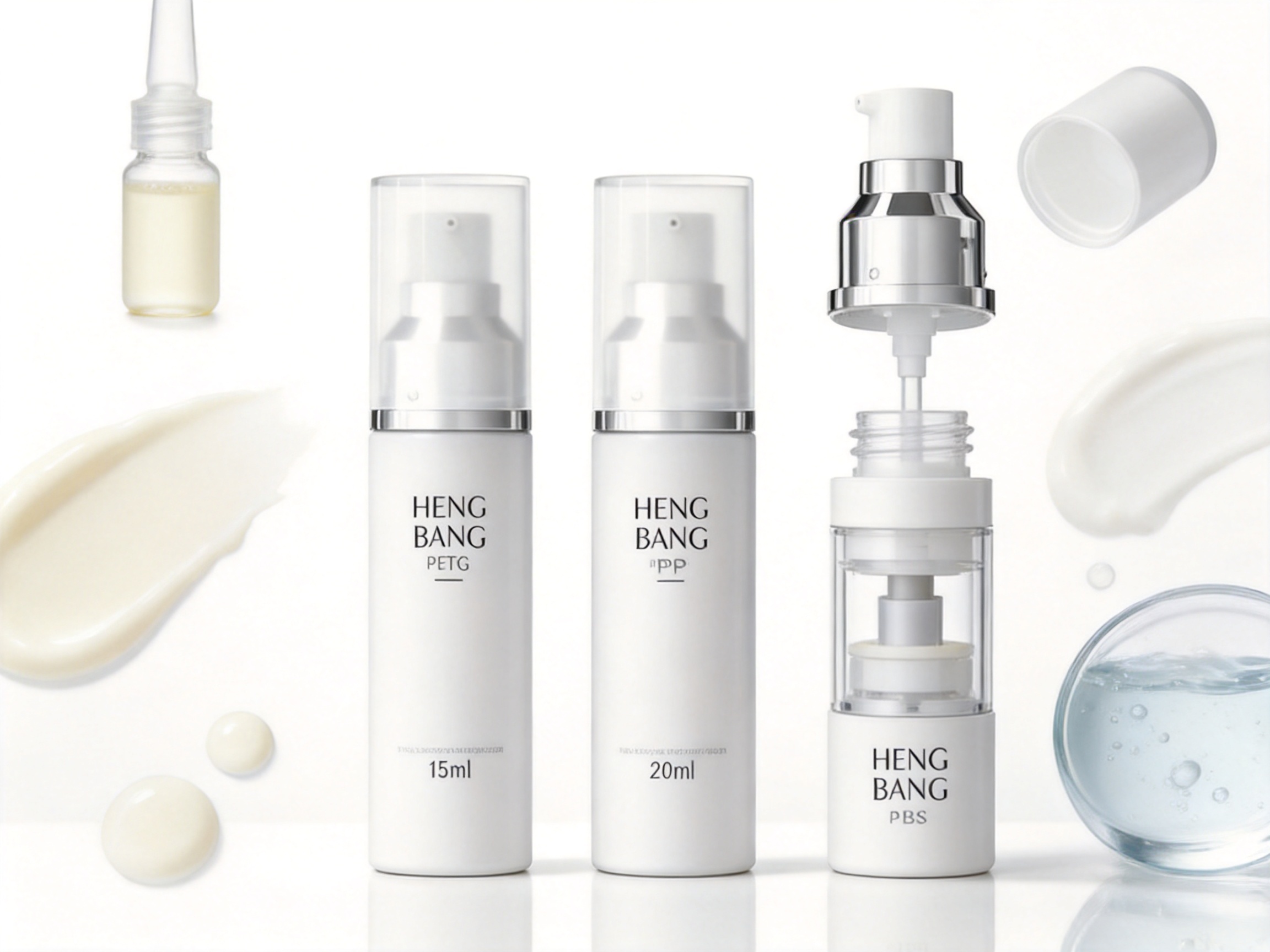
Travel-friendly skincare packaging must combine compact dimensions, reliable dispensing, attractive appearance, and practical protection for the formula inside. The HB-R007 PETG plastic travel-size lotion bottle is designed to meet these needs in a small, efficient package. Available in 15ml and 20ml capacities, this bottle provides a convenient solution for moisturizers, creams, serums, hand lotions, and other personal-care formulas that consumers want to carry during business trips, holidays, gym visits, overnight stays, and everyday commuting.
Unlike ordinary refill containers that may look generic or feel difficult to use, the HB-R007 is developed as a purpose-built cosmetic package. Its PETG body offers a refined appearance and a useful balance of clarity, strength, and lightweight performance. The combination of PETG with PP components supports the functional requirements of lotion packaging while maintaining a compact footprint. With a diameter of approximately 25.5mm and heights of about 90.7mm or 100.7mm, depending on capacity, the bottle is easy to organize in a toiletry bag, cosmetic pouch, handbag, or travel case.
This product is also suitable for companies that need packaging in multiple formats. The listed configurations include A, B, and C options, with capacities of 15ml and 20ml. The lotion versions use PETG and PP, while the water-oriented version uses ABS, PP, and PETG. This range allows cosmetic brands, skincare manufacturers, hotels, travel retailers, and sample-product developers to select a configuration that better suits the texture and dispensing behavior of their formula.
For a packaging buyer, the value of a small bottle is not determined by size alone. The package must be compatible with the product, convenient for the end user, attractive on a retail shelf, and suitable for consistent production. It must also support filling, transportation, storage, labeling, and quality inspection. The HB-R007 addresses these practical considerations through a compact design, carefully selected materials, several capacity options, and the manufacturing experience of a specialized cosmetic packaging producer.
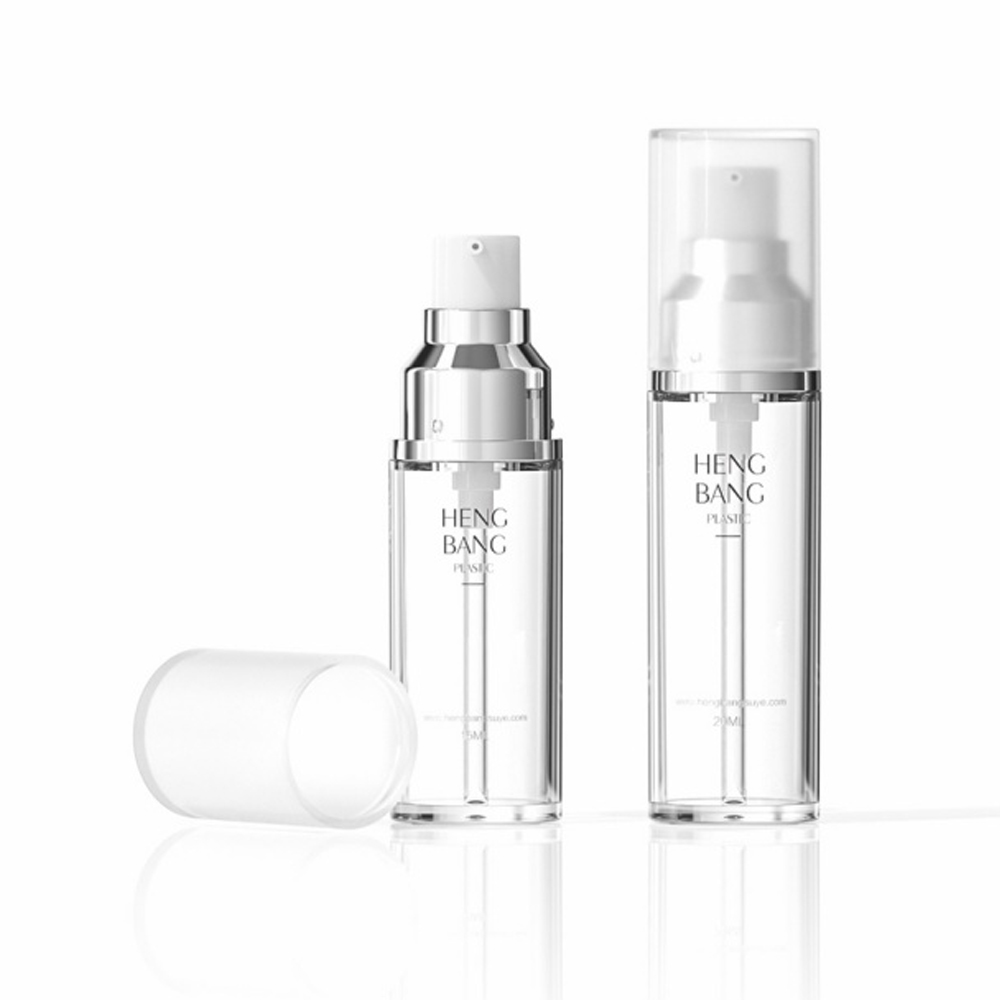
HB-R007 PETG Plastic Travel Size Lotion Bottle
The strongest advantage of a travel-size lotion bottle is convenience. Consumers increasingly expect skincare products to fit naturally into flexible routines. A full-size lotion container may be appropriate for bathroom use, but it can occupy unnecessary space when a user is traveling or carrying products throughout the day. A 15ml or 20ml container provides a more suitable quantity for short trips, trial programs, promotional kits, and portable personal-care collections.
The HB-R007 is designed around this compact-use requirement. Its narrow cylindrical form helps reduce the amount of space needed in a cosmetic bag. The approximately 25.5mm diameter makes the bottle easy to hold and arrange with other travel accessories. Its height varies according to the selected capacity, with listed dimensions of approximately 90.7mm for one size and 100.7mm for the other. This format allows the package to remain slim while still providing enough internal volume for a useful quantity of lotion or liquid skincare product.
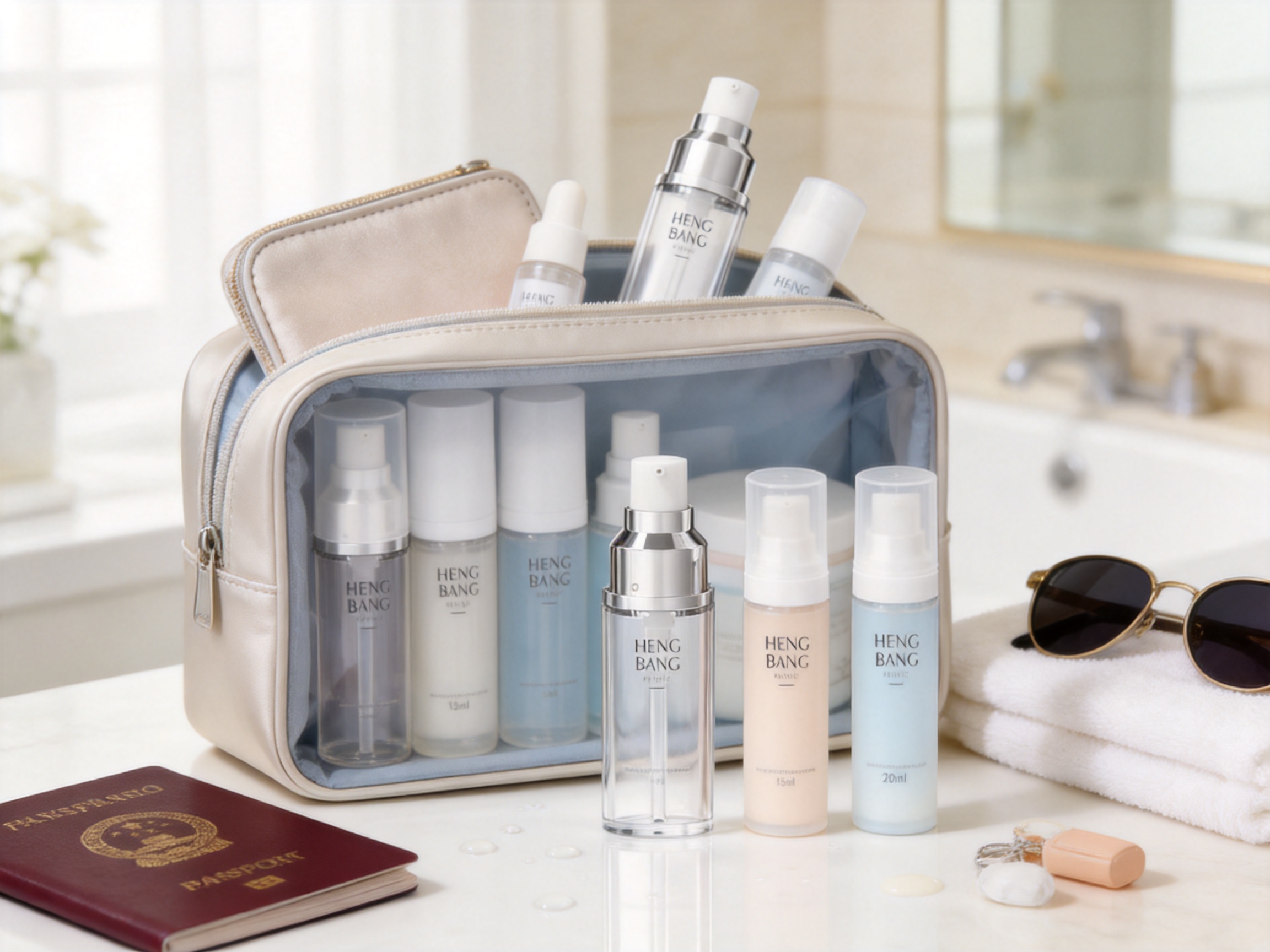
A compact package can also improve product organization. Travelers often carry several products, including cleanser, toner, serum, moisturizer, sunscreen, and hand cream. Small bottles with consistent shapes can be placed together in a dedicated kit, making the routine easier to identify and manage. For brands, the same basic package can support a coordinated travel collection in which each product uses a related bottle design while different labels or decorations distinguish the formulas.
In addition to travel, the bottle is appropriate for situations where portability is important. It can be used for gym bags, office drawers, hotel amenities, sample sets, beauty subscription boxes, event gifts, and emergency personal-care kits. The size can also support controlled consumption. Instead of opening a large package repeatedly, a consumer can carry a smaller quantity for a defined period, reducing the burden of transporting unnecessary product.
PETG is widely valued in packaging applications because it can provide a clear, smooth, and polished appearance while maintaining useful mechanical performance. In cosmetic packaging, visual presentation is especially important. Consumers frequently evaluate a product before purchase by looking at the package, examining its surface, and judging whether its construction appears clean and dependable. A PETG bottle can contribute to a modern and professional appearance that is appropriate for skincare and personal-care brands.
The HB-R007 lotion configurations are specified as PETG plus PP. PETG forms the principal bottle material, while PP is used in associated components. This material combination gives packaging buyers a practical foundation for lotion products. PETG can help create an attractive container body, while PP is commonly used for functional cosmetic packaging parts that require dimensional consistency and suitable processing characteristics.
Material selection must always be evaluated together with the formula. A packaging supplier can provide a suitable bottle structure, but the final brand owner or filler should confirm compatibility through testing. Factors such as alcohol content, oils, botanical extracts, acids, fragrances, viscosity, preservatives, and active ingredients may influence the long-term interaction between a formula and its container. Compatibility testing should include storage at appropriate temperatures, observation of color or odor changes, leakage checks, dispensing performance, and assessment of the package surface.
The PETG body may be especially attractive for products that benefit from a visible or refined container appearance. Depending on the selected finish and decoration process, the bottle can support a transparent, translucent, colored, frosted, printed, or otherwise customized visual direction. The specific available finish should be confirmed during development because decoration options depend on the design, order quantity, production process, and customer requirements.
Compared with basic commodity travel containers, a dedicated PETG cosmetic bottle can provide a more considered appearance. A generic refill bottle may be functional, but it may not communicate the quality or identity of a skincare brand. The HB-R007 offers a more structured platform for brands that want portability without abandoning a premium presentation.
The product description identifies the HB-R007 as a travel-size lotion bottle. It is intended for moisturizers, creams, serums, and hand lotions, making it relevant to a broad range of skincare and personal-care products. The listed application value is 0.12cc, which can support controlled dispensing when matched with the appropriate pump or dispensing mechanism.
Controlled output is important in skincare packaging. A consumer usually does not need a large amount of lotion or serum at one time. A measured or moderate dose can make application easier and help reduce waste. It can also support a more consistent user experience across repeated applications. For brands, an appropriate output rate may help communicate quality and make the package feel more precise than a simple open-mouth container.
Formula viscosity should be considered during product development. A lightweight serum, fluid lotion, rich cream, and gel may require different dispensing characteristics. The 0.12cc application specification provides a useful reference point, but the final dispensing result should be checked with the actual formula. Testing should confirm that the product can be primed efficiently, dispensed without excessive force, and used without clogging or irregular output.
The product information also lists a water-oriented configuration using ABS, PP, and PETG. This indicates that the range can include a version intended for water-like products, while the lotion versions use PETG and PP. Such differentiation is valuable because packaging should be selected according to both the appearance and the physical behavior of the formula. A water-like toner or essence may have different requirements from a thicker lotion or cream.
For a cosmetic brand, having related package options can simplify the development of a product family. A toner, serum, lotion, and hand-care product may be offered in coordinated sizes or silhouettes while using material combinations suited to each formula. This creates visual consistency while preserving functional flexibility.
The HB-R007 is available in 15ml and 20ml capacities. This two-size structure gives buyers more control over how the package is positioned. A 15ml bottle can be suitable for sample programs, short-term travel, trial-size products, gift sets, and premium discovery collections. A 20ml bottle offers slightly more content while maintaining the same general travel-friendly concept.
The choice between 15ml and 20ml can be linked to the intended use of the product. A skincare brand launching a new serum may prefer 15ml for sampling and customer acquisition. A travel retailer may select 20ml for a product intended to last through several days of use. A hotel or spa may use either size depending on the service format and expected consumption period.
Different capacities can also support price-tier planning. A smaller container may allow a brand to offer a lower entry price or include the product as part of a promotional kit. The larger option can be positioned as a portable retail product with a higher fill volume. Both formats can help brands expand their product range without creating a completely different packaging concept for every application.
According to the provided specifications, the listed heights are approximately 90.7mm and 100.7mm for configurations A and C, while configuration B is listed at approximately 69.8mm and 79.8mm. The exact dimension depends on the selected design and capacity. Buyers should request a production drawing or technical specification sheet before finalizing artwork, filling equipment, shipping cartons, and retail displays.
The listed HB-R007 range includes three configurations identified as A, B, and C. The capacity for each is shown as 15ml or 20ml. The material information identifies A and C as lotion versions using PETG and PP, and B as a water-oriented version using ABS, PP, and PETG.
| Configuration | Intended Product Direction | Listed Materials | Available Capacity | Listed Height Range |
|---|---|---|---|---|
| A | Lotion and similar skincare formulas | PETG + PP | 15ml / 20ml | 90.7mm / 100.7mm |
| B | Water-like formulas | ABS + PP + PETG | 15ml / 20ml | 69.8mm / 79.8mm |
| C | Lotion and similar skincare formulas | PETG + PP | 15ml / 20ml | 90.7mm / 100.7mm |
| All listed versions | Travel-size cosmetic packaging | Configuration-dependent | 15ml / 20ml | Configuration-dependent |
The table should be treated as a product-selection guide rather than a substitute for the final technical drawing. The materials supplied for each version are based on the available product information. Before mass production, a buyer should confirm the specific component structure, neck or closure details, pump operation, bottle weight, decoration area, tolerances, and filling compatibility.
Offering multiple configurations can be a competitive advantage because it reduces the need to search for separate suppliers for every product texture. A brand developing a complete travel collection may be able to use related packaging from one manufacturing partner while selecting the version best matched to each formula.
Many travel containers are designed primarily as inexpensive refill vessels. They may have limited visual appeal, inconsistent dispensing, or a shape that is difficult to integrate into a coordinated cosmetic line. The HB-R007 is positioned more specifically as a cosmetic skincare package, which gives it several potential advantages for professional brands.
First, the PETG body can offer a more polished appearance than ordinary soft plastic travel bottles. A refined surface and carefully controlled shape may help the package communicate the quality of the formula inside. This is particularly important for facial skincare, premium hand care, and products sold through beauty retailers.
Second, the two-capacity range provides greater flexibility than a single-size container. Buyers can select 15ml or 20ml according to the purpose of the product rather than adapting every project to one fixed volume.
Third, the range includes material and configuration choices for lotion and water-like products. This is more useful than selecting one universal container without considering formula behavior. A package designed for the general cosmetic market can be more practical when it offers different structures for different product types.
Fourth, the compact cylindrical dimensions support efficient handling and storage. The narrow diameter can make the bottle easy to place in travel bags and display trays. A uniform format can also support the creation of product sets with coordinated branding.
Fifth, the stated 0.12cc application specification provides a starting point for controlled dispensing. While the final performance must be confirmed with the complete assembly and formula, a defined output reference is valuable during testing and product planning.
Finally, the product is manufactured by a company with an established focus on cosmetic and skincare packaging. This matters because cosmetic containers require more than general plastic processing. They must be developed with attention to appearance, dimensional accuracy, component assembly, formula compatibility, filling requirements, decoration, and quality control.
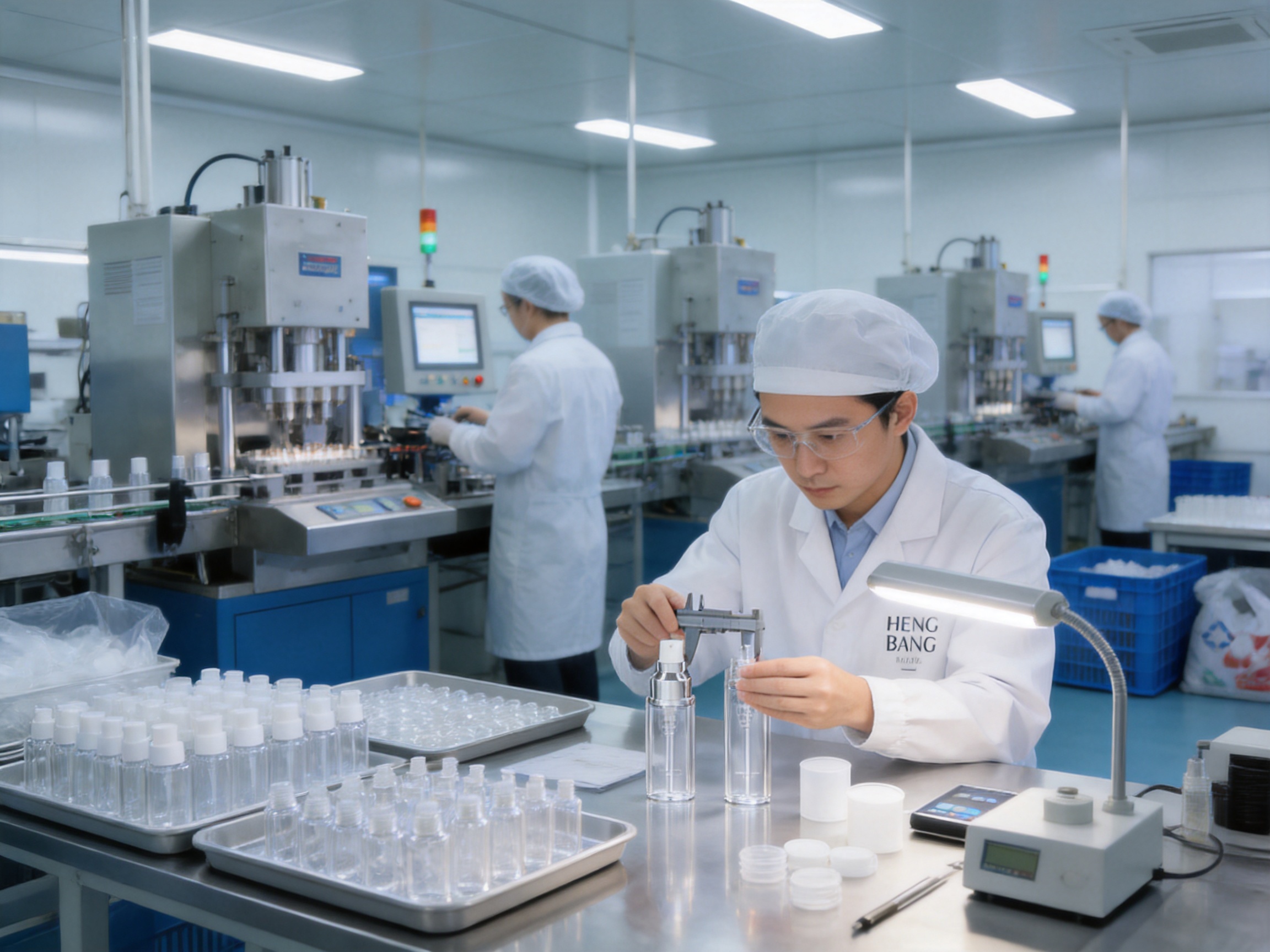
Yuyao Hengbang Plastic Co., Ltd. was established in 2006 and specializes in plastic packaging for cosmetics and skincare products. The company has a building area of approximately 35,000 square meters and more than 300 employees. These resources provide a substantial foundation for product development, tooling, molding, assembly, inspection, and customer service.
The company’s specialization is relevant to the HB-R007 because cosmetic packaging has requirements that differ from many other plastic products. A cosmetic bottle must combine technical reliability with a high standard of appearance. Surface quality, color consistency, assembly alignment, component fit, and clean handling can all influence the customer’s perception of the final product.
A larger production site can also support coordination among different manufacturing stages. Product development may begin with design and engineering, followed by mold development, trial production, process adjustment, component manufacturing, assembly, inspection, and packing. When these activities are organized within an experienced packaging operation, communication can be more efficient and production issues can be addressed earlier.
The company states that its young and professional team provides a full range of services, including design and development. This service capability is important for customers that do not want to purchase an off-the-shelf package without technical consultation. Design support can help with product selection, dimensional adjustments, component matching, decoration planning, and preparation for production.
A customer may approach the manufacturer with a general concept, such as a 15ml travel lotion package, and then require guidance on the appropriate configuration. Questions may include whether the formula is best suited to a lotion or water version, which capacity is more suitable, how much space is available for decoration, and whether the chosen dispenser can provide the intended output. A professional development team can help structure this process.
Yuyao Hengbang Plastic Co., Ltd. has passed ISO9001:2015 and ISO14001:2015 certifications according to the provided company information. ISO9001:2015 is associated with quality management systems, while ISO14001:2015 is associated with environmental management systems. Certifications do not eliminate the need for product-specific inspection, but they demonstrate that the company has established formal management frameworks related to quality and environmental practices.
For a packaging buyer, a quality management system can support more consistent control of production activities. It may include documented procedures, responsibilities, process monitoring, corrective actions, record management, and customer-feedback handling. These systems are useful when manufacturing large quantities of small cosmetic components, where minor dimensional variations can affect assembly or dispensing performance.
Environmental management is also increasingly important in the cosmetic packaging industry. Brands are paying closer attention to material selection, production efficiency, waste reduction, energy use, packaging logistics, and end-of-life considerations. ISO14001 certification indicates that environmental management is addressed through a formal system, although buyers should still request project-specific information when sustainability claims or environmental targets are important to a product launch.
For the HB-R007, responsible development can include evaluating the amount of material used, optimizing packaging dimensions, minimizing unnecessary secondary packaging, and selecting shipping cartons that protect the bottles without excessive empty space. A compact bottle may contribute to more efficient storage and transportation compared with a larger package, although the total environmental impact depends on the complete supply chain and disposal method.
The company was awarded as a Ningbo High-Tech Enterprise in 2021 and owns multiple invention patents, according to the supplied information. These credentials indicate an emphasis on technical development and innovation. In the packaging sector, innovation can involve more than creating a new visual shape. It may include improvements in dispensing, assembly, sealing, mold design, material use, component integration, manufacturing efficiency, or user experience.
Research and development capability can be valuable when a customer needs packaging adapted to a particular formula or market. For example, a brand may require a specific output rate, a compact travel format, a certain decoration area, or a more distinctive appearance. Engineering experience can help translate these commercial goals into a manufacturable design.
Product development should follow a controlled process. The first stage is usually the definition of the intended application. The buyer should identify the formula type, viscosity, sensitivity to air or light, expected usage period, target market, capacity, and dispensing preference. The next stage is the selection or modification of a suitable package. Samples can then be evaluated for appearance, handling, filling, dispensing, leakage, and compatibility.
After a design is selected, mold and process development become important. The manufacturer must control dimensions, wall thickness, gate locations, cooling behavior, component fit, and surface quality. Assembly trials can reveal whether the parts align properly and whether the finished bottle meets the expected tactile and visual standard. Quality-control procedures should be defined before mass production begins.
This development approach helps reduce the risk of discovering major problems after a large production run. It also allows the brand to make informed decisions about artwork, labels, cartons, filling machinery, and product claims.
The HB-R007 uses a multi-component structure involving PETG, PP, and, for the water-oriented version, ABS. Each material brings different processing characteristics. Consistent molding requires appropriate control of temperature, pressure, cooling, cycle time, and mold conditions. The exact parameters are determined by the component design and production equipment.
For the PETG bottle body, appearance and dimensional control are especially important. Cosmetic consumers may notice haze, flow marks, scratches, uneven walls, contamination, or inconsistent color. A professional manufacturing process should therefore include attention to mold condition, material handling, clean production, and inspection standards.
PP components must be produced with dimensions that support reliable assembly. If a PP part is too loose, the package may feel unstable or leak. If it is too tight, assembly may become difficult or the part may deform. Proper tolerances are necessary to support the intended function without creating unnecessary stress on the components.
The water-oriented version uses ABS, PP, and PETG. Since different polymers may be included in the same package, the assembly process must account for their individual properties. The final package should be evaluated for fit, appearance, mechanical handling, and chemical compatibility with the intended product.
Assembly quality is particularly important for small packages. A minor misalignment can be more visible on a compact bottle, and a small seal problem can affect the entire user experience. Inspection should therefore cover component presence, visual defects, closure fit, dispensing behavior, leakage, and packaging cleanliness.
Before confirming a production order, a buyer should create a clear quality specification for the HB-R007. The specification should define the selected configuration, capacity, materials, dimensions, color, surface finish, decoration, output rate, packaging method, and acceptable defect limits.
Visual inspection is one of the first quality-control steps. Inspectors may check for scratches, black spots, air marks, short shots, deformation, color variation, contamination, and uneven surfaces. For a clear or translucent PETG bottle, visual defects may be especially noticeable. The buyer and manufacturer should agree on inspection lighting and viewing distance so that acceptance decisions are consistent.
Dimensional inspection can confirm the height, diameter, wall characteristics, and relevant component measurements. The listed diameter is approximately 25.5mm, but the buyer should confirm the tolerance and identify the exact measurement location. Height can vary according to the selected configuration and capacity, so the final drawing should be used for production control.
Functional testing should include dispensing tests with the actual formula or a representative test substance. The evaluator should observe priming time, output quantity, smoothness, leakage, recovery after use, and the ability to dispense near the end of the package’s life. The stated 0.12cc application value can serve as a reference, but the acceptable range should be defined for the complete product assembly.
Leakage testing is important for products transported in luggage or shipped through distribution networks. The package should be tested under relevant conditions, including upright and inverted storage where appropriate. Temperature changes, vibration, and pressure variation may also be considered depending on the intended market and transportation route.
Compatibility testing should run for an appropriate period and include the actual formula. The bottle and formula should be evaluated for changes in color, odor, viscosity, mass, appearance, and dispensing behavior. The container should also be checked for swelling, cracking, stress marks, deformation, softening, or other signs of interaction.
A travel-size bottle has a limited decoration area, which makes design efficiency important. The narrow body can support a simple logo, product name, ingredient message, usage instruction, or color-coded identity. The brand should prioritize the information that consumers need most and ensure that text remains legible at the final size.
Depending on the selected surface and decoration process, the package may support printing, labeling, coating, frosting, coloring, or other visual treatments. Available options should be confirmed with the manufacturer during the development stage. Decoration trials are recommended because the appearance of ink, coating, or labels can vary according to PETG surface conditions, curvature, color, and production method.
A consistent bottle shape can help a skincare brand build a coordinated collection. For example, a 15ml serum, a 20ml lotion, and a travel hand cream can share a similar visual system while using different labels or color details. This can make the product family easier to recognize and can simplify retail presentation.
Packaging design should also consider the user’s grip and visual orientation. A bottle that is easy to identify and hold can improve convenience during travel. Clear information about the product type and usage instructions helps prevent confusion when several small bottles are stored together.
For promotional or sample products, the package should communicate enough brand value to encourage a future purchase. A cheap-looking sample container may reduce the perceived quality of the formula. A well-designed PETG package can create a more positive first interaction and help the customer understand the brand’s attention to detail.
The HB-R007 can be considered for a broad range of applications. Moisturizers are a natural fit because the bottle is described as a lotion package and is available in compact volumes. Hand lotions can benefit from a portable format that fits in a purse, work bag, or travel case. Serums and concentrated skincare products may also use the bottle when the formula and dispensing system are compatible.
The travel format is suitable for sunscreen products as well, particularly for consumers who want to carry a small amount for reapplication or short outdoor activities. Sunscreen formulas must be tested carefully because their ingredients can vary significantly, but the package concept is relevant to the category.
Brands may also consider the bottle for sample sets, hotel amenities, spa products, dermatology kits, event giveaways, and subscription boxes. The 15ml capacity can be useful when the purpose is trial and discovery, while the 20ml option may better support a short-term retail product.
The related water-oriented configuration may be considered for toners, essences, or other low-viscosity formulas. However, the exact product suitability depends on the formula and dispensing mechanism. A water-like product may benefit from a different body height or component arrangement, as reflected in the listed dimensions for configuration B.
Because the container is small, it can help brands create a complete travel collection without requiring consumers to transfer products from large packages. A ready-to-use package is generally more convenient and can provide better product identification than an unmarked refill bottle.
Wholesale buyers often need packaging that can serve multiple projects. The HB-R007’s 15ml and 20ml capacities, together with A, B, and C configuration options, provide a useful platform for private-label skincare and personal-care programs. A buyer may use the same general product family for different formulas, markets, or customer segments.
A specialized manufacturer can also help reduce the coordination burden. Instead of sourcing the bottle from one supplier, the pump or functional component from another, and development services from a third party, a buyer may be able to discuss the project with one packaging partner. The exact scope of supply should be confirmed for each order, but integrated communication can make the development process more efficient.
For emerging brands, packaging development can be challenging because the company may have limited experience with molds, materials, filling lines, or quality standards. Design and development support can help such customers avoid common problems, such as selecting a container that is too small for the label, choosing a dispenser unsuitable for the formula, or overlooking the effects of transportation and storage.
For established brands, the advantage may be production consistency and the ability to develop coordinated packaging programs. A manufacturer with experience in cosmetic packaging can support repeat orders, product extensions, and changes in decoration or capacity, subject to tooling and production requirements.
Buyers should discuss minimum order quantities, mold ownership, sample charges, lead times, decoration methods, shipping conditions, inspection procedures, and documentation at the quotation stage. Clear communication helps ensure that the final product matches the commercial plan.
The first step is to define the formula. The buyer should provide information about viscosity, ingredients, alcohol or oil content, pH, fragrance, active ingredients, and expected shelf life. This information helps the manufacturer recommend the most suitable configuration and identify any compatibility tests that may be needed.
The second step is to select the capacity. A 15ml package may suit samples, travel kits, and introductory products. A 20ml package may be more appropriate for longer use or a slightly more generous portable format. The buyer should also consider the product dosage and expected number of applications.
The third step is to review samples. Samples should be evaluated for appearance, hand feel, dispensing, stability, and compatibility with the intended formula. It is useful to fill samples with the real product whenever possible because water or an unrelated test liquid may not reproduce the behavior of a thick lotion or cream.
The fourth step is to finalize the decoration and artwork. The buyer should confirm the printable area, label dimensions, colors, text size, barcode placement, regulatory information, and carton design. Artwork should not be finalized solely from a general product photograph because the exact production dimensions and surface conditions may differ.
The fifth step is to approve a pre-production sample or signed production standard. This sample can define the accepted color, finish, component alignment, decoration position, and functional performance. A retained reference sample can support future inspections and repeat orders.
The final step is to establish shipping and inspection requirements. The package should be protected from scratching, dust, deformation, and excessive compression during transport. Carton quantity, inner packaging, palletization, and storage conditions should be discussed in advance.
Travel-size packaging naturally uses less material per unit than a large container, but the total sustainability profile should be evaluated carefully. A smaller package may require more units to deliver the same total amount of product, and secondary packaging may influence the overall environmental impact. Responsible decisions therefore require consideration of the full product system.
Potential improvement areas include optimizing wall thickness without compromising strength, reducing unnecessary decorative layers, selecting efficient carton dimensions, minimizing empty space during shipping, and avoiding excessive protective materials. Production efficiency and reduced scrap can also contribute to more responsible manufacturing.
PETG, PP, and ABS have different recycling characteristics and local recycling availability varies by region. Brands should consider how the complete package will be handled after use and should provide disposal guidance where appropriate. If sustainability claims are planned, they should be based on verified information rather than general assumptions about a material.
The company’s ISO14001:2015 certification indicates that environmental management is part of its formal organizational framework. Buyers seeking specific sustainability data should request information about material efficiency, production waste, energy management, packaging materials, and available documentation for the selected project.
A bottle may appear simple, but a successful cosmetic package combines many technical and commercial decisions. The container must protect the formula, operate consistently, communicate the product identity, withstand distribution, and satisfy the customer’s expectations. These needs are especially important for skincare, where the packaging is closely associated with quality and hygiene.
A specialized cosmetic packaging manufacturer understands that a bottle is part of the product experience. The shape, surface, component fit, dispensing performance, and visual finish all influence how consumers perceive the formula. Experience with cosmetics can also help the manufacturer anticipate requirements related to filling, decoration, sampling, retail display, and repeat purchasing.
The HB-R007 reflects this specialized approach through its PETG cosmetic body, compact travel format, multiple capacities, related product configurations, and application-specific material choices. It is not limited to being a generic container for carrying liquid. It is intended to provide a practical and presentable package for modern skincare routines.
The manufacturer’s history since 2006, production site, employee base, design and development services, quality and environmental certifications, high-tech enterprise recognition, and patent portfolio provide additional reasons for buyers to evaluate the product as part of a broader packaging partnership. These strengths do not replace product-specific testing, but they support confidence in the supplier’s ability to manage professional cosmetic packaging projects.
The HB-R007 is designed as a PETG plastic travel-size lotion bottle for moisturizers, creams, serums, hand lotions, and other suitable skincare or personal-care formulas. A related configuration is listed for water-like products such as toners or essences.
The listed capacities are 15ml and 20ml. The smaller size can support samples, trial products, and short trips, while the larger size offers additional product volume in a similarly portable format.
The lotion versions are listed as PETG plus PP. The water-oriented version is listed as ABS, PP, and PETG. The exact component arrangement should be confirmed in the final technical documentation for the selected configuration.
The listed diameter is approximately 25.5mm. The heights depend on the configuration and capacity. Configurations A and C are listed at approximately 90.7mm and 100.7mm, while configuration B is listed at approximately 69.8mm and 79.8mm.
The 0.12cc value is a reference for application or dispensing output. Actual performance should be confirmed with the complete package and the customer’s formula because viscosity and other product characteristics can affect dispensing.
The product description identifies the containers as compact and TSA-compliant travel sizes. Travelers should always confirm current airline and airport requirements for their specific route, since regulations and screening practices can change.
The compact format may be suitable for a sunscreen product, but the specific sunscreen formula must undergo compatibility and dispensing tests. Ingredients, oils, filters, fragrances, and viscosity can influence package performance.
The listed water-oriented configuration may be considered for toner or other low-viscosity products. The buyer should confirm the formula type and select the configuration that provides the appropriate dispensing behavior.
PETG can provide a smooth, refined appearance and useful mechanical performance for cosmetic packaging. It is particularly attractive for brands seeking a more polished presentation than a basic refill container. The final appearance depends on the design, molding process, color, finish, and decoration.
Cosmetic packaging projects may support customization of color, decoration, labeling, surface treatment, and related design details. Available options depend on the selected configuration, order requirements, tooling, and production process. Buyers should request samples and confirm all customization details before placing a production order.
The actual formula should be filled into production-representative samples and stored under relevant conditions. Testing should monitor appearance, odor, color, viscosity, package deformation, leakage, dispensing, and any other changes over the planned evaluation period.
Buyers should confirm the configuration, capacity, materials, dimensions, closure or dispenser, output rate, decoration, color, tolerances, compatibility results, inspection standard, packaging method, minimum order quantity, lead time, and shipping requirements.
The supplier was established in 2006, operates in a facility of approximately 35,000 square meters, employs more than 300 people, provides design and development services, has ISO9001:2015 and ISO14001:2015 certifications, was recognized as a Ningbo High-Tech Enterprise in 2021, and owns multiple invention patents.
Skincare brands, private-label manufacturers, cosmetic wholesalers, travel retailers, hotels, spas, sample-kit developers, subscription-box companies, and personal-care companies may find the HB-R007 relevant to their packaging needs.
The HB-R007 PETG plastic travel-size lotion bottle offers a balanced solution for brands seeking compact, presentable, and practical skincare packaging. Its 15ml and 20ml capacities support different commercial uses, from sampling and promotional kits to travel retail and daily portable skincare. The approximately 25.5mm diameter helps maintain a slim profile, while the PETG and PP construction provides a professional foundation for lotion-oriented products.
The availability of A, B, and C configurations adds flexibility for lotion and water-like formulas. The stated 0.12cc application specification provides a useful starting point for dispensing evaluation, while the material and dimensional options allow buyers to develop packaging around the needs of different products.
Its greatest competitive value comes from the combination of a refined PETG cosmetic appearance, travel-friendly dimensions, multiple capacities, product-specific configurations, and support from a specialized manufacturer. With experience dating back to 2006, a large production facility, more than 300 employees, design and development services, quality and environmental certifications, high-tech enterprise recognition, and invention patents, Yuyao Hengbang Plastic Co., Ltd. offers the manufacturing background needed for professional cosmetic packaging development.
As with any cosmetic container, the final selection should be supported by formula compatibility testing, dispensing trials, leakage evaluation, dimensional confirmation, decoration approval, and a clear production specification. When these steps are completed carefully, the HB-R007 can help brands deliver a portable skincare experience that is convenient for consumers and commercially adaptable for modern cosmetic product lines.
1. Product information supplied for the HB-R007 PETG Plastic Travel Size Lotion Bottle, including materials, capacities, dimensions, application specification, and product configurations.
2. Company information supplied for Yuyao Hengbang Plastic Co., Ltd., including company history, facility area, employee count, certifications, technical recognition, patents, and design-development capabilities.
3. ISO 9001:2015, Quality Management Systems — Requirements.
4. ISO 14001:2015, Environmental Management Systems — Requirements with Guidance for Use.
5. General cosmetic packaging development practices concerning material compatibility, dispensing performance, leakage testing, dimensional control, decoration evaluation, and transport protection.


Copyright © Yuyao Hengbang Plastic Co., Ltd.
All Rights Reserved.
 Wholesale Plastic Cosmetic Packaging Manufacturers