English
 中文简体

News
Home > Author > Wang Mengyao — Product After-Sales Service Coordinator > How Double-Wall Acrylic Cream Jars Elevate Premium Skincare Packaging

 2026.09.14
 Wang Mengyao — Product After-Sales Service Coordinator
Content
In the skincare market, packaging is far more than a protective shell around a formula. It is the first physical point of contact between a product and its user, and it communicates quality before the customer has opened the lid, tested the texture, or experienced the fragrance. For facial creams, where consumers often associate appearance, weight, and dispensing performance with product value, the choice of container can directly influence brand perception, shelf appeal, gifting potential, and purchasing decisions.
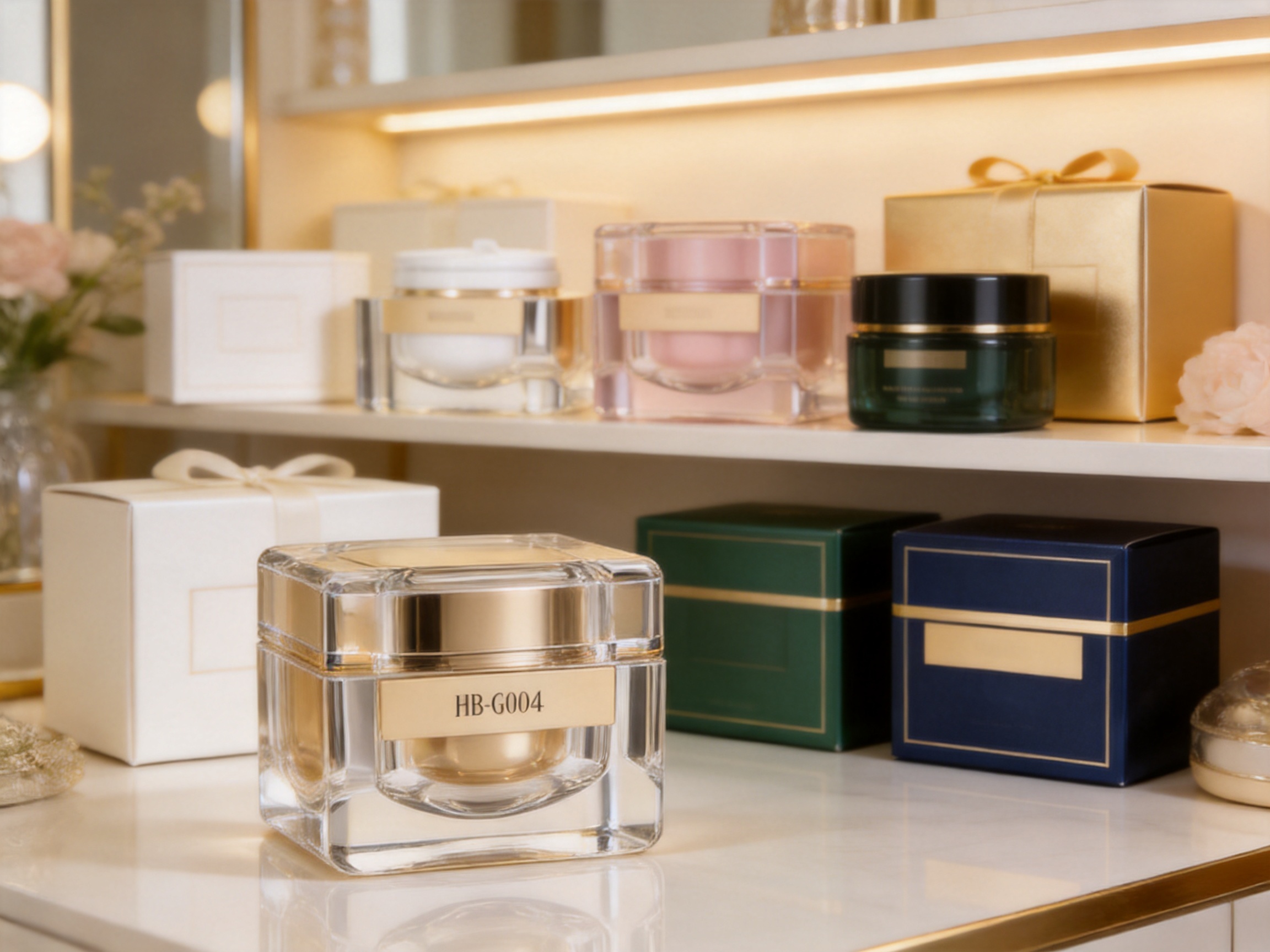
The HB-G004 double-wall plastic acrylic face cream jar has been developed to meet these expectations through a combination of geometric styling, substantial construction, decorative finishing, and carefully selected plastic components. With a 50 ml capacity, a square profile, a double-wall structure, and a metallic gold-plated appearance, it is designed for facial creams, moisturizers, masks, eye creams, luxury skincare collections, and other premium cosmetic formulations.
Its design provides a practical alternative to ordinary single-wall plastic jars, lightweight commodity containers, and heavier glass packaging. The container aims to deliver a refined visual impression without sacrificing the advantages of plastic, including design flexibility, reduced breakage risk, and compatibility with efficient cosmetic packaging production.
This article examines the product’s structure, materials, decoration, manufacturing strengths, competitive advantages, customization potential, quality considerations, and suitability for modern skincare packaging programs.
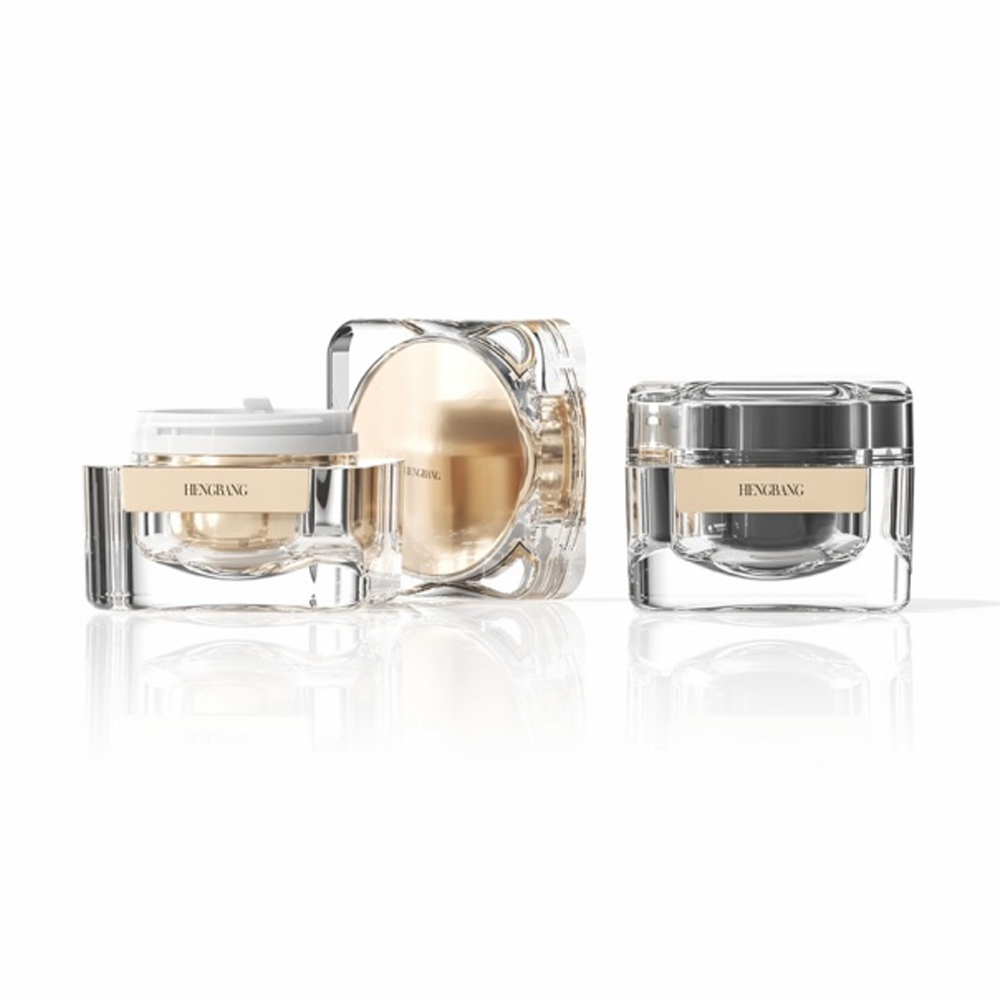
HB-G004 Double Wall Plastic Acrylic Face Cream Jar
The HB-G004 is a square acrylic face cream jar with a double-wall construction. Its external geometry is clean, architectural, and highly recognizable. Instead of relying on the familiar round jar shape used throughout the cosmetics industry, the square profile introduces a sharper and more contemporary visual language.
The product has a listed capacity of 50 ml, making it suitable for many facial skincare products. This size is widely applicable to daily moisturizers, night creams, firming creams, brightening creams, nourishing masks, and premium sample-to-retail product lines. It offers enough volume for a complete consumer package while remaining compact enough for cosmetic counters, bathroom storage, travel kits, and gift sets.
The external dimensions are approximately 69 by 69 millimeters, with a listed height of 54.8 millimeters. The broad square footprint gives the jar a stable stance and a visually substantial presence. Compared with narrow cylindrical packaging, the square shape creates more visible surface area for decoration, labeling, embossing concepts, or a minimalist presentation in which the container itself becomes the primary visual feature.
Geometric packaging can also help a product establish stronger shelf recognition. In a crowded skincare category, where many competing items use similar round containers, a square acrylic jar can create a clear silhouette from a distance. This may be especially valuable for product families that require a distinctive appearance across multiple retail channels.
The classic cream jar remains popular because it is familiar, easy to use, and appropriate for thick or semi-solid formulations. However, traditional jar packaging can appear ordinary when the shape, color, and decoration are not carefully coordinated. The HB-G004 updates this familiar format through its square geometry, double-wall construction, acrylic appearance, and gold-plated surface treatment.
The result is a container that can support several design directions. It may be used for a modern minimalist line with restrained labeling, a luxury collection with metallic decoration, a classic skincare range with elegant typography, or a gift-oriented product with rich color and premium surface details.
Because the design is visually strong without depending entirely on complex graphics, it can reduce the need for excessive external decoration. A brand may choose to let the gold finish and architectural form communicate the primary message, using only a small label or a discreet printed logo.
Proportion is an important part of perceived quality. A jar that is too thin or visually light may suggest an entry-level product even when the formula is positioned as premium. The HB-G004’s broad square body and double-wall structure help create a fuller, more substantial appearance.
The large side panels also provide flexibility for brand communication. Depending on the selected decoration method, they can accommodate product names, ingredient highlights, usage instructions, regulatory information, or a simple visual identity. The container can therefore function as both packaging and a three-dimensional branding element.
At the same time, the compact height maintains a balanced silhouette. The jar is not excessively tall, which can make a package difficult to store or visually top-heavy. The relatively broad base supports a stable presentation on counters, shelves, vanity tables, and display trays.
The material specification identifies several components: the cap is made from PMMA and ABS, the outer bottle is made from PMMA, and the inner bottle is made from PP. Each material contributes different functional and aesthetic properties to the overall package.
Component | Specified Material | Primary Packaging Contribution |
Cap | PMMA + ABS | Visual clarity, structural support, dimensional stability, and a premium closure appearance |
Outer bottle | PMMA | Clear, refined appearance, rigid form, and a suitable surface for decorative finishing |
Inner bottle | PP | Lightweight internal container structure and practical compatibility with cosmetic packaging applications |
Nominal capacity | 50 ml | Suitable format for facial creams, moisturizers, masks, and related skincare products |
Overall dimensions | Approximately 69 × 69 mm; height 54.8 mm | Stable square presentation with a substantial shelf presence |
Double-wall packaging consists of an outer structural or decorative shell and an inner container that holds the cosmetic formulation. This construction can offer several advantages compared with a simple single-wall jar.
First, the outer wall creates additional visual depth. When the package is viewed from different angles, the layered construction can produce a more substantial and refined appearance. It may also allow the outer surface to receive special decoration without placing the full decorative burden on the formula-contacting component.
Second, the double-wall format can help create a more protected visual package. The outer shell contributes to the perception of strength and quality, while the inner bottle provides the primary product-holding structure. The combination is especially appropriate for skincare products positioned above the mass-market level.
Third, double-wall construction gives designers more flexibility in combining colors, finishes, and transparency effects. For example, the outer PMMA component may carry a metallic finish while the inner PP bottle maintains a coordinated color. This allows a package to appear layered, dimensional, and carefully engineered.
It is important to recognize that packaging performance depends on the complete design, assembly, closure system, formula compatibility, and testing program. A double-wall structure should not automatically be treated as a guarantee of barrier performance or formula protection. Those characteristics must be confirmed for each product application. Nevertheless, the architecture provides a strong foundation for premium presentation and practical package development.
PMMA, commonly known as acrylic, is widely used in cosmetic packaging where clarity, rigidity, and visual quality are important. It can create a glass-like appearance while retaining many of the handling advantages associated with plastic packaging. Its clear and polished visual character is particularly suitable for containers intended to communicate cleanliness, sophistication, and modern design.
In the HB-G004, PMMA is used for the outer bottle and forms part of the cap construction. This creates visual consistency between the body and closure. When combined with gold plating, the material can support a richer decorative effect than an undecorated commodity jar.
PMMA also supports precise, structured shapes. The square body depends on clean corners and consistent surfaces to achieve its intended appearance. A high-quality rigid plastic can help maintain the visual definition of these geometric features during normal handling and display.
ABS is used together with PMMA in the cap. In packaging engineering, material combinations are often selected because different polymers provide different balances of appearance, strength, processing behavior, and assembly performance. The cap must not only look coordinated with the jar; it must also support repeated opening and closing by the consumer.
PP is specified for the inner bottle. Polypropylene is a lightweight material commonly used in cosmetic packaging components. Its role in the inner container supports an efficient multi-material structure in which the external wall can focus on aesthetics and the internal component can provide a practical product-holding surface.
Formula compatibility should always be evaluated using the actual cream, fragrance system, active ingredients, storage conditions, and intended market requirements. Compatibility testing may include visual inspection, odor evaluation, weight change, leakage observation, stress testing, and storage at different temperatures. The appropriate testing program should be established for each formulation rather than assumed solely from the material name.
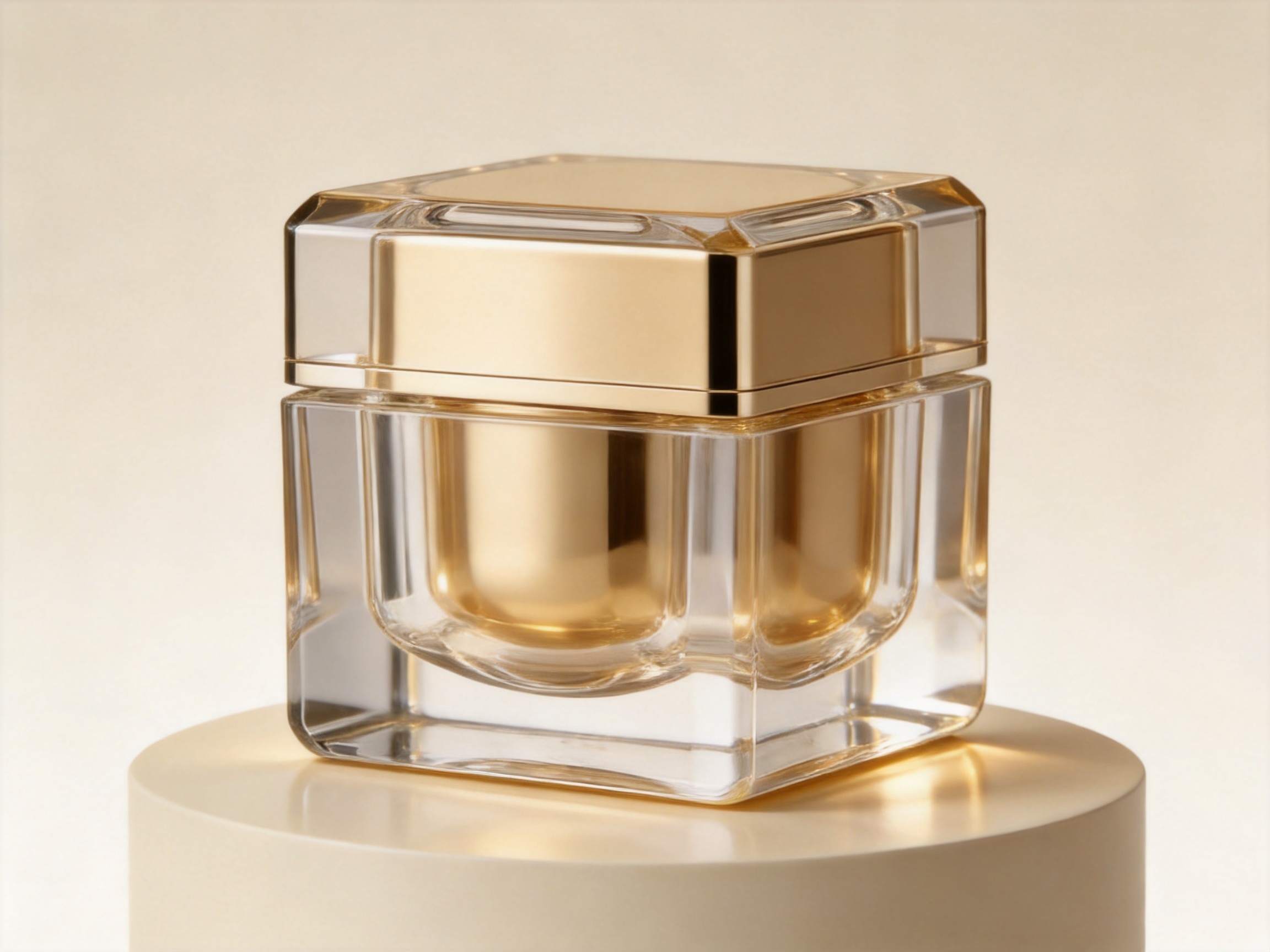
The gold-plating process is one of the most distinctive features of the HB-G004. Metallic decoration can immediately change how consumers interpret a package. Gold is commonly associated with luxury, prestige, celebration, heritage, and high perceived value. On a square acrylic jar, the effect becomes particularly noticeable because the large flat surfaces and crisp edges provide a strong foundation for reflective decoration.
The product description emphasizes that the gold-plating process creates a luxurious metallic texture and a visually dazzling effect. It is also described as supporting wear resistance and corrosion resistance, helping the surface retain its luster over time. Actual performance should be verified through the manufacturer’s quality-control and durability testing procedures, but the intended result is clear: the package is designed to maintain a premium appearance beyond the initial point of purchase.
Gold decoration does not have to be used only for an overtly luxurious style. It can be integrated into several visual directions. A bright gold surface may support an opulent skincare line, while a softer metallic tone may create a more restrained light-luxury appearance. Gold can also be paired with white, black, cream, blush, deep green, navy, or translucent tones depending on the product identity.
For a classic skincare collection, gold can reinforce heritage and elegance. For a contemporary line, it can act as a contrasting accent against a clean geometric form. For a gift product, it can contribute to a celebratory impression without requiring elaborate secondary packaging.
The finish may be applied across the complete external surface or combined with other decoration methods. For example, a manufacturer or brand may consider using gold on the cap and selected body areas while leaving another surface visible or applying a contrasting print. The final result should be defined through approved color standards, samples, and production specifications.
Cosmetic packaging is exposed to frequent handling. Consumers may carry a jar in a handbag, place it on a bathroom counter, touch it with moisturized hands, or wipe it repeatedly during use. Decorative performance therefore matters as much as first impression.
A suitable surface-treatment process should be evaluated for adhesion, resistance to rubbing, resistance to common cosmetic residues, and appearance after repeated handling. Corrosion resistance can also be relevant when packaging is used in humid bathroom environments or exposed to perspiration and other contaminants.
The gold-plated finish described for the HB-G004 is intended to provide both visual impact and lasting surface quality. For a specific commercial project, buyers should confirm the applicable test methods, acceptance criteria, coating thickness where relevant, color tolerance, and inspection standards with the packaging supplier.
One advantage of an integrated decorative finish is that it may reduce dependence on additional visual elements. A package that already possesses a strong form and premium surface can remain elegant with relatively simple labeling. This can support a more disciplined brand identity and avoid the crowded appearance sometimes created by excessive graphics, foil labels, ribbons, or secondary embellishments.
Minimal decoration can also help a skincare brand create a more modern presentation. The square acrylic body becomes a recognizable signature, while the gold surface supplies warmth and premium detail. This combination can appeal to consumers who want a luxurious product that still feels contemporary and organized.
The cosmetics market includes many packaging options, from low-cost single-wall PP jars to clear PET containers, molded glass jars, airless systems, and complex refillable packages. No one format is ideal for every formula or brand. The HB-G004 competes most directly in the premium cream jar segment, where appearance, tactile experience, and shelf differentiation are important purchasing factors.
Round jars remain practical and widely available, but their familiarity can also make them visually predictable. A square jar introduces a more distinctive outline and gives a skincare collection a stronger visual signature. The HB-G004’s geometry may help products stand out in retail displays, online photography, trade-show presentations, and social media content.
The square shape also supports a more architectural brand language. It can communicate precision, order, modernity, and confidence. These associations may be useful for skincare brands that want to position products around advanced formulations, professional care, or carefully developed routines.
Basic single-wall plastic packaging is often selected for cost efficiency, but it may not provide the weight, depth, or visual richness expected from a premium facial cream. A double-wall acrylic structure can create a fuller appearance and offers more opportunities for refined decoration.
The HB-G004’s gold-plated exterior further separates it from plain containers. The metallic surface can increase perceived value at the point of sale, particularly when the product is part of a prestige skincare line or intended for gifting.
Glass has a strong premium image and can offer a satisfying weight. However, glass may be more vulnerable to breakage during transportation, warehouse handling, retail display, and consumer use. It can also increase shipping weight and require additional protective materials.
A plastic acrylic jar can offer a glass-like visual direction while reducing some of the practical concerns associated with brittle packaging. The actual resistance of any package depends on its design, wall thickness, assembly, and testing, but plastic construction is generally attractive to companies seeking a balance between premium appearance and day-to-day handling convenience.
The square body offers broad, relatively flat panels that can support printing, labeling, or carefully controlled decoration. This may be more convenient for certain brand layouts than a curved surface, where small text and logos must follow a radius or may be more difficult to align.
The package can be presented with a restrained identity or used as part of a broader family system. Different cream types may share the same jar while using variations in label color, inner bottle color, or metallic details. This can help a brand build a coherent product architecture.
At 50 ml, the jar is large enough to support a meaningful skincare routine but compact enough to remain commercially versatile. It can serve as a standard retail size, a premium treatment size, or a gift-set component. The format can also be considered for hotel amenities, spa collections, professional skincare programs, and limited-edition releases, subject to the specific filling and regulatory requirements of the market.
The product is supplied by Yuyao Hengbang Plastic Co., Ltd., a company established in 2006 and focused on plastic packaging for cosmetics and skincare products. According to the supplied company information, the manufacturer operates in a facility with a building area of 35,000 square meters and has more than 300 employees.
These figures indicate a substantial organizational and production base for a specialized packaging supplier. A larger facility and workforce can support multiple activities, including tooling coordination, molding, component production, assembly, decoration, inspection, warehousing, and customer service. The value of such a structure is not simply its size; it is the ability to coordinate the different stages required to turn a packaging concept into a consistent commercial product.
Packaging for cosmetics requires knowledge that differs from general plastic manufacturing. Cosmetic containers must balance appearance, dimensional accuracy, closure performance, surface quality, formula contact, decoration, and market presentation. A supplier focused on skincare packaging is more likely to understand the practical expectations of these products.
Since its establishment, the company has specialized in plastic packaging for cosmetics and skincare products. This specialization can support more informed discussions about jar proportions, component assembly, surface decoration, production feasibility, and the visual standards expected in the beauty sector.
For buyers, industry specialization may shorten the learning curve during development. Instead of explaining every basic packaging requirement, a specialized manufacturer can contribute knowledge about common cosmetic structures, decoration options, and production considerations. Final decisions should still be made through documented specifications, samples, and testing.
The company information states that its young and professional team provides a full range of services, including design and development. This is important because packaging projects often begin with a visual idea rather than a fully engineered drawing.
A complete design-and-development capability can help translate a concept into practical components. This may involve evaluating the external silhouette, cap fit, internal volume, wall structure, decoration area, assembly method, and production tolerances. For a double-wall jar, coordination between the outer bottle, inner bottle, and cap is particularly important because the components must appear aligned and function together as one package.
Development support can also be useful when a brand wants to modify a standard design. Potential changes may include color, surface finish, logo treatment, inner bottle appearance, closure details, or coordinated packaging for several product sizes. The feasibility of each change depends on tooling, order volume, material selection, decoration method, and quality requirements.
The manufacturer has passed ISO9001:2015 and ISO14001:2015 certifications, according to the provided information. ISO 9001 is associated with quality management systems, while ISO 14001 is associated with environmental management systems. Certifications do not replace product-specific testing, but they indicate that the company has established formal systems related to quality processes and environmental management.
For packaging buyers, a quality management system can support clearer procedures for incoming materials, production control, inspection, nonconformance handling, corrective action, documentation, and continuous improvement. These processes are especially valuable for cosmetic packaging because visual defects, dimensional variation, decoration inconsistency, or closure problems can affect both consumer experience and filling-line efficiency.
An environmental management system can help a manufacturer identify and control environmental aspects associated with production. It may support greater awareness of resource use, waste management, process controls, and environmental responsibilities. Brands should request current certification documentation and confirm the scope of certification when this information is important to a procurement decision.
The company was awarded Ningbo High-Tech Enterprise status in 2021 and owns multiple invention patents, according to the supplied company profile. These details suggest a focus on technical development and product innovation rather than relying exclusively on standard commodity packaging.
Patents and high-tech recognition do not automatically indicate that every product contains a patented feature or that every project will have the same technical complexity. However, they can reflect an organizational interest in research, engineering, process improvement, and differentiated packaging solutions. For customers seeking a distinctive jar rather than an undifferentiated stock container, this development orientation can be relevant.
One of the potential advantages of working with an experienced packaging manufacturer is the ability to coordinate several production stages through one supplier relationship. The HB-G004 requires more than the molding of a basic jar. Its final appearance depends on material selection, component production, surface preparation, gold plating, assembly, inspection, and packing.
When these steps are coordinated effectively, the supplier can better manage the relationship between component dimensions and decorative results. For example, the visual alignment of a square cap with a square body depends on consistent molding and assembly. A metallic finish must also be applied to surfaces that are clean, properly prepared, and suitable for coating.
Centralized coordination may simplify communication for international buyers, although buyers should still establish clear approval procedures, production samples, inspection standards, and shipping documentation before mass production.
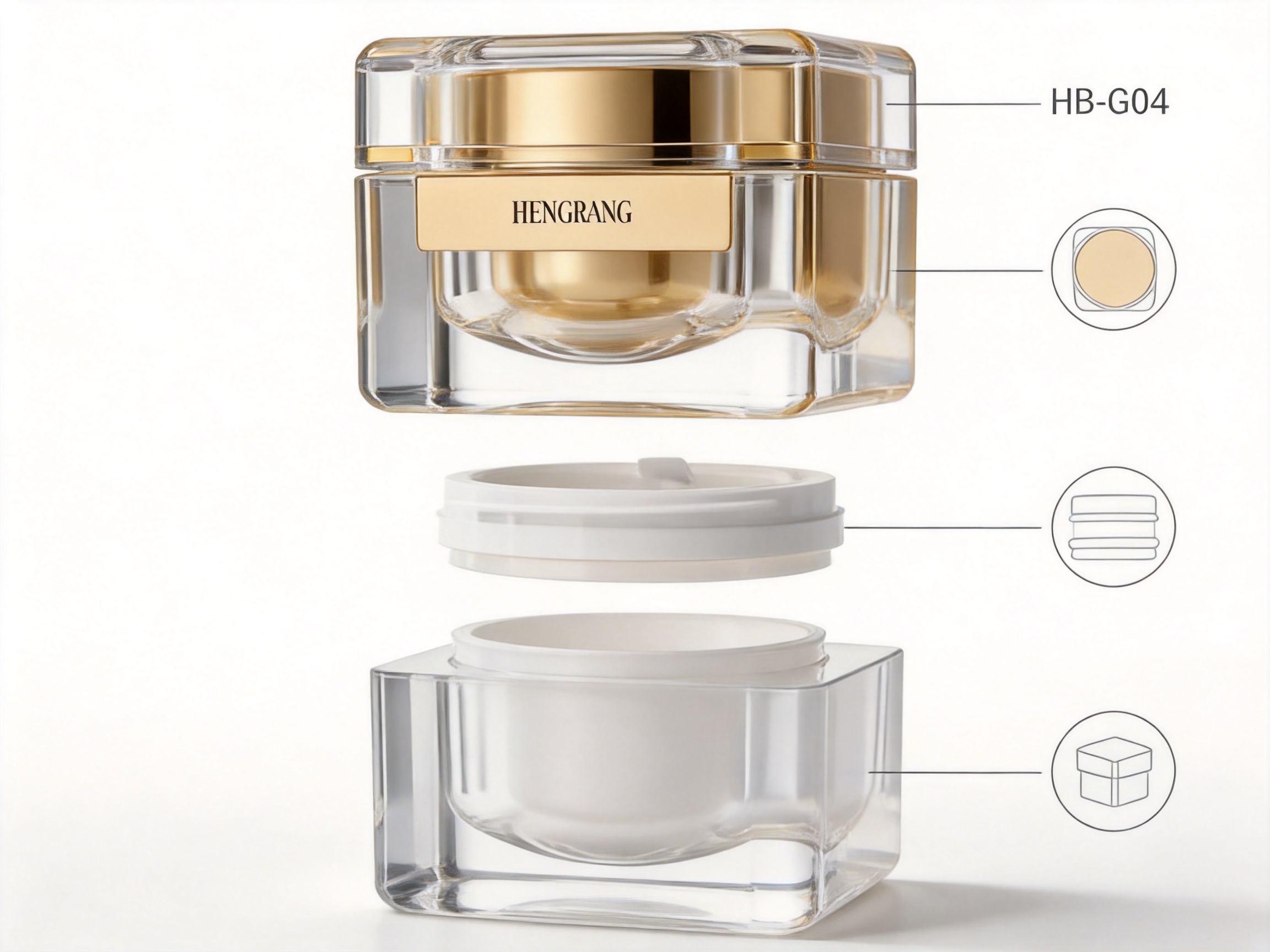
The precise production sequence for a specific order should be confirmed with the manufacturer, but a premium double-wall acrylic jar typically requires a series of controlled manufacturing stages. Understanding these stages helps buyers evaluate the product realistically and prepare more effective development specifications.
The process begins with design review and engineering preparation. The square body, cap, inner bottle, and assembly relationships must be considered together. Engineers may evaluate wall thickness, corner geometry, draft angles, shrinkage, parting lines, fit, clearance, and the intended decoration area.
Tooling quality is essential for a geometric container. Square corners, flat panels, and cap alignment are visually unforgiving. Small inconsistencies that might be less noticeable on a rounded container can become obvious on a square one. Proper tooling development therefore contributes directly to the product’s perceived quality.
Before mass production, the supplier and buyer should review technical drawings, 3D files, color references, decoration samples, and functional prototypes where appropriate. This stage provides an opportunity to identify problems before they become expensive production changes.
The PMMA outer bottle, PMMA and ABS cap components, and PP inner bottle are produced using suitable molding processes. During molding, process conditions influence appearance, dimensional accuracy, surface quality, and structural consistency.
For a premium acrylic jar, the external surface should be carefully controlled because marks, flow lines, sink areas, weld lines, or uneven corners may affect the final decorative appearance. The internal component must also meet dimensional requirements so that it fits properly inside the outer bottle and supports the intended filling volume.
Production control may include monitoring material handling, machine conditions, mold temperature, injection parameters, cooling, ejection, and part inspection. The exact controls depend on the material, machine, mold design, and factory procedures.
After molding, components selected for gold decoration generally require surface preparation. The surface must be clean and suitable for the coating system. Preparation may involve cleaning, activation, base coating, or other treatments appropriate to the process.
The gold-plating stage creates the metallic effect described for the product. Consistent color and coverage are important, particularly on a square jar where broad panels can reveal variation. Corners, edges, transitions, and recessed areas may require special attention because coating behavior can differ across the geometry.
Inspection after decoration may include visual checks under controlled lighting, color comparison against an approved standard, adhesion evaluation, rubbing or abrasion tests, and examination for dust, pinholes, uneven coverage, or other defects. The specific test criteria should be agreed upon before production.
The outer bottle and inner bottle must be assembled in a way that maintains alignment and creates the intended double-wall appearance. The cap must fit securely while remaining practical for consumer opening and closing.
Assembly quality can influence the customer’s perception of the entire product. A misaligned cap, uneven gap, loose closure, or visible adhesive residue may undermine an otherwise attractive package. For this reason, inspection should consider not only individual parts but also the completed jar as a functional and visual unit.
Finished jars should be inspected according to the customer’s approved quality standard. Common inspection categories may include dimensions, appearance, color, decoration, component fit, closure performance, cleanliness, and packaging condition.
Protective packing is also important for gold-plated components. The supplier should consider how parts are separated, cushioned, stacked, and handled during transportation. Proper packing can help reduce scratches, scuffing, dust accumulation, and deformation risks before the containers reach the filling facility or distribution center.
The 50 ml format and premium appearance make the HB-G004 suitable for a wide range of skincare products. The final application should always be confirmed through formula compatibility, filling trials, stability studies, and regulatory review.
Face cream is the most direct application for the jar. The wide opening commonly associated with cream jars can be convenient for thicker formulations that are scooped or removed with a spatula. A premium moisturizer packaged in a gold-plated square jar can communicate richness, care, and daily indulgence.
Day creams, night creams, anti-aging creams, firming creams, nourishing creams, and barrier-support products may all be considered, depending on the formulation and intended market. The container can also support different positioning levels through changes in color, label design, and secondary packaging.
Facial masks and intensive treatments often use jar packaging because consumers need access to a larger quantity than would typically be dispensed from a narrow nozzle. The square acrylic format can give a treatment product a professional or spa-inspired appearance.
For clay, cream, sleeping, or moisturizing masks, the inner bottle and closure should be evaluated for residue management and cleaning expectations. The supplier and brand should also consider whether the selected decoration will remain attractive when the package is used in humid environments.
Eye creams are often sold in smaller packages, but a 50 ml version may be appropriate for a broader treatment collection, professional-use concept, or coordinated skincare set. The substantial appearance of the jar can help unify a range of premium products.
For active treatment products, packaging communication is especially important. The clean geometric structure can convey precision and advanced care, while the gold finish can add a sense of prestige. Product claims must be supported by appropriate evidence, but the package can establish a premium context for those claims.
Gold-plated packaging is naturally suitable for gift-oriented programs. It can support holiday collections, anniversary products, wedding-related beauty sets, luxury subscription boxes, and limited-edition launches.
The square form can also stack and display efficiently in certain gift presentations. Designers may coordinate the jar with a square carton, rigid gift box, or tray. Because the package already has a strong decorative presence, the outer box can remain simple or use complementary rather than competing graphics.
Modern packaging decisions increasingly involve environmental questions as well as appearance and cost. The HB-G004 is a multi-material plastic package containing PMMA, ABS, and PP components. These materials provide different functional benefits, but the combination also creates considerations for recycling, separation, and end-of-life management.
Brands should evaluate the complete packaging system rather than focusing on one material in isolation. Relevant questions may include the total package weight, material quantity, decoration method, production waste, transport efficiency, durability, expected consumer use period, and available recycling infrastructure in the target market.
The double-wall structure may require more material than a simple single-wall jar, but it can also support a longer-lasting premium presentation. If consumers retain or reuse a durable package, the practical value of the container may increase. However, reuse should not be assumed without appropriate cleaning guidance, structural suitability, and product safety evaluation.
The manufacturer’s ISO14001:2015 environmental management certification is a relevant part of its stated company profile. Buyers should request current information about environmental objectives, production controls, waste management, energy use, and any available material or process documentation when sustainability is a key purchasing criterion.
Clear component identification can help brands communicate more responsibly. If the package is intended to be separated after use, instructions may be considered for the carton or product information. Brands should confirm whether the components can be practically separated and whether local recycling systems accept the materials.
Decoration can also influence end-of-life processing. Metallic coatings, labels, adhesives, and mixed materials may affect recyclability depending on local systems. A responsible packaging development process should balance the desired luxury effect with the environmental goals of the product line.
Before placing a large order, buyers should establish a detailed quality specification for the HB-G004. Premium packaging is judged by both function and appearance, and expectations can vary significantly between customers.
Visual approval should include the jar shape, corner definition, surface smoothness, gold color, reflective effect, cap alignment, inner bottle visibility, and overall cleanliness. An approved reference sample should be retained for comparison during production.
Lighting conditions matter when evaluating metallic surfaces. Gold can appear different under daylight, cool white light, warm light, and retail lighting. Brands should define the inspection environment and acceptable variation where color consistency is important.
Dimensional checks may include height, width, length, opening dimensions, cap fit, inner bottle position, and component gaps. Consistent dimensions help ensure that the jars run efficiently on filling, capping, labeling, and packing equipment.
Assembly checks should confirm that the cap closes properly, remains secure during handling, and does not create unacceptable friction or looseness. The inner and outer bottles should remain properly aligned and should not rattle, shift, or show visible assembly defects.
The actual cosmetic formulation should be tested in the final package. Factors such as oils, alcohol, fragrances, acids, botanical extracts, pigments, and active ingredients may affect different materials or decorations in different ways.
Testing may include accelerated temperature storage, room-temperature storage, freeze-thaw cycles, light exposure where relevant, leakage observation, odor evaluation, color change, weight change, and interaction between the formula and container. A qualified technical or regulatory team should determine the appropriate program for the product.
Premium cosmetic jars may travel through several distribution stages before reaching the consumer. Transportation testing can help evaluate the impact of vibration, compression, drops, temperature changes, and handling. The test program should reflect the intended shipping method and packaging configuration.
Because the HB-G004 uses a decorative gold-plated surface, special attention should be given to scratch prevention and component separation during transit. Inner cartons, dividers, protective films, or other packing solutions may be considered based on the production and shipping conditions.
The HB-G004 can serve as a foundation for a customized skincare package. Customization does not necessarily require a completely new mold. In some cases, brands may achieve differentiation through color, decoration, closure treatment, labeling, carton design, and coordinated product architecture.
The outer PMMA bottle, inner PP bottle, cap, and gold finish can be coordinated to create different moods. Black and gold may suggest dramatic luxury. White and gold may communicate purity and classic elegance. Soft pink or champagne tones may support a feminine premium line, while deep green or navy may create a more sophisticated and unisex impression.
A square surface can provide a disciplined area for logo placement. Brands may choose centered typography, corner positioning, vertical layouts, or a small emblem that allows the metallic surface to remain visible. The final decoration method should be tested on the actual finished surface because metallic backgrounds can influence ink appearance, contrast, and readability.
A consistent jar shape can unify multiple skincare products. Different formulas may use variations in inner bottle color, cap finish, printed text, or carton color while retaining the same basic silhouette. This approach can make a product family easier to recognize and may simplify visual merchandising.
If different capacities or components are required, the manufacturer’s design and development team can assess whether a related structure can be created. The feasibility of a family system depends on tooling investment, minimum order quantities, component compatibility, and production planning.
International buyers should approach the package as a complete development project rather than ordering a container based only on a photograph. The following considerations can help create a smoother process.
Provide the supplier with the formula type, viscosity, filling temperature, filling method, target market, expected shelf life, and intended consumer use. These details help determine whether the jar is appropriate and what testing may be necessary.
Review capacity, dimensions, material composition, component structure, decoration coverage, color standards, closure requirements, and packing configuration. The listed capacity is 50 ml, but fill volume, headspace, and actual product weight should be confirmed through filling trials.
Samples should be evaluated for appearance, fit, handling, formula contact, filling-line performance, and compatibility with secondary packaging. For gold-plated products, the approved sample should represent the expected production finish as closely as possible.
Define acceptable limits for scratches, dust, color variation, plating defects, molding marks, dimensional variation, cap fit, and assembly alignment. A clear standard reduces misunderstandings and supports objective quality evaluation.
Decoration and component assembly may influence minimum order quantities and production schedules. Buyers should confirm tooling status, decoration capacity, sample timing, mass-production lead time, packing requirements, and shipping arrangements before committing to a launch date.
The HB-G004 is a double-wall plastic acrylic face cream jar designed for cosmetic and skincare applications. It has a square body, a premium gold-plated appearance, and a listed capacity of 50 ml.
The specified materials are PMMA and ABS for the cap, PMMA for the outer bottle, and PP for the inner bottle. Each component contributes to the package’s appearance, structure, and practical function.
The package uses an outer bottle and an inner bottle rather than a single simple wall. This structure creates visual depth, supports a more substantial appearance, and allows the external component to focus on premium presentation while the inner component serves as the product-holding container.
The listed capacity is 50 ml. Brands should confirm the usable fill volume, headspace, and actual filling weight with the supplier and through production trials using the intended formulation.
The listed height is 54.8 millimeters, and the listed diameter or footprint is 69 by 69 millimeters. Because the product is square, the term footprint is more accurate than diameter when describing its external shape.
The premium appearance comes from the square geometric design, double-wall construction, acrylic material, substantial proportions, and gold-plated surface treatment. Together, these features create a more luxurious presentation than a basic undecorated plastic jar.
The finish is intended to provide a luxurious metallic appearance with wear and corrosion resistance. However, the exact performance should be confirmed through supplier testing and project-specific evaluation, particularly for products used in humid bathrooms or handled frequently.
It may be suitable for moisturizers, sleeping masks, facial masks, eye treatments, nourishing creams, and other semi-solid skincare products. Formula compatibility, filling behavior, regulatory requirements, and consumer-use conditions should be assessed for each application.
Plastic construction can reduce certain breakage concerns associated with glass, but durability depends on the complete design, materials, wall structure, assembly, and transportation conditions. Appropriate drop, vibration, and handling tests should be performed for the intended distribution system.
Customization may be possible through color, inner bottle coordination, gold-plating specifications, logo decoration, labeling, cap treatment, and secondary packaging. More significant structural changes should be reviewed with the manufacturer’s design and development team.
The supplier reports experience in plastic cosmetic packaging, design and development services, a building area of 35,000 square meters, more than 300 employees, ISO9001:2015 and ISO14001:2015 certifications, Ningbo High-Tech Enterprise recognition in 2021, and multiple invention patents.
Recommended evaluation areas may include appearance, dimensions, cap fit, assembly alignment, decoration adhesion, formula compatibility, stability, leakage, filling-line performance, transportation durability, and packing protection. The exact testing plan should be based on the formula and target market.
The HB-G004 double-wall plastic acrylic face cream jar is positioned as a premium cosmetic container that combines strong geometry, layered construction, and metallic decoration. Its 50 ml capacity is versatile for facial skincare products, while its square 69 by 69 millimeter footprint provides a distinctive shelf presence and broad branding surfaces.
The use of PMMA for the outer bottle gives the package a refined acrylic appearance, while ABS and PMMA in the cap support a coordinated closure design. The PP inner bottle contributes to the practical multi-material structure. The gold-plated finish adds a luxury element that can support high-value positioning, gift presentation, and light-luxury or classic visual themes.
Compared with ordinary round single-wall jars, the product offers greater visual differentiation and a more substantial appearance. Compared with glass luxury packaging, it may provide a more practical plastic-based solution with reduced breakage concerns and greater design flexibility. These advantages should be considered alongside the need for formula compatibility testing, decoration validation, environmental evaluation, and careful quality control.
The supplier’s reported experience, facility scale, workforce, design and development services, management-system certifications, technical recognition, and patent portfolio provide a foundation for supporting cosmetic packaging projects from concept through production. For brands seeking a distinctive skincare container, the product can function not only as a vessel for cream but also as an important part of the product’s identity and perceived value.
Ultimately, the strongest results will come from treating the HB-G004 as a complete packaging system. Material selection, molding, gold plating, assembly, filling, transportation, consumer handling, and end-of-life considerations should all be evaluated together. When these factors are aligned, the jar can help a skincare product appear more refined, recognizable, and competitive in a demanding beauty market.
1. Product specification sheet for the HB-G004 Double Wall Plastic Acrylic Face Cream Jar, including material composition, capacity, dimensions, and decorative description.
2. Company profile information for Yuyao Hengbang Plastic Co., Ltd., including establishment history, facility size, workforce, certifications, technical recognition, and product development capabilities.
3. ISO 9001:2015, Quality Management Systems — Requirements.
4. ISO 14001:2015, Environmental Management Systems — Requirements with Guidance for Use.
5. General cosmetic packaging development practices covering material compatibility, decoration durability, component assembly, filling trials, and transportation evaluation.
6. General polymer packaging references concerning PMMA, ABS, and PP applications in cosmetic containers.


Copyright © Yuyao Hengbang Plastic Co., Ltd.
All Rights Reserved.
 Wholesale Plastic Cosmetic Packaging Manufacturers