English
 中文简体
中文简体
News
Home > Author > Wang Mengyao — Product After-Sales Service Coordinator > How Double-Walled Airless Lotion Bottles Improve Cosmetic Packaging Performance

 2026.08.25
 Wang Mengyao — Product After-Sales Service Coordinator
Content
In the competitive cosmetics and skincare market, packaging is no longer limited to appearance. A bottle must protect the formula, support convenient dispensing, communicate product quality, and help a brand create a distinctive shelf presence. The HB-K009A/B plastic airless lotion bottle is designed to address these requirements through a combination of airless dispensing technology, double-walled construction, refined surface treatment, and flexible capacity options.
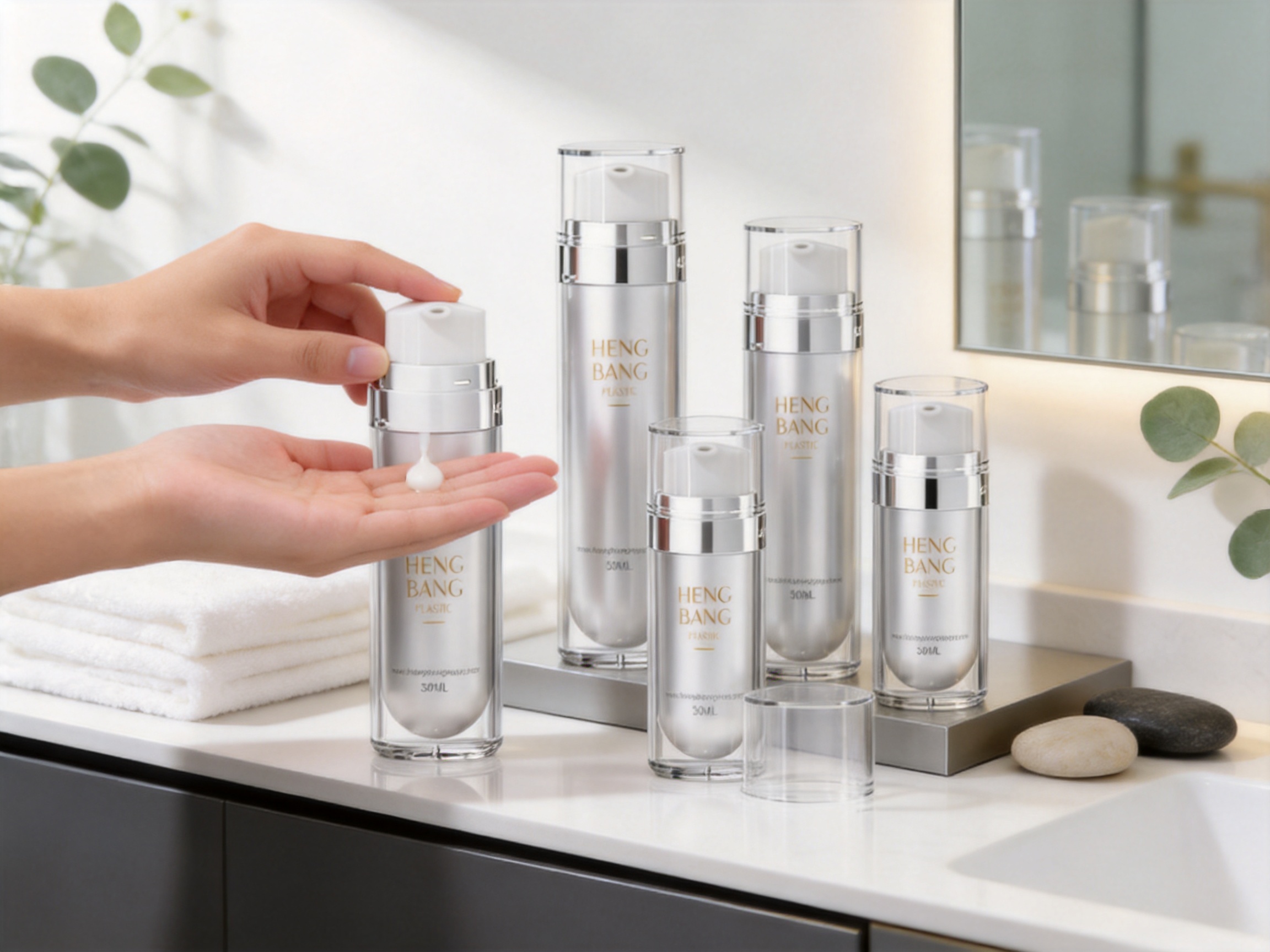
This packaging solution is suitable for lotions, creams, moisturizers, serums, sunscreens, liquid foundations, and other personal-care formulations that benefit from controlled dispensing and reduced exposure to external air. Its minimalist appearance combines a white injection-molded pump head, a matte-silver inner bottle, a bright-silver collar, and transparent exterior components. The result is a modern package with a premium visual character while retaining the practical advantages of a plastic container.
Manufactured by Yuyao Hengbang Plastic Co., Ltd., the bottle reflects the company’s focus on cosmetic and skincare packaging. The manufacturer has operated since 2006 and has developed a production base with a building area of approximately 35,000 square meters and more than 300 employees. Its capabilities include product design, development, plastic packaging production, surface finishing, and customer-oriented packaging services.
This article examines the product’s construction, dispensing benefits, appearance, manufacturing considerations, customization potential, application suitability, quality advantages, and selection criteria. It also explains why a double-walled airless bottle can provide a stronger packaging proposition than conventional lotion bottles and ordinary single-wall pump containers.
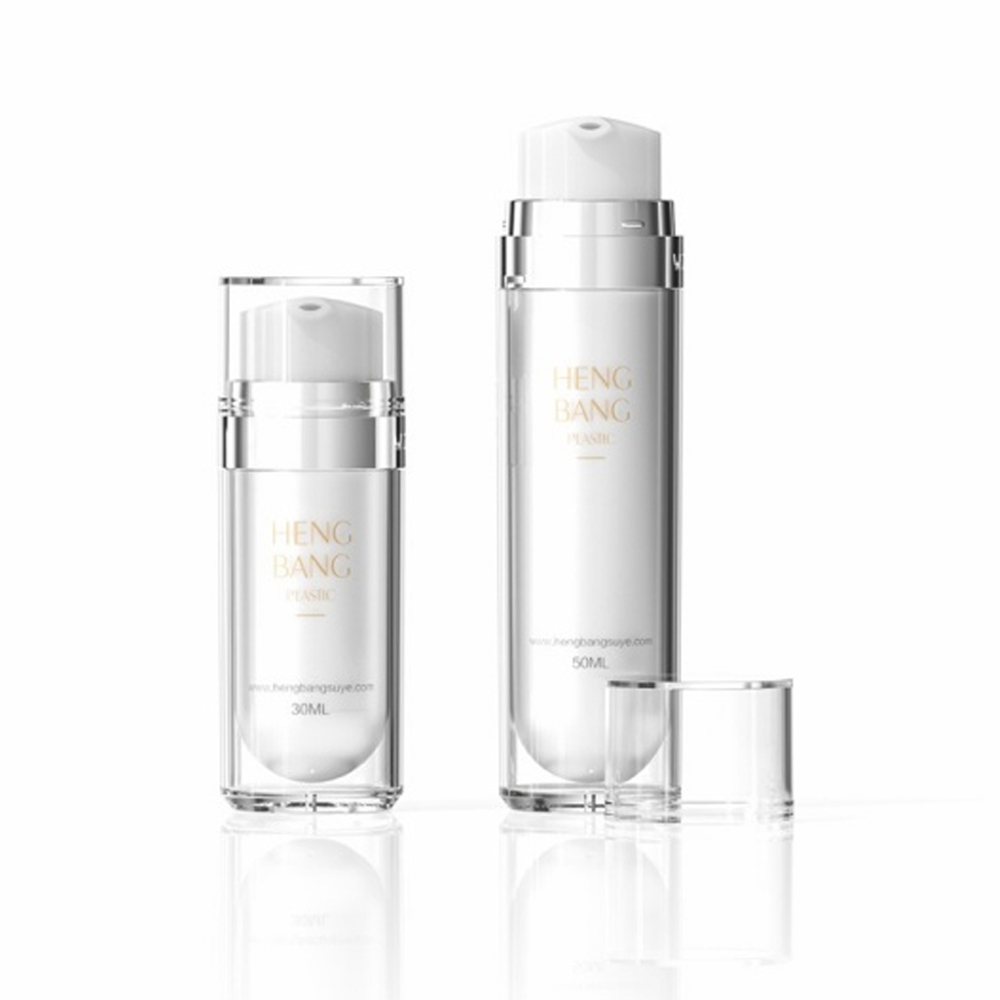
HB-K009A/B Plastic Airless Lotion Bottle
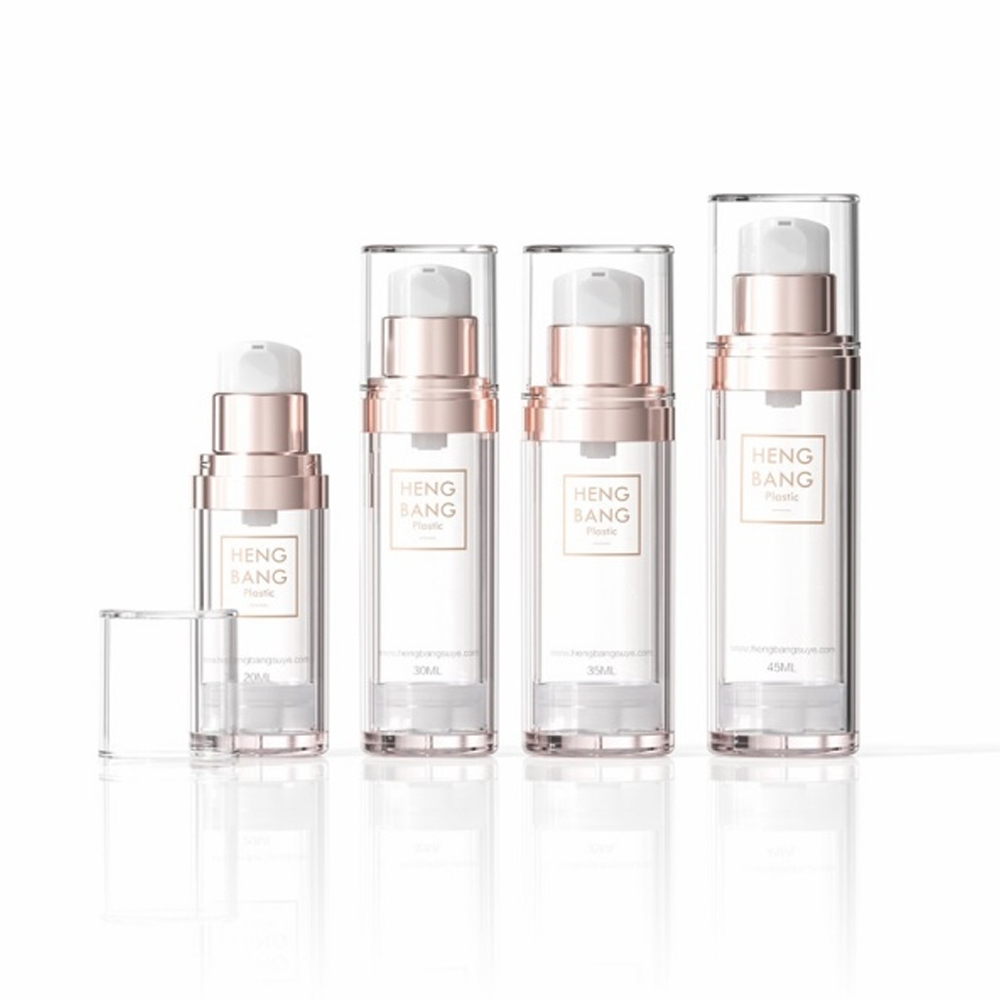
The HB-K009A/B is a plastic airless lotion bottle developed for cosmetic and skincare applications. It is characterized by a wide-mouth, double-walled structure and an airless pump mechanism. The design is intended to combine a substantial appearance with efficient formula dispensing.
The product is available in two stated capacity options. The product description identifies 30 ml and 50 ml versions, while the supplied dimensional information lists 20 ml and 50 ml capacities. Because capacity and dimensions can vary according to the internal configuration, buyers should confirm the final capacity, height, and filling volume with the manufacturer before placing an order or preparing artwork.
The listed height is 111.5 mm for one capacity and 149.1 mm for the other, with a stated diameter of 39.5 mm. The dispensing dosage is listed as 0.23 cc per actuation. These dimensions create a compact cylindrical format that can be used in travel-size, trial-size, premium retail, professional skincare, or daily-use product lines.
The bottle contains several coordinated components:
• A transparent outer bottle that gives the package a clean and contemporary appearance.
• A plastic inner bottle that forms the primary formula chamber.
• A white pump head produced through injection molding.
• A collar finished with bright silver plating.
• A matte-silver sprayed finish on the inner bottle.
• A transparent cap that protects the actuator and contributes to visual clarity.
The listed material structure identifies MS for the cap, PP for the pump, MS for the outer bottle, and PP for the inner bottle. This material combination balances visual finishing with the functional requirements of a cosmetic dispensing package. As with all cosmetic containers, compatibility testing should be conducted with the intended formula, fragrance, preservatives, oils, solvents, and active ingredients before commercial use.
Many skincare formulas are sensitive to air, contamination, repeated handling, and uncontrolled dispensing. Each time a conventional jar is opened, the contents may be exposed to ambient air, moisture, fingers, or other external contaminants. A standard open-neck bottle can also allow oxygen to enter the container as the product is consumed.
An airless package uses a pump system that dispenses product while the internal platform or piston moves upward. Instead of relying on a dip tube that reaches down into the formula, the internal system is designed to push the product toward the pump outlet. This arrangement can support a more controlled dispensing experience and may reduce the amount of air introduced during normal use.
The HB-K009A/B airless structure is especially relevant for products positioned around quality, efficacy, freshness, or advanced skincare performance. It can help brands present a formula as more carefully protected and professionally packaged. Although packaging cannot replace appropriate formulation, preservation, stability testing, or hygienic filling, a well-designed airless system can contribute to the overall product-protection strategy.
Airless dispensing also provides a more consistent user experience. The consumer presses the pump head rather than scooping product from a jar or pouring liquid from an open bottle. This makes it easier to control the amount used per application. With a nominal output of 0.23 cc per actuation, brands can develop usage instructions around a repeatable pump dose, subject to actual testing and formula viscosity.
Controlled dosage can be valuable for moisturizers, eye creams, facial lotions, concentrated serums, and sunscreen products. It can reduce over-application, limit mess around the opening, and help users establish a regular skincare routine. For commercial products, the consistent dispensing format may also support clearer claims regarding approximate uses per package, provided those claims are verified under actual operating conditions.
One of the most distinctive features of the product is its double-walled design. A double-walled bottle uses an inner container and an outer shell rather than relying on a single visible wall. This construction provides several advantages in appearance, handling, and brand presentation.
Single-wall plastic bottles can be lightweight and practical, but their appearance may not always meet the expectations of premium skincare brands. A double-walled format creates additional visual depth. The transparent outer bottle, silver inner surface, and plated collar work together to produce a layered appearance that resembles more expensive packaging formats.
The space between the exterior and interior surfaces can make the bottle appear more solid and substantial. This is useful for brands seeking to position a lotion or cream above mass-market packaging while maintaining the cost and production advantages of plastic.
The double-wall design allows the inner bottle to carry a matte-silver appearance without making the entire package visually heavy. The transparent external shell preserves clarity around the inner structure, while the silver elements provide contrast. The white pump head adds a clean highlight, and the bright-silver collar creates a refined transition between the actuator and bottle body.
This component separation gives packaging designers more opportunities to develop a coordinated identity. A brand may use the transparent cap and outer bottle to create a glass-like impression, the silver inner bottle to communicate technology or luxury, and printed or labeled graphics to identify the product range.
An external wall can provide an additional layer between the inner product chamber and everyday handling. It may help reduce direct contact with the inner bottle and provide a degree of structural support. However, the exact protection offered depends on the material thickness, assembly precision, transportation conditions, and formulation requirements.
Brands should still perform drop testing, compression testing, vibration testing, and transport simulation for the final filled package. The double-wall structure is an advantage, but it should be evaluated as part of a complete packaging system rather than treated as a substitute for validation.
Compared with a basic single-wall lotion bottle, this construction offers more room for color coordination and finish combinations. The outer bottle may remain transparent while the inner bottle receives spraying, coating, or another decorative treatment. The collar can be plated in bright silver, and the pump head can be molded in a contrasting color.
These options help brands create a visual hierarchy without changing the fundamental dispensing platform. The same basic package may support different product families through variations in internal color, decoration, labeling, pump color, and cap treatment.
The supplied material information identifies the cap as MS, the pump as PP, the outer bottle as MS, and the inner bottle as PP. Material abbreviations should be confirmed with the supplier during technical discussions, especially when preparing regulatory documentation, recycling information, or market-specific packaging declarations.
Polypropylene is commonly used in cosmetic packaging because it offers a useful combination of chemical resistance, low density, processability, and mechanical performance. In this product, PP is identified for the pump and inner bottle. These components are directly relevant to dispensing and formula containment, so compatibility testing is essential.
The suitability of PP depends on the specific formula. A lotion containing high levels of oils, alcohols, essential oils, solvents, acids, or other active substances should be evaluated through accelerated compatibility testing. Testing may include visual inspection, weight change, leakage observation, pump performance, color migration, odor transfer, and formula stability.
The outer bottle and cap are identified as MS in the supplied information. Because material abbreviations can have different meanings in different supplier documentation systems, customers should request a detailed material declaration before final approval. The declaration may include resin identification, coating information, plating composition, and any relevant compliance statements.
The outer bottle has a transparent appearance, while the inner bottle receives a matte-silver sprayed finish. The bright-silver collar is plated, creating a reflective accent around the pump assembly. These finishes are not only decorative; they also influence the perceived quality of the package and the way it interacts with retail lighting.
Cosmetic packaging must be evaluated as a complete container-closure system. The formula may contact the inner bottle, piston, pump passages, seals, and actuator. External coatings may encounter fingerprints, alcohol-based cleaning products, transport abrasion, or humidity. A technically attractive package should therefore be tested under realistic storage and use conditions.
Hengbang’s manufacturing and development services can support the process of selecting and coordinating packaging components. Nevertheless, the final responsibility for formula compatibility, filling conditions, product safety, and regulatory compliance belongs to the brand owner and its qualified technical teams.
The appearance of a cosmetic bottle affects how consumers interpret the product before they read the label. The HB-K009A/B uses multiple finishes to create a layered and contemporary visual effect.
The matte-silver inner bottle provides a soft metallic background. Unlike a fully glossy surface, a matte finish diffuses light and can communicate a more understated, sophisticated aesthetic. It can also help reduce the visual impact of minor fingerprints or reflections compared with a highly polished surface.
The bright-silver collar supplies a sharper reflective accent. It frames the pump area and helps define the upper section of the package. This contrast between matte silver and bright silver creates visual variation without requiring a complex external shape.
The transparent cap protects the pump head while allowing the user to see the white actuator. A transparent outer bottle also permits the metallic inner bottle to remain visible. Together, these elements create a modern package that can suit both clinical skincare and premium beauty positioning.
Injection molding is used for the white pump head. Injection molding can produce repeatable dimensions and defined surfaces when tooling, material preparation, molding conditions, and quality control are properly managed. Consistency is important because the pump head must align with the collar, operate smoothly, and maintain a reliable visual relationship with the bottle body.
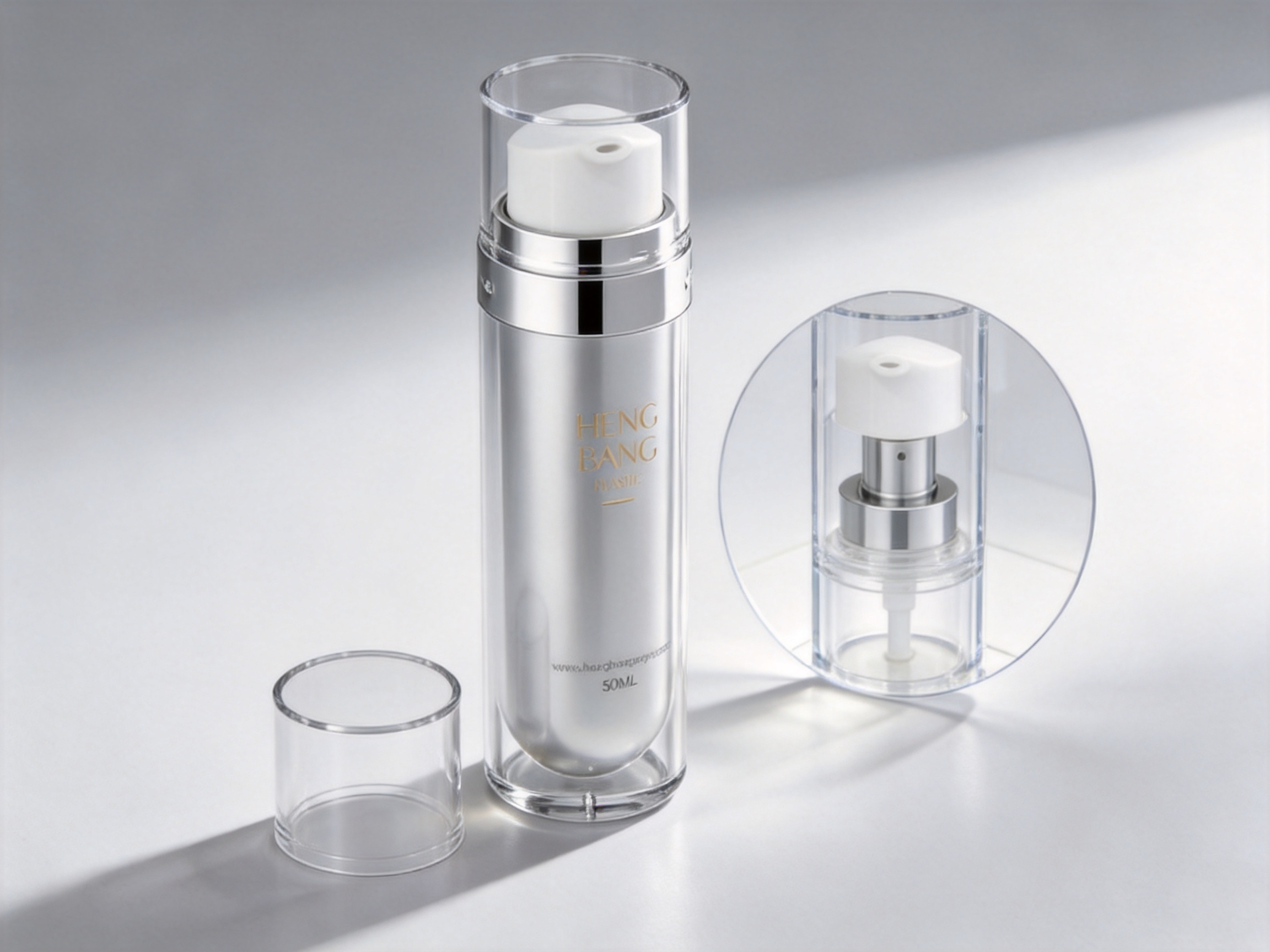
Yuyao Hengbang Plastic Co., Ltd. was established in 2006 and has built its business around plastic packaging for cosmetics and skincare products. The company reports a building area of 35,000 square meters and a workforce of more than 300 employees. This scale provides a foundation for coordinating product development, manufacturing, decoration, quality management, and customer service.
The company states that it provides a full range of services, including design and development. This is important for brands that need more than an off-the-shelf container. Packaging development may involve selecting a capacity, adjusting the shape, reviewing pump performance, preparing decoration samples, evaluating assembly, and coordinating the package with filling-line requirements.
A successful airless bottle must be developed as a system. The bottle body, inner container, piston, pump, collar, and cap all need to fit together with appropriate tolerances. The design must also consider filling, evacuation, storage, transportation, customer use, and end-of-life handling.
A manufacturer with in-house or closely coordinated development capabilities can identify potential problems earlier. Examples include insufficient pump engagement, cap interference, unstable assembly, leakage at the closure, incomplete product evacuation, or decorative surfaces that do not meet appearance expectations.
For a brand, early technical communication can reduce the risk of expensive changes after tooling, decoration, or filling-line preparation has already begun. It also makes it easier to align the package with the intended formula and sales channel.
The pump head is injection-molded in white, and plastic cosmetic packaging commonly depends on controlled injection-molding operations for dimensional accuracy and repeatability. Important production factors include mold design, resin drying where applicable, injection pressure, holding pressure, cooling time, cycle stability, and part inspection.
Consistent molding helps maintain the appearance of the actuator and supports reliable assembly. Cosmetic packaging requires particularly strong visual control because small defects may be visible on the retail shelf. Common inspection points can include short shots, flash, sink marks, flow lines, color variation, scratches, deformation, and mismatch at assembly interfaces.
The product uses a matte-silver spray finish and a bright-silver plated collar. Surface treatment requires careful preparation because appearance depends on cleanliness, adhesion, coating uniformity, color consistency, and resistance to handling.
During production, components may be inspected for coating coverage, color difference, gloss level, dust, pinholes, uneven edges, and adhesion. Plated parts may also require checks for surface brightness, uniformity, abrasion resistance, and compatibility with assembly processes. Exact test methods and acceptance standards should be agreed upon between the supplier and customer during project development.
Hengbang reports certification to ISO9001:2015 and ISO14001:2015. ISO9001:2015 is associated with quality management systems, while ISO14001:2015 is associated with environmental management systems. These certifications indicate that the company has established formal systems relevant to quality control and environmental management, subject to the scope and validity of the certificates.
For customers, a structured management system can support clearer procedures for incoming materials, production control, inspection, corrective action, documentation, and continuous improvement. Environmental management systems can also encourage more systematic attention to resource use, waste handling, emissions, and process impacts.
The company owns multiple invention patents and was recognized as a Ningbo High-Tech Enterprise in 2021. These credentials indicate an emphasis on technical development and innovation. In the packaging sector, innovation may involve dispensing structures, assembly methods, component design, manufacturing efficiency, decorative techniques, or other improvements.
Customers should review the specific technical scope of any patent or development claim that is important to a project. Nevertheless, the company’s stated technical background supports its positioning as a packaging manufacturer capable of developing products beyond simple standard containers.
The HB-K009A/B offers several advantages when compared with an ordinary open-neck bottle, basic squeeze bottle, or standard single-wall pump bottle.
The pump format allows the user to dispense the product with one hand and helps reduce direct contact with the formula. This can be more convenient than opening a screw cap, squeezing a flexible bottle, or using a cosmetic spatula.
The stated 0.23 cc output provides a reference point for dosing. Actual output can vary with formula viscosity, pump speed, temperature, filling level, and component tolerances, so brands should conduct production validation. Once verified, the output can support usage instructions and consumer education.
An airless package is designed to limit the exchange of air during dispensing. This may be beneficial for formulas that are sensitive to oxidation or repeated exposure. It can also help maintain a cleaner dispensing interface than an open jar.
The actual protective performance depends on the complete package, including the pump, seals, piston, closure, formula, and storage conditions. Airless technology should therefore be presented as a functional advantage, not as an absolute guarantee of formula preservation.
Glass can create a luxurious appearance, but it may add weight and increase the risk of breakage during transportation or use. The double-walled plastic structure provides a way to achieve visual depth and a substantial form while retaining the practical benefits associated with plastic packaging.
The transparent and silver combination can appeal to brands that want a premium aesthetic for skincare products while maintaining easier handling. It is suitable for bathroom counters, dressing tables, travel bags, professional treatment rooms, and retail displays.
The bottle’s cylindrical form and coordinated components provide a clean canvas for branding. Labels, screen printing, hot stamping, stickers, or other decoration methods may be considered according to the surface and production plan. The silver inner bottle can serve as a visual foundation, while the transparent outer wall preserves a sense of depth.
The availability of multiple capacities allows a brand to create a coordinated range. A smaller bottle can be positioned as a trial, travel, introductory, or professional-use format, while a larger version can support daily home use. The exact capacity options should be confirmed because the product description and supplied table show different smaller-volume specifications.
The bottle is suitable for a broad range of cosmetic and skincare categories listed by the manufacturer, including cosmetic bottle sets, airless bottles, double-chamber bottles, lotion bottles, plastic cream jars, sunscreen bottles, and toner bottles. Its airless pump format is particularly appropriate for products that require controlled dispensing.
Facial lotions and moisturizers are natural applications for this format. Users can dispense a measured amount without placing fingers inside the container. The premium silver finish also suits products positioned around hydration, barrier care, anti-aging, or advanced daily skincare.
Sunscreen packaging must be evaluated carefully because formulas may contain oils, filters, solvents, or other ingredients that can affect plastic and elastomeric components. Once compatibility and dosage have been confirmed, the pump can provide a practical method for dispensing sunscreen. Brands should also consider whether the pump output is appropriate for the amount required to support the product’s usage instructions.
Some serums and treatment emulsions benefit from a package that limits repeated handling and creates a precise dispensing routine. The bottle can support premium positioning for active-focused skincare, provided the formula’s viscosity and ingredient profile are compatible with the airless system.
Liquid or cream makeup products may also be considered. The pump format can help manage application amounts and reduce mess. However, shade consistency, pigment settling, pump passage dimensions, cleaning, and compatibility should be tested carefully for each formula.
The smaller format may be useful for professional skincare programs, treatment kits, hotel amenities, sample programs, or subscription boxes. The larger format can be used for retail products or salon and spa environments. A unified package design can make different product sizes appear to belong to the same collection.
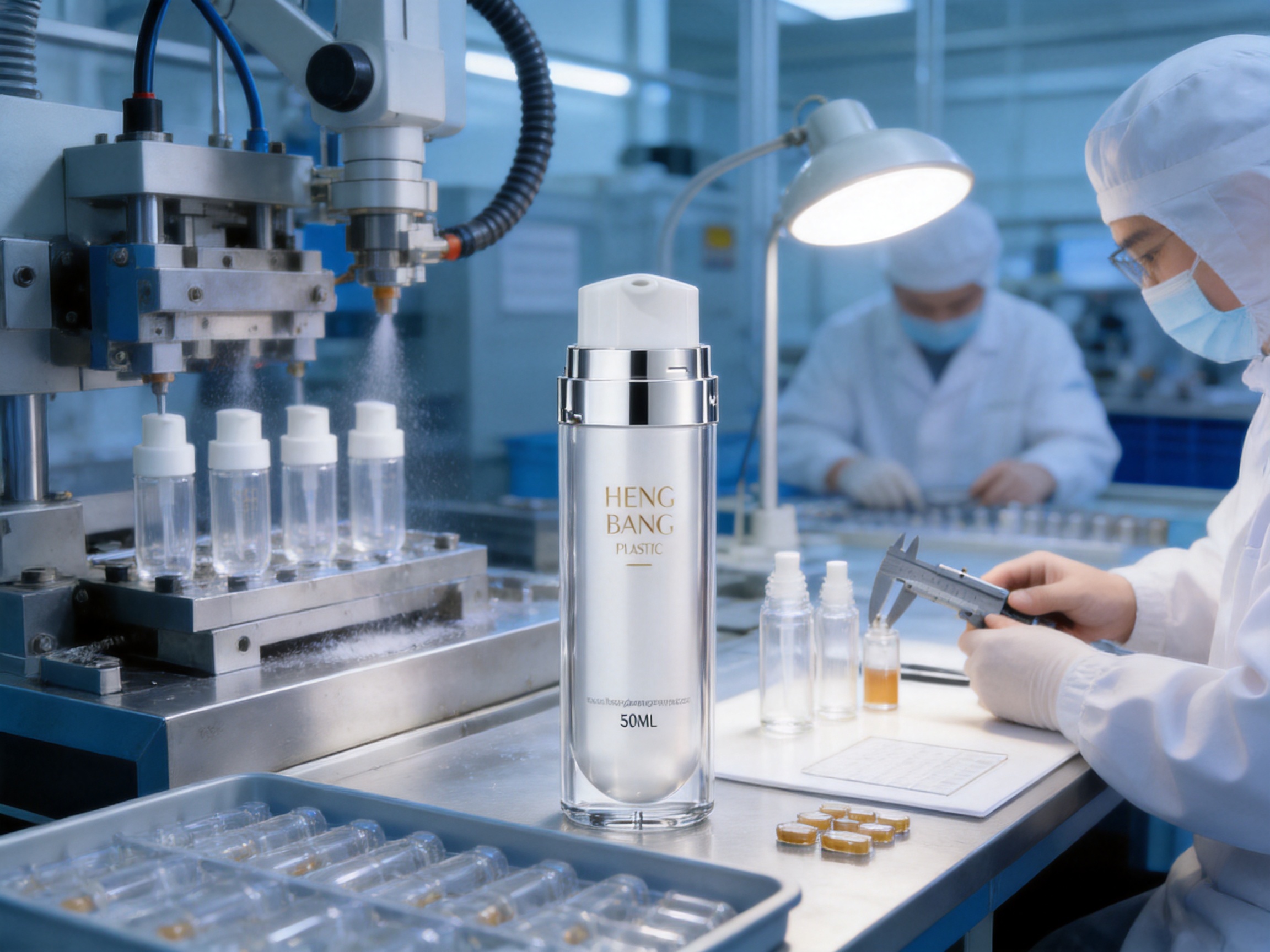
The supplied product description states 30 ml and 50 ml capacities, whereas the accompanying information table lists 20 ml and 50 ml. This discrepancy should be resolved before artwork, mold confirmation, filling-line planning, or product registration. Capacity terminology may refer to nominal volume, overflow volume, or recommended fill volume, and these values are not always identical.
The listed heights are 111.5 mm and 149.1 mm, with a diameter of 39.5 mm. A taller format may support a larger nominal capacity while retaining a similar diameter. This can help maintain consistency across a product family, although the final dimensions should be confirmed through an approved technical drawing.
The diameter is relevant to packaging design, shelf stability, label dimensions, carton size, and shipping efficiency. A diameter of 39.5 mm produces a relatively compact cylindrical footprint. Brands should evaluate how many units fit in a shipping carton, whether the bottle fits existing retail displays, and how the cap and collar affect the overall width.
Filling operations should be reviewed before mass production. The filling line may require specific neck, opening, or pump-assembly conditions. The supplier and filling partner should confirm whether the bottle is filled before pump insertion, whether the inner container is evacuated or primed, and how the airless system is activated after filling.
Sample filling is essential. A package may perform differently with a thin toner-like liquid, a medium-viscosity lotion, a thick cream, or a formula containing particles. Testing should assess priming time, output consistency, residual product, leakage, pump recovery, cap fit, and performance after storage at different temperatures.
Quality control should cover both visual and functional properties. A premium package can fail commercially if it looks attractive but leaks, does not prime, dispenses inconsistent amounts, or develops surface damage during transportation.
Appearance inspection may include checking the transparency of the cap and outer bottle, the whiteness and uniformity of the pump head, the evenness of the matte-silver inner finish, and the brightness of the plated collar. Inspectors may also look for scratches, dust, dents, coating defects, color variation, deformation, and assembly mismatch.
Critical dimensions should be measured against approved drawings or samples. These may include height, diameter, pump engagement, collar dimensions, cap clearance, inner-bottle position, and assembly alignment. Dimensional consistency is important for both consumer perception and filling-line performance.
Pump tests may examine priming, output per stroke, actuation force, recovery, leakage, and operation at different temperatures. The testing formula should represent the customer’s intended product as closely as possible. A water-based test may not predict the behavior of a high-viscosity cream or an oil-rich emulsion.
Leakage tests can include upright storage, inverted storage, side storage, pressure changes, vibration, and transportation simulation. The cap and collar should remain secure, and the pump should not release product unintentionally during handling.
Decorated or coated surfaces may be evaluated for adhesion, abrasion resistance, alcohol resistance, moisture resistance, and color stability. The exact test requirements depend on the customer’s market, handling conditions, and product positioning.
A well-managed packaging project normally progresses through several stages. The first is requirement definition. The customer should provide the desired formula category, capacity, target market, decoration preferences, expected order quantity, filling method, and delivery schedule.
The second stage is technical review. The supplier and customer confirm the component structure, material information, dimensions, pump output, finish, color, and assembly requirements. At this stage, the capacity discrepancy in the supplied information should be clarified.
The third stage is sample evaluation. Empty samples can be inspected for appearance, dimensions, cap fit, pump operation, and general handling. Filled samples should then be evaluated with the actual formula under realistic conditions.
The fourth stage is decoration approval. The customer reviews the matte-silver finish, bright-silver plating, pump color, transparency, label position, printing, or other selected decorations. Approval samples should represent the production method rather than only a digital rendering.
The fifth stage is filling-line validation. The bottle should be tested on the customer’s intended filling equipment. This can identify issues related to bottle positioning, pump insertion, cap placement, conveyor handling, and output speed.
The final stages involve mass production, inspection, packing, shipment, and post-delivery feedback. Clear records of approved samples, specifications, tolerances, inspection standards, and corrective actions help maintain consistency across repeat orders.
Plastic packaging remains important in cosmetics because it can reduce breakage risk and provide design flexibility. At the same time, brands are increasingly expected to examine material use, decoration, recyclability, and production impacts.
The double-walled structure provides a premium appearance, but it also contains multiple components and finishes. Customers should discuss the material composition and end-of-life considerations with the manufacturer. They may also evaluate whether the product can be simplified, whether certain decorative treatments are necessary, and how the package will be classified in the target market.
Hengbang’s ISO14001:2015 certification reflects the company’s stated environmental management framework. An environmental management system can support more organized control of production impacts, though customers should request project-specific information when sustainability claims are required.
Potential sustainability discussions may include production scrap management, energy efficiency, coating processes, plating controls, packaging reduction, shipping efficiency, and material declarations. A responsible packaging decision should consider the complete life cycle rather than focusing only on one material characteristic.
Packaging communicates product identity through shape, color, touch, sound, and dispensing behavior. The HB-K009A/B supports a clean, technical, and premium positioning through its silver inner bottle, transparent outer components, white pump head, and reflective collar.
For a clinical skincare line, the white and silver color combination can suggest cleanliness, precision, and laboratory-inspired design. For a luxury lotion, the metallic finishes and substantial double-wall construction can support a more elevated presentation. For a modern natural skincare brand, the transparent exterior may be combined with restrained typography and simple labels.
The same bottle can also help organize a product family. Different labels or internal colors may distinguish cleanser, lotion, serum, sunscreen, and treatment products while retaining a common package architecture. This can improve shelf recognition and make the range appear professionally coordinated.
The pump itself can become part of the user experience. A smooth actuator, consistent dose, protective cap, and clean dispensing area can contribute to perceptions of quality. These details matter because consumers often judge a product through repeated daily interaction rather than through the first purchase alone.
Before approving the product, buyers should request a current technical drawing that identifies all dimensions, tolerances, materials, and capacity definitions. The drawing should indicate whether the stated height includes the cap and whether the listed capacity represents nominal fill volume or another measurement.
Buyers should also confirm the exact pump output and ask whether the 0.23 cc figure is a nominal average or a controlled range. Testing should be completed with the intended formula at relevant temperatures.
Additional questions may address minimum order quantity, sampling procedures, decoration options, plating specifications, color matching, lead time, packaging method, carton dimensions, inspection standards, and available documentation.
For international distribution, brands should request information required for their destination market. This may include material declarations, quality certificates, environmental certificates, testing records, safety documentation, and packaging-related compliance information. Requirements differ by country and product category, so the brand should work with qualified regulatory professionals.
Product model |
HB-K009A/B |
Product type |
Plastic airless lotion bottle |
Structure |
Double-walled, wide-mouth airless pump bottle |
Capacity stated in product description |
30 ml and 50 ml |
Capacity stated in supplied technical table |
20 ml and 50 ml |
Listed height |
111.5 mm and 149.1 mm |
Listed diameter |
39.5 mm |
Listed dispensing output |
0.23 cc per actuation |
Pump head |
White injection-molded component |
Inner bottle finish |
Matte-silver sprayed finish |
Collar finish |
Bright-silver plating |
Cap and outer appearance |
Transparent |
Material information supplied |
Cap: MS; pump: PP; outer bottle: MS; inner bottle: PP |
Primary applications |
Lotions, creams, serums, sunscreens, skincare, and cosmetic formulas |
The HB-K009A/B is a plastic airless lotion bottle with a double-walled structure, a pump dispenser, a transparent exterior, a matte-silver inner bottle, and a bright-silver plated collar. It is designed for cosmetic and skincare products.
The product description states 30 ml and 50 ml capacities. However, the supplied technical table lists 20 ml and 50 ml. Buyers should confirm the available smaller capacity and its corresponding dimensions with Yuyao Hengbang Plastic Co., Ltd. before ordering.
The supplied information lists an output of 0.23 cc per actuation. Actual output may vary according to formula viscosity, temperature, filling conditions, and component tolerances. Production testing is recommended.
It may be suitable for certain creams and emulsions, but compatibility and dispensing tests are necessary. Thick formulas may require additional priming, a different actuation force, or adjustments to the filling and pump system.
The airless system is designed to dispense product while limiting the amount of air introduced during normal use. It can support controlled dosing and help reduce direct contact with the formula compared with an open jar.
A double-walled bottle creates greater visual depth, provides a more substantial appearance, supports premium positioning, and allows the inner and outer components to use different finishes. It may also provide additional structural support, subject to testing.
The bottle can be considered for sunscreen applications, but the formula must be tested for compatibility with the inner bottle, pump, seals, and other components. The pump output should also be evaluated against the intended application instructions.
The supplied product information confirms a matte-silver sprayed inner bottle and a bright-silver plated collar. Additional decoration options should be discussed with the manufacturer based on the selected material, surface, order volume, and required appearance.
Yuyao Hengbang Plastic Co., Ltd. reports ISO9001:2015 and ISO14001:2015 certifications. Customers should request current certificates and confirm their scope when documentation is required for a specific project.
Yes. Filled samples should be tested with the actual formula. Recommended evaluations include pump priming, output consistency, leakage, storage stability, surface appearance, cap fit, transportation resistance, and compatibility.
The smaller capacity option may be appropriate for travel, sampling, trial, professional treatment, or hospitality products. The exact smaller capacity should be confirmed because the supplied materials identify both 20 ml and 30 ml references.
The buyer should confirm capacity, dimensions, materials, pump output, decoration, color, minimum order quantity, filling method, lead time, testing standards, packaging method, and required compliance documents.
The HB-K009A/B plastic airless lotion bottle combines functional dispensing with a carefully layered visual design. Its airless pump can support controlled application and reduced exposure during normal use, while its double-walled construction creates a more substantial and premium appearance than many conventional single-wall containers.
The transparent outer bottle, matte-silver inner bottle, bright-silver collar, white pump head, and transparent cap create a modern packaging language suitable for lotions, creams, serums, sunscreens, and other cosmetic products. The stated 0.23 cc output provides a useful reference for dosage development, while the compact cylindrical format can support multiple product-line applications.
Its strongest competitive advantage is the combination of appearance and function. Brands do not have to choose between a practical plastic package and a premium visual presentation. The product provides a platform that can be evaluated for both daily usability and brand impact.
The manufacturing background of Yuyao Hengbang Plastic Co., Ltd. further supports the product proposition. Since 2006, the company has focused on cosmetic and skincare packaging and has developed a production operation with design, development, manufacturing, quality management, and environmental management capabilities. Its reported ISO9001:2015 and ISO14001:2015 certifications, high-tech enterprise recognition, and invention patents indicate an organized approach to technical and operational development.
Before commercial approval, customers should resolve the capacity discrepancy between the product description and supplied table, confirm all material abbreviations, and conduct formula-specific compatibility and performance testing. With those technical points established, the HB-K009A/B can serve as a versatile packaging choice for brands seeking a clean, premium, and functional airless presentation.
1. Product information supplied for the HB-K009A/B plastic airless lotion bottle, including dimensions, capacities, materials, finishes, and dispensing output.
2. Company information supplied by Yuyao Hengbang Plastic Co., Ltd., including company history, facility size, employee count, services, certifications, patents, and enterprise recognition.
3. ISO 9001:2015, Quality Management Systems—Requirements.
4. ISO 14001:2015, Environmental Management Systems—Requirements with Guidance for Use.
5. General cosmetic packaging development practices concerning material compatibility, pump performance, leakage testing, decoration inspection, and filled-package validation.


Copyright © Yuyao Hengbang Plastic Co., Ltd.
All Rights Reserved.
 Wholesale Plastic Cosmetic Packaging Manufacturers