English
 中文简体
中文简体
News
Home > Author > Wang Mengyao — Product After-Sales Service Coordinator > Why Double-Wall Acrylic Cream Jars Elevate Premium Skincare Packaging

 2026.08.09
 Wang Mengyao — Product After-Sales Service Coordinator
Content
In the skincare market, packaging is no longer a simple container for protecting a formula. It is part of the product experience, a visible expression of quality, and an important influence on how consumers evaluate a cream before they try it. The HB-G004 Double Wall Plastic Acrylic Face Cream Jar is designed for brands that want to combine a premium appearance, dependable protection, flexible customization, and practical manufacturing performance in one sophisticated package.
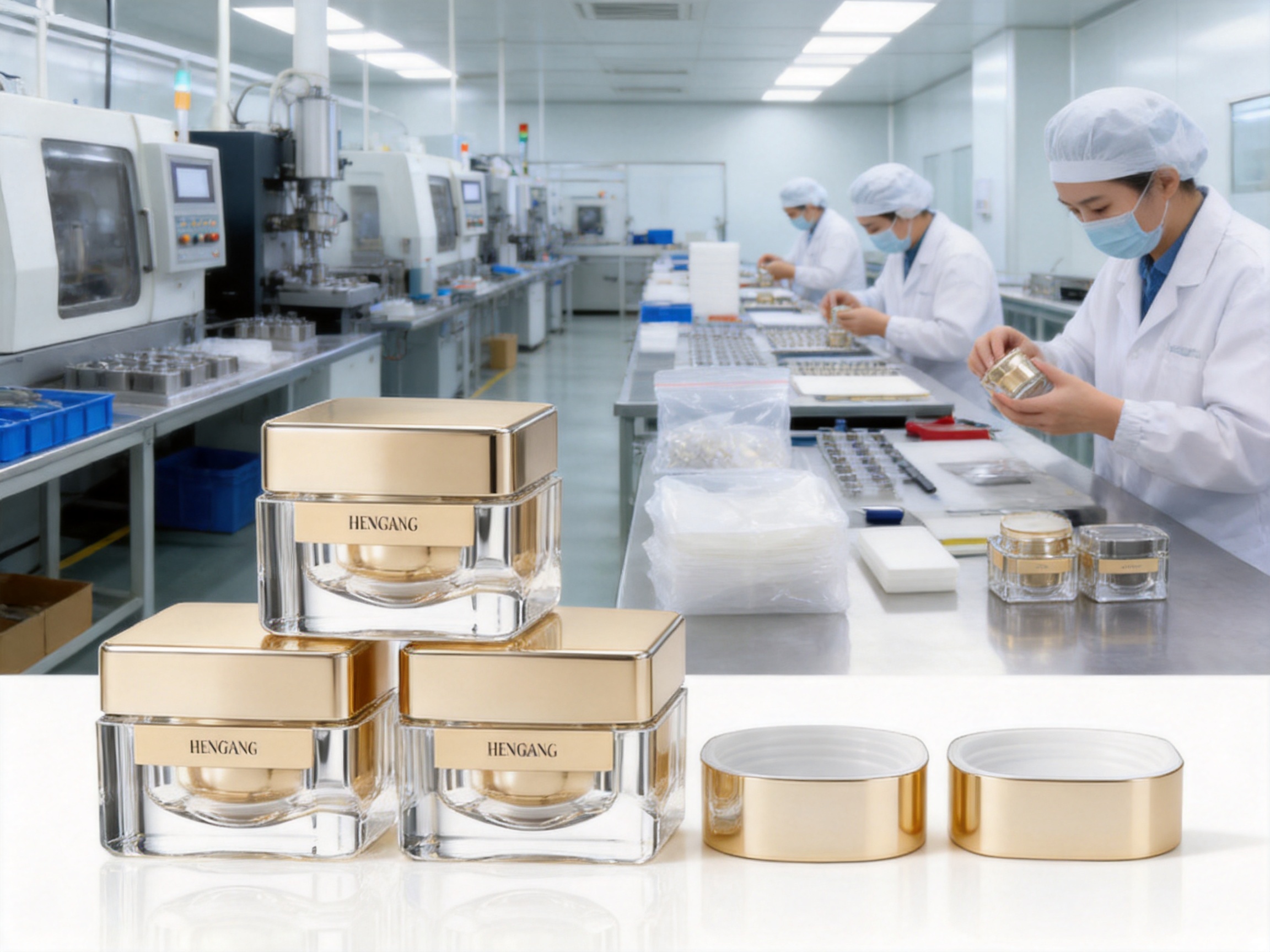
With its square geometric profile, double-wall construction, 50 ml capacity, and high-end gold-plated finish, this cream jar offers a distinctive alternative to ordinary round plastic jars and basic single-wall containers. It presents a substantial, modern appearance while remaining based on lightweight plastic materials. The design is especially suitable for facial creams, moisturizers, eye creams, sleeping masks, body creams, and other skincare products that require an elevated visual identity.
The jar is manufactured with a PMMA and ABS cap, a PMMA outer bottle, and a PP inner bottle. This material combination balances appearance, structural performance, chemical compatibility, and production flexibility. The exterior PMMA provides clarity and a glass-like visual impression, while the inner PP component supports practical product containment. ABS is used in the cap structure to contribute strength and dimensional stability.
Beyond its visual appeal, the HB-G004 reflects a complete approach to cosmetic packaging development. Its value comes from the combination of geometry, material selection, double-wall construction, surface treatment, component coordination, and the manufacturing capabilities of an experienced packaging producer. For brands seeking a container that can communicate light luxury or timeless elegance, this model offers a strong foundation for a refined product presentation.
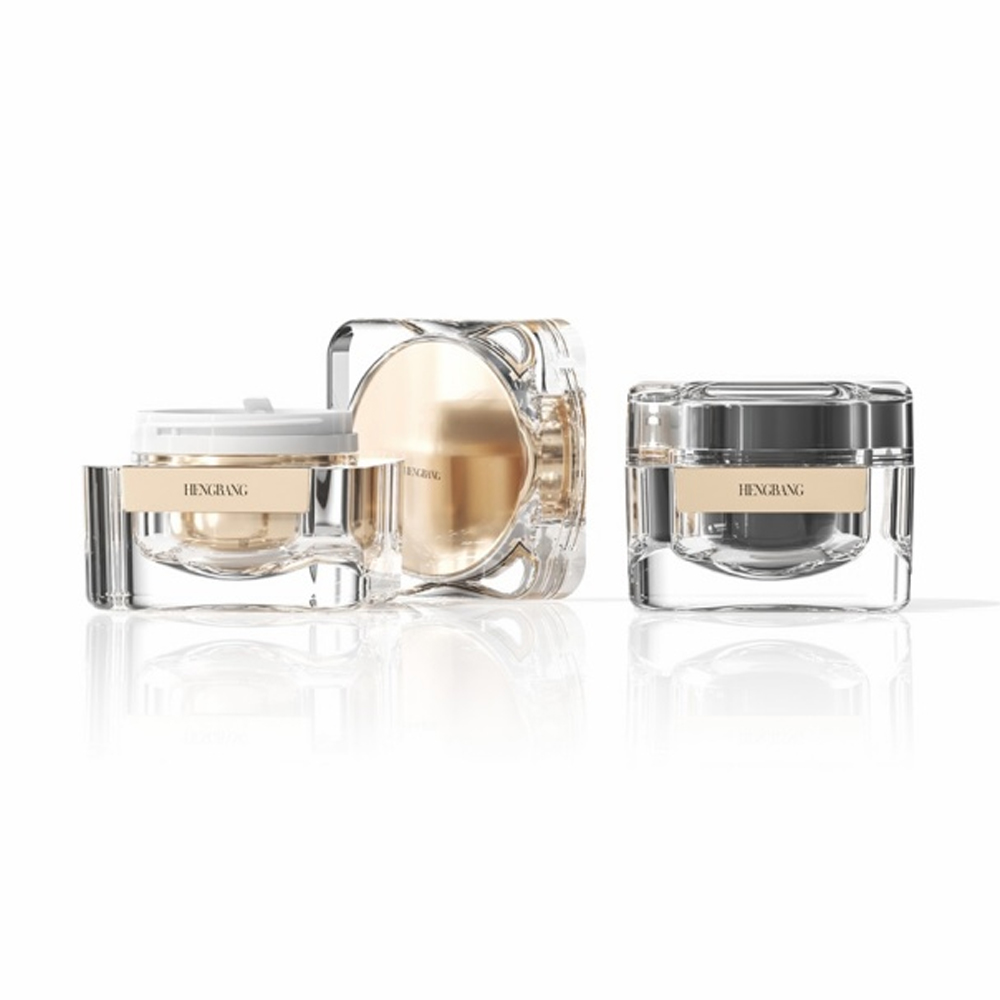
HB-G004 Double Wall Plastic Acrylic Face Cream Jar
The HB-G004 is a square double-wall plastic acrylic face cream jar with a 50 ml nominal capacity. Its external dimensions measure approximately 69 by 69 mm, with a height of 54.8 mm. These proportions create a broad, stable silhouette that feels substantial in the hand while maintaining a compact footprint suitable for cosmetic shelves, vanity tables, travel cases, and gift packaging.
Its square shape is one of the clearest points of differentiation. Many cream jars use familiar cylindrical profiles because round forms are simple to manufacture and easy to label. However, a square container creates stronger visual recognition. The four-sided geometry provides clean architectural lines and a contemporary appearance. It can make a skincare range look more organized and premium, particularly when several products are displayed together.
The design has a modern minimalist character, but it does not appear plain. The geometry supplies structure, while the metallic gold-plated surface introduces visual richness. This balance allows the jar to serve multiple brand directions. It can support a modern luxury line with restrained graphics, a classic skincare collection with decorative details, or a premium gift set with coordinated gold accents.
The double-wall construction adds depth to the package. Rather than presenting a thin, basic plastic profile, the jar creates a layered appearance that suggests solidity and refinement. The external wall becomes the primary visual surface, while the inner bottle provides a separate product-contact component. This construction is especially valuable for brands that want the visual weight associated with glass but prefer the handling advantages of engineered plastic.
A premium jar must perform at several levels simultaneously. It should look attractive from a distance, feel dependable when handled, protect the formula during ordinary use, and support efficient filling and assembly. The HB-G004 is designed around these combined requirements rather than focusing only on decoration. Its appearance attracts attention, while its component construction supports practical use.
Material selection is central to the performance of cosmetic packaging. Every component must be selected according to its role, including external appearance, product contact, closure performance, structural support, and compatibility with surface finishing. The HB-G004 uses three established plastic materials in a coordinated component system.
PMMA, also known as acrylic, is widely used in cosmetic packaging because of its clarity, smooth surface, and glass-like appearance. It can create a clean and upscale visual effect without the weight and fragility associated with conventional glass. The PMMA outer bottle in the HB-G004 provides a refined exterior platform for the product’s square shape and decorative finish.
The smooth surface of PMMA is also valuable for decoration. It can support a consistent visual treatment across the package and provide a suitable base for processes such as plating, coating, printing, and other decorative techniques, subject to project specifications and validation. A well-finished acrylic surface can make metallic colors appear more even and visually convincing.
For skincare brands, the appearance of PMMA can help communicate transparency, cleanliness, and technical quality. Even when the package is decorated with gold, the underlying material contributes to a polished and precise impression. This is particularly useful for products positioned in the premium, professional, anti-aging, brightening, or luxury skincare segments.
The cap uses PMMA combined with ABS. ABS is a durable engineering plastic known for its strength, rigidity, and suitability for molded components. In a cosmetic closure, these characteristics can support the dimensional stability of the cap and help it maintain a well-defined shape during handling and assembly.
A cap must do more than complete the appearance of a jar. It needs to align correctly with the bottle, provide a secure closing action, and withstand repeated opening and closing during the product’s use cycle. The ABS component can contribute to the structural foundation required for these functions, while PMMA helps maintain continuity with the premium acrylic appearance of the container.
The combination also allows the closure to be designed with visual depth. Instead of relying on a single material to perform every function, the component architecture can separate structural and decorative roles. This approach gives packaging engineers more flexibility when balancing appearance, assembly, and handling performance.
The inner bottle is made from PP, or polypropylene. PP is frequently used in cosmetic packaging because of its practical performance, light weight, and broad application in product-contact components. Its role in the HB-G004 is particularly important because the inner bottle forms the primary receptacle for the cream formula.
Using a dedicated inner bottle allows the outer PMMA wall to focus on appearance and structural presentation while the inner PP component supports product containment. This separation can be advantageous for skincare brands that need a polished external package without making the entire container dependent on one material.
Product compatibility should always be confirmed through appropriate testing because formulas vary in pH, oil content, active ingredients, fragrances, solvents, and preservation systems. Nevertheless, the use of PP as an inner component provides a recognized packaging solution for many cream and lotion applications. The final selection should be validated against the specific formula, filling conditions, storage requirements, and intended market.
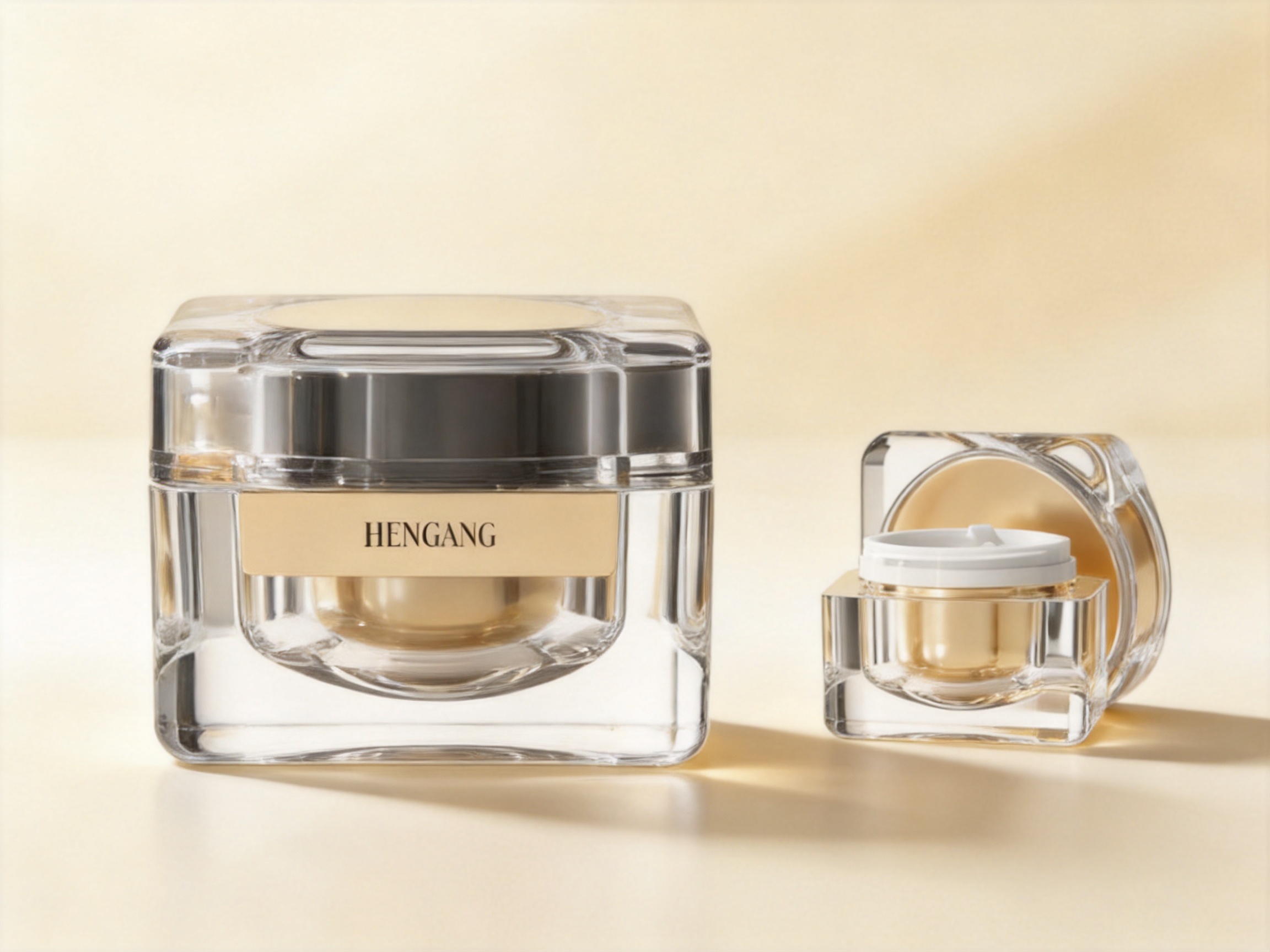
Double-wall packaging is valued because it creates a layered container system with both practical and aesthetic benefits. In the HB-G004, the outer PMMA bottle and inner PP bottle work together to form a package that looks more substantial than a basic single-wall jar.
The space and layering between the external and internal components create visual depth. This can make the jar appear more luxurious and substantial on a retail shelf. The result is a package that communicates quality before the consumer has opened it.
Visual depth is particularly important in premium skincare, where consumers often associate thicker walls, layered surfaces, and carefully coordinated components with greater product value. A double-wall jar can support this perception without requiring the weight of a solid glass vessel.
Packaging is evaluated through touch as well as sight. A container that feels stable and solid can increase consumer confidence in the product. The HB-G004’s broad square form and layered construction give it a confident hand feel. Its proportions help it sit firmly in the hand, while the smooth exterior provides a refined tactile experience.
A good hand feel also supports the ritual aspect of skincare. Applying a face cream is often part of a personal routine, and the opening, handling, and closing of the jar contribute to that routine. A carefully designed package can make daily use feel more deliberate and enjoyable.
One of the practical strengths of double-wall construction is the ability to separate the outer decorative component from the inner product-contact component. The external PMMA bottle can carry the visual identity, finish, and decorative treatment. The internal PP bottle can focus on containment and formula contact.
This arrangement may give brands greater freedom when developing a high-end visual concept. A package does not need to compromise its exterior appearance simply because the formula requires a specific interior material. Instead, each component can contribute to the role for which it is best suited.
Glass remains associated with luxury, but it can also increase transportation weight, handling concerns, and breakage risk. Acrylic-based packaging provides a way to achieve a clear, polished, and substantial appearance while maintaining the practical benefits of plastic.
The HB-G004 is not intended to imitate every characteristic of glass, nor should it be evaluated as a direct substitute for every glass application. Its advantage is that it combines a premium visual language with lightweight plastic construction and a more flexible component system. This can be attractive to brands balancing image, logistics, consumer convenience, and cost management.
The gold-plated finish is a defining feature of the HB-G004. Metallic decoration can transform an otherwise simple surface into a visually distinctive package. Gold is widely associated with prestige, celebration, heritage, and luxury, making it suitable for skincare products positioned above the mass market.
On this square acrylic jar, the gold treatment emphasizes the clean geometric lines and gives the container a luminous metallic character. It can create a light-luxury impression when paired with restrained typography and neutral colors. It can also support a more classic look when combined with ornamental graphics, rich cream tones, deep green, black, burgundy, or other traditional palette choices.
Packaging influences perceived value because consumers use visible and tactile signals to estimate the quality of an unfamiliar product. A carefully applied metallic finish can make a jar look more exclusive and giftable. This is especially useful for facial creams sold in department stores, beauty boutiques, online premium collections, holiday sets, and special-edition programs.
The gold surface may also help a brand build a recognizable visual code. If gold is used consistently across jars, bottles, cartons, and secondary packaging, it can become part of the product family identity. The HB-G004 provides a strong decorative base for this type of coordinated packaging system.
The product description identifies the coating as combining wear resistance and corrosion resistance to help maintain its luster. These qualities are important in a cosmetic package because the container may be exposed to repeated handling, contact with fingers, humidity, oils, creams, and normal transport conditions.
Decorative performance depends on the complete process, including surface preparation, coating control, curing, handling, inspection, and packaging protection. A visually attractive finish must also be consistent from batch to batch. Appropriate production controls help reduce variation in color, coverage, gloss, adhesion, and surface uniformity.
Brands should still evaluate decoration according to their actual distribution environment. Testing may include rubbing, adhesion, humidity, temperature cycling, chemical exposure, and compatibility with secondary packaging. Such validation is especially important for products intended for long shelf life or international transportation.
The HB-G004 competes not only through its material composition but through the total experience created by its structure and finish. Compared with a conventional single-wall plastic jar, it offers a more layered and premium appearance. Compared with a plain cylindrical jar, its square geometry gives it stronger shelf distinction. Compared with a fully glass package, it provides a lighter plastic-based alternative with a more flexible component architecture.
| Feature | HB-G004 Double-Wall Acrylic Jar | Basic Single-Wall Plastic Jar | Typical Glass Cream Jar |
|---|---|---|---|
| Exterior design | Square geometric profile with premium decorative potential | Often simple and standardized | Can be premium but may use conventional shapes |
| Construction | Outer PMMA bottle with inner PP bottle | Usually one primary molded container | Generally a glass vessel with separate closure components |
| Hand feel | Substantial, layered, and smooth | Lightweight and functional | Dense and premium, but heavier |
| Decoration | Suitable for gold-plated luxury presentation | May support simpler decoration | Can support decoration but may require additional weight and handling care |
| Breakage consideration | Plastic construction reduces the risk associated with glass breakage | Generally low breakage risk | Requires greater care during shipping and use |
| Capacity | 50 ml | Varies by model | Varies by model |
This comparison does not mean that one package is universally better than every other option. Packaging selection depends on the formula, brand position, filling line, target market, regulatory requirements, cost structure, and sustainability strategy. The competitive strength of the HB-G004 lies in the way it combines several desirable characteristics in a single format.
Retail shelves and online product images are crowded with similar round jars. A square format can make a product immediately easier to recognize. Its straight edges create a disciplined silhouette that photographs well and can align neatly in product arrangements.
For online retail, geometry can be equally important. A distinctive container may remain recognizable in thumbnails, social media content, advertisements, and unboxing videos. The gold surface can further increase contrast and create a visual cue associated with premium positioning.
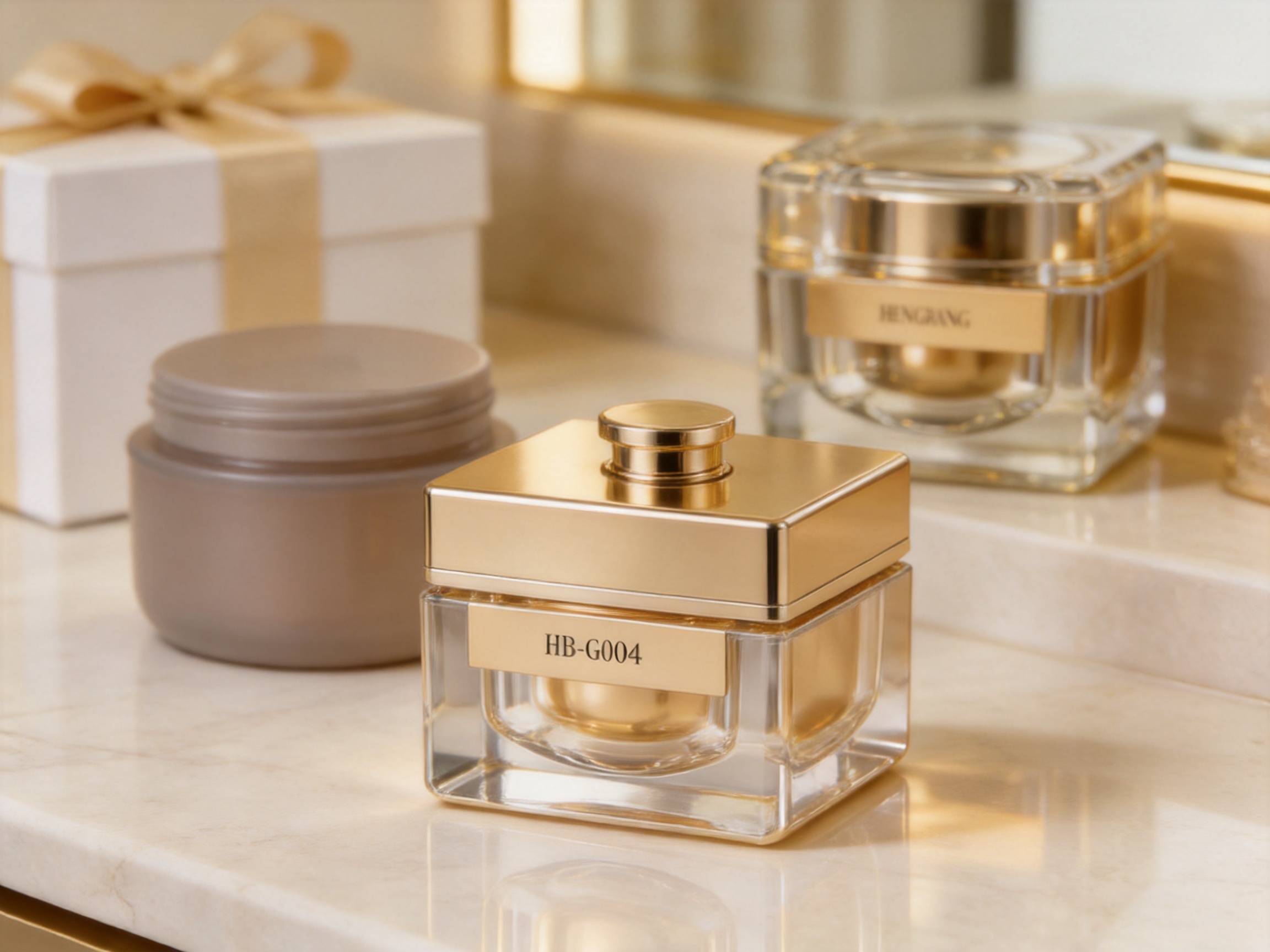
Gift appeal is a major consideration in skincare packaging. A jar that looks decorative and substantial can help a product feel appropriate for birthdays, holidays, anniversaries, and special beauty collections. The HB-G004’s metallic finish and architectural shape make it suitable for gift sets and limited-edition packaging programs.
Its appearance can also support a higher-value presentation when combined with a rigid carton, molded insert, foil-stamped label, or coordinated accessory. Packaging teams can build an entire visual experience around the jar rather than treating it as a hidden functional component.
Some luxury packages prioritize visual effect at the expense of everyday convenience. The HB-G004 aims for a more balanced result. Its plastic-based construction helps reduce the handling concerns associated with fragile materials, while its double-wall design and metallic decoration maintain a premium appearance.
This balance is valuable for products intended for regular use. Consumers can keep the jar in a bathroom, dressing area, travel bag, or handbag without treating it as an overly delicate display object. The package remains elegant but practical.
A successful cosmetic container depends on more than a good design drawing. It requires reliable tooling, controlled molding, accurate assembly, consistent decoration, quality inspection, and responsive project management. The manufacturing strength behind the HB-G004 is supported by the capabilities of Yuyao Hengbang Plastic Co., Ltd., a specialist in plastic packaging for cosmetics and skincare products.
The company was established in 2006 and operates from a facility with a building area of approximately 35,000 square meters and more than 300 employees. This scale provides a production foundation for handling product development, manufacturing coordination, quality management, and customer service within an experienced organization.
Cosmetic packaging projects often begin with a visual idea rather than a fully engineered product. A brand may know the desired shape, capacity, finish, and market position but need support translating that concept into a manufacturable package. A professional design and development team can help evaluate wall thickness, component fit, closure structure, decoration areas, assembly requirements, and production feasibility.
For the HB-G004, development considerations include the square profile, the relationship between the outer PMMA bottle and inner PP bottle, the cap construction, the 50 ml fill volume, and the gold-plating process. Each element must work with the others. A change to one part can influence assembly, appearance, tolerance, or filling performance.
Development support can also help brands avoid common problems such as uneven gaps, poor cap alignment, decoration interference, excessive material stress, or insufficient clearance between components. Early engineering review reduces the possibility that a package will look attractive in a concept image but become difficult to manufacture at scale.
Plastic packaging components are generally produced through controlled molding processes. Consistent molding requires attention to tooling design, material drying where applicable, injection parameters, cooling, ejection, and dimensional inspection. Geometric containers with broad flat surfaces require careful control because visible distortion, sink marks, flow lines, or uneven cooling can affect the final appearance.
The square body of the HB-G004 places emphasis on corner definition and surface uniformity. The external PMMA bottle must present clean lines, while the internal PP bottle must fit accurately within the outer component. The cap must also maintain a reliable relationship with the jar during repeated use.
Manufacturing experience helps a producer identify the parameters that influence these results. Proper tooling maintenance and process monitoring support repeatability. When a product is ordered in larger quantities, consistency becomes particularly important because consumers expect every unit in a product line to have the same color, proportions, finish, and closing behavior.
Double-wall packaging requires more assembly coordination than a basic single-piece jar. The outer bottle, inner bottle, cap elements, and decorative surfaces must be managed as a complete system. Assembly must preserve alignment and avoid scratching or damaging the finished surfaces.
Component matching is another important consideration. If the inner bottle and outer bottle are produced within different dimensional ranges, the fit may become too tight, too loose, or visibly uneven. Controlled tolerances and inspection procedures help maintain a clean assembled appearance.
A professional manufacturer can also evaluate assembly sequence. Some parts may need to be decorated before assembly, while others may be assembled first depending on the selected process. The sequence must protect the gold finish and maintain the functional relationship between the closure and the container.
Gold plating or related metallic finishing requires a controlled surface preparation and coating process. The final appearance depends on substrate cleanliness, coating adhesion, color consistency, curing conditions, and careful handling after decoration. Any contamination, uneven preparation, or poor process control can become visible on a reflective surface.
Surface inspection is therefore an important part of production. Operators and quality personnel may review color, gloss, coverage, edge definition, scratches, particles, pinholes, and other visible defects according to approved standards. Cosmetic packaging has a high appearance expectation, so decorative inspection must be treated as a central quality activity rather than a final cosmetic afterthought.
Quality management provides the framework that connects design, manufacturing, inspection, and customer requirements. Yuyao Hengbang Plastic Co., Ltd. has passed ISO9001:2015 and ISO14001:2015 certifications. ISO9001 relates to quality management systems, while ISO14001 relates to environmental management systems. These certifications indicate that the company has established structured systems for managing quality and environmental responsibilities.
Certification alone does not replace product-specific testing, but it demonstrates a formal commitment to controlled operations. For cosmetic packaging buyers, this can provide greater confidence that procedures are documented, responsibilities are defined, and improvement activities are part of the organization’s operating approach.
The company was also recognized as a Ningbo High-Tech Enterprise in 2021 and owns multiple invention patents. These achievements reflect an orientation toward technical development and product innovation. In a competitive packaging market, technical capability is valuable because brands increasingly require more than standard containers. They seek differentiated shapes, advanced decoration, new dispensing structures, improved user experiences, and coordinated product families.
A young and professional team supports the company’s service model. Packaging programs often involve communication between brand managers, designers, purchasing departments, formula developers, filling factories, and quality teams. A manufacturer that can communicate across these functions can help reduce misunderstandings and improve project efficiency.
The company’s stated business philosophy centers on quality, integrity, and customer-first service. These principles are particularly relevant to custom or semi-custom packaging projects, where timelines, approvals, samples, specifications, and production consistency must be managed carefully. Reliable communication is a practical strength because packaging decisions frequently change during development.
The 50 ml capacity is a widely recognized size for facial skincare. It provides enough volume for a meaningful use period while remaining compact enough for personal routines and premium presentation. The HB-G004 can be considered for a broad range of cream-based formulas, subject to compatibility and filling validation.
Daily face creams and moisturizers are natural applications for this format. The jar’s premium appearance can support products positioned around hydration, nourishment, barrier care, firmness, or radiance. The gold finish may be particularly suitable for formulas marketed as intensive, luxurious, or ritual-focused.
Anti-aging products often depend on a premium visual identity. Consumers may expect the packaging to communicate research, efficacy, and investment. The structured square profile and layered construction can support a clinical-luxury or prestige treatment concept.
Night products frequently use richer textures and more indulgent brand language. A substantial jar can reinforce the idea of an evening ritual. The 50 ml capacity is appropriate for a product intended for repeated home use, while the decorated exterior can enhance the feeling of a special nighttime treatment.
Although eye creams are often sold in smaller capacities, the format may be adapted for selected targeted-care products or premium eye treatment collections. The final fill volume and dosing requirements should be confirmed according to the formula and intended usage pattern.
The HB-G004 is well suited to gift-oriented programs because its gold surface provides an immediate decorative effect. It can be paired with a matching toner bottle, lotion bottle, airless bottle, or additional cream jar to create a coordinated collection. A consistent finish across several package types can help a brand build a unified shelf and unboxing experience.
One of the most useful features of a premium cosmetic jar is its ability to serve as a flexible branding surface. The HB-G004’s broad, clean geometry can accommodate several identity strategies while retaining its core visual character.
Brands may choose to use minimal printing so that the gold surface remains dominant. A small logo, short product name, and limited information can create a restrained luxury appearance. Alternatively, a contrasting label or printed panel can provide stronger communication for a clinical, botanical, or professional skincare concept.
Color coordination can also change the character of the package. Gold with white may appear clean and luminous. Gold with black can create a dramatic luxury effect. Gold with soft beige or blush tones may support a gentle premium skincare identity. Gold with deep green, navy, or burgundy can suggest heritage and richness.
Secondary packaging should be considered at the same time as the jar. A carton that repeats the square geometry can create a consistent package architecture. Protective inserts may help prevent surface damage during transport. A carefully selected carton finish can either emphasize the metallic jar or provide contrast so that the jar remains the visual focus.
Before mass production, brands should approve physical samples rather than relying only on digital renderings. Metallic colors can appear different under various lighting conditions, and the interaction between a reflective surface and printed graphics may not be fully represented on a screen. Sample approval helps confirm the actual appearance, fit, and hand feel.
Although the HB-G004 offers a strong premium packaging platform, responsible product development requires a complete technical review. Cosmetic packaging should be evaluated in relation to the formula, filling process, closure requirements, distribution environment, and regulatory expectations.
The formula should be tested against the PP inner bottle and any other component that may contact the product. Compatibility testing can examine changes in color, odor, viscosity, weight, appearance, and chemical stability. The formula should also be observed for interactions with the package over the intended shelf life.
Testing may be performed under normal and accelerated conditions. The exact protocol depends on the product category, market, formula characteristics, and internal quality requirements. A packaging supplier can provide material information, but the brand and its technical partners remain responsible for confirming suitability for the final formula.
The filling line should be checked for compatibility with the jar dimensions and assembly method. Important points may include filling accuracy, inner bottle positioning, cap application, torque or closing force, line speed, and finished product inspection.
Where a protective inner seal, liner, or other secondary closure is required, the interface should be reviewed during development. The completed package should be evaluated for leakage, transport stability, and user opening behavior.
Gold-plated surfaces should be tested against the conditions expected during manufacturing, shipping, retail display, and consumer use. Testing can include abrasion, rubbing, moisture, formula contact, and exposure to oils or common cosmetic residues.
Brands should define acceptable standards for color variation and surface imperfections before production. Clear approval criteria help the manufacturer and buyer evaluate quality consistently. This is especially important for reflective finishes, where small differences may be more visible than on matte or opaque surfaces.
The jar should be protected from scratching, impact, dust, and excessive temperature during transport and storage. Appropriate inner packaging and carton design can help preserve the finish. The completed product should also be assessed through distribution simulation or equivalent transport testing when required.
Because the HB-G004 uses plastic components, it may reduce some breakage concerns compared with glass, but plastic packaging can still be scratched, deformed, or damaged if it is poorly packed. Premium decoration requires particular attention to contact points between units.
A packaging supplier becomes especially valuable when a brand is moving from a concept to commercial production. Early-stage brands may require guidance on component selection, decoration feasibility, minimum order planning, sample evaluation, and production scheduling. Established brands may need dependable repeat orders, coordinated product families, and support for regional or seasonal launches.
The manufacturing organization behind the HB-G004 has experience in plastic packaging for cosmetic and skincare products and provides design and development services. This combination can simplify communication because technical questions can be reviewed by a team familiar with both product appearance and manufacturing requirements.
For buyers, a strong supplier relationship should include clear specifications, approved samples, documented tolerances, quality standards, packaging instructions, and communication procedures. These practices help maintain consistency as orders are repeated or expanded.
The company’s facility size, workforce, certifications, technical recognition, and patent portfolio contribute to its ability to support professional packaging programs. No single factor guarantees the success of every project, but together they indicate a manufacturing partner with a structured operational base and an interest in continuous development.
Environmental considerations are increasingly important in cosmetic packaging. The HB-G004 is made from plastic components, so responsible development should consider material efficiency, product durability, decoration choices, shipping impact, and end-of-life conditions.
Its plastic-based construction may offer logistical advantages through lower weight and reduced breakage compared with some glass alternatives. A durable package can also help prevent product loss caused by container damage. However, the environmental profile of a package depends on the complete life cycle, including raw materials, manufacturing energy, transportation, use, and disposal.
Double-wall packaging uses multiple components, which may make separation and recycling more complex in some waste systems. This is an important design consideration. Brands should review local recycling infrastructure, labeling requirements, material identification, and consumer disposal guidance before finalizing the package.
Environmental management systems, including ISO14001-based practices, can support a manufacturer’s efforts to monitor and improve environmental performance. Buyers should discuss material reduction, process efficiency, packaging protection, and decoration options with the supplier at the beginning of development rather than treating sustainability as a final-stage adjustment.
A responsible approach does not require sacrificing premium design. It means evaluating whether each component serves a clear purpose, minimizing unnecessary packaging, selecting appropriate materials, and designing for dependable product protection. The long service life and strong perceived value of a well-made jar may also support a more considered consumer experience.
The HB-G004 brings together several qualities that are difficult to achieve in a basic cream jar. Its square profile provides visual distinction. Its double-wall construction creates depth and hand feel. Its PMMA exterior offers a polished acrylic appearance. Its PP inner bottle supports practical product containment. Its PMMA and ABS cap combines decorative continuity with structural support. Its gold-plated finish adds a recognizable luxury signal.
These features create advantages for both brands and consumers. Brands receive a container that can strengthen product positioning, support gift appeal, and create a coordinated range identity. Consumers receive a package that feels substantial, attractive, and appropriate for a premium skincare ritual.
The product is also supported by a manufacturer with long-term experience in cosmetic plastic packaging, a substantial production site, a professional workforce, design and development capabilities, ISO9001:2015 and ISO14001:2015 certifications, high-tech enterprise recognition, and multiple invention patents. These strengths matter because premium packaging must be consistent not only in concept but also in production.
For a skincare brand seeking a package that stands apart from ordinary round jars, the HB-G004 offers a compelling combination of modern geometry, material coordination, metallic decoration, and manufacturing support. It can be used as a foundation for facial cream lines, treatment collections, luxury gift sets, and coordinated skincare ranges.
The stated capacity is 50 ml. This format is commonly suitable for facial creams, moisturizers, night creams, treatment products, and other skincare formulas, subject to filling and compatibility validation.
The cap is made from PMMA and ABS, the outer bottle is made from PMMA, and the inner bottle is made from PP. Each material serves a different role in the overall package structure.
The listed height is approximately 54.8 mm, and the listed diameter or external measurement is 69 by 69 mm. Because the container has a square profile, the 69 by 69 mm specification describes its width and depth rather than a circular diameter.
The jar contains an external PMMA bottle and a separate internal PP bottle. This layered construction creates a more substantial appearance and allows the outer component to focus on decoration while the inner component supports product containment.
The square shape provides stronger shelf recognition than many conventional round jars. Its clean geometric lines support modern branding, organized product displays, and distinctive online product imagery.
The gold-plated finish provides a metallic, luxurious appearance and can increase visual impact, gift appeal, and perceived product value. The described coating is intended to combine decorative quality with wear and corrosion resistance.
It may be considered for moisturizers, sleeping masks, eye treatments, body creams, and other compatible cream-based products. The formula, filling process, and intended storage conditions should be tested before commercial use.
Yes. Its geometric design, double-wall structure, acrylic exterior, and gold-plated decoration are well suited to premium, luxury, professional, and gift-oriented skincare positioning.
Plastic construction can provide a lighter and less breakage-prone alternative to conventional glass while maintaining a polished and substantial visual impression. The best choice depends on the brand’s formula, environmental goals, logistics, and positioning.
Brands should evaluate formula compatibility, filling performance, closure fit, leakage resistance, decoration adhesion, abrasion resistance, transport durability, dimensional consistency, and overall appearance. Physical samples should be approved before a production order is released.
Yes. The HB-G004 can serve as a cream component within a broader collection that includes matching toner bottles, lotion bottles, airless bottles, or other cosmetic containers. Coordinated finishes and visual details can create a unified product family.
The manufacturer provides design and development support and specializes in plastic packaging for cosmetics and skincare products. Its stated capabilities are supported by a 35,000-square-meter building area, more than 300 employees, ISO9001:2015 and ISO14001:2015 certifications, high-tech enterprise recognition, and multiple invention patents.
The HB-G004 Double Wall Plastic Acrylic Face Cream Jar is designed for brands that want more than a functional cream container. It combines a distinctive square silhouette, layered construction, carefully selected plastic materials, a premium gold-plated finish, and a 50 ml capacity suited to many skincare applications.
Its strongest advantage is the balance between appearance and practicality. The PMMA outer bottle creates a refined visual surface, the PP inner bottle supports product containment, and the PMMA and ABS cap contributes both continuity and structure. The double-wall format gives the package depth and a substantial hand feel, while the metallic finish supports light-luxury, classic, and gift-oriented branding.
The product is further strengthened by the manufacturing background of Yuyao Hengbang Plastic Co., Ltd. The company’s experience since 2006, production scale, professional team, design and development services, quality and environmental certifications, technical recognition, and invention patents provide a solid foundation for cosmetic packaging projects.
For facial creams, moisturizers, treatment products, sleeping masks, and premium skincare collections, this jar offers a packaging solution that can improve shelf presence and reinforce product value. With appropriate formula testing, decoration validation, filling review, and transport protection, it can become an effective centerpiece for a sophisticated cosmetic line.
1. Product specification sheet for the HB-G004 Double Wall Plastic Acrylic Face Cream Jar, including material composition, capacity, dimensions, and finish description.
2. ISO 9001:2015, Quality Management Systems—Requirements.
3. ISO 14001:2015, Environmental Management Systems—Requirements with Guidance for Use.
4. General technical literature on PMMA acrylic materials used in cosmetic packaging.
5. General technical literature on polypropylene materials used for cosmetic product-contact components.
6. General technical literature on ABS engineering plastics used in molded cosmetic closures.
7. Cosmetic packaging quality-control practices covering dimensional inspection, decoration adhesion, abrasion testing, compatibility testing, and transport evaluation.


Copyright © Yuyao Hengbang Plastic Co., Ltd.
All Rights Reserved.
 Wholesale Plastic Cosmetic Packaging Manufacturers